
Adaptive bitrate streaming didn't emerge from some grand Silicon Valley vision. It was born from frustration. In the mid-2000s, internet video was a mess. You'd click play on a YouTube clip, watch three seconds, then stare at a spinning wheel for thirty. The problem was simple: traditional streaming assumed every viewer had the same connection speed. When networks got congested or someone's Wi-Fi faltered, the video either froze or dropped entirely. Engineers at companies like Move Networks, Microsoft, and Apple realized they needed a system that could adapt in real time to whatever bandwidth a user actually had, not what they theoretically should have.
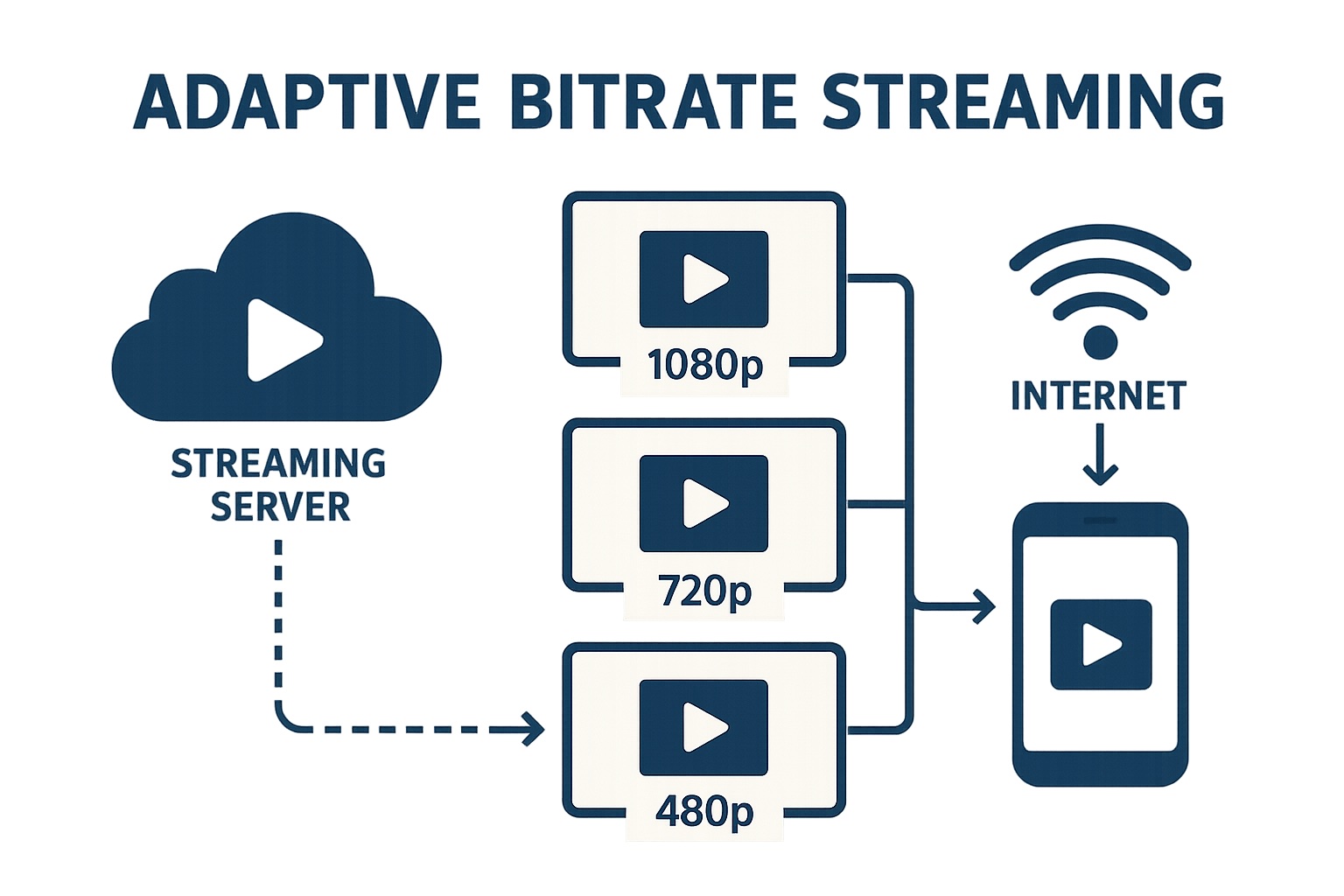
The breakthrough came between 2005 and 2009. Move Networks (founded in 2003 by a team including Akamai veterans) pioneered the concept of encoding video at multiple quality levels and switching between them mid-stream based on network conditions. Microsoft followed with Smooth Streaming in 2008, launching it publicly at the Beijing Olympics. Apple released HTTP Live Streaming (HLS) in 2009 alongside the iPhone 3GS. The magic trick? Instead of maintaining a constant connection like old-school streaming protocols (RTSP, RTMP), ABR broke video into small chunks (typically 2-10 seconds each) and delivered them over standard HTTP. Each chunk existed in multiple quality versions (240p, 480p, 720p, 1080p, etc.). A player on your device would constantly measure download speed and buffer status, grabbing the highest quality chunk it could reliably download before playback caught up. Network slowing down? Drop to 480p. Bandwidth opens up? Jump back to 1080p. All invisible to the viewer. Why did this matter so much? Because HTTP was already the language of the web. Every server, every CDN (Content Delivery Network), every firewall already understood HTTP. Traditional streaming protocols required special server software and often got blocked by corporate networks. ABR piggybacked on existing infrastructure, which meant it scaled instantly. By 2012, MPEG (Moving Picture Experts Group) standardized the approach as MPEG-DASH (Dynamic Adaptive Streaming over HTTP), creating an open alternative to proprietary systems. Netflix adopted ABR in 2008 and credits it as the foundation of their streaming empire. Today, every major platform uses some variant: YouTube, Twitch, Disney+, HBO Max, Amazon Prime, TikTok. Without ABR, the streaming economy as we know it simply doesn't exist. The technology kept evolving. Early ABR was reactive, switching quality only after detecting problems. Modern systems use predictive algorithms and machine learning to anticipate network changes before they cause buffering. Context-aware encoding emerged around 2015, letting platforms spend more bits on complex scenes (action sequences, sports) and fewer on static shots (talking heads). Per-title encoding meant each piece of content got custom quality ladders rather than one-size-fits-all. Companies like Bitmovin, Harmonic, and Akamai turned ABR optimization into a multi-billion dollar business. Research from 2023 showed that Netflix alone encodes each title into over 1,200 different versions to serve every possible device and network condition optimally. As of July 2026, ABR is entering its next phase. The shift to 8K streaming (already live in parts of Asia through platforms like NHK+) demands even smarter bandwidth management. Each 8K frame contains 33 million pixels compared to 8 million in 4K, creating file sizes that would choke most home networks without advanced ABR. Simultaneously, extended reality (XR) applications like Apple Vision Pro's immersive video and Meta's Horizon experiences require ultra-low latency ABR variants that can adapt within milliseconds rather than seconds. Web searches from July 2026 show growing interest in AI-driven ABR that uses neural networks to predict user behavior (are you about to pause? skip ahead?) and preload accordingly. The technology that once just prevented buffering is now orchestrating entirely new media experiences. The challenges ahead are equally significant. As streaming consumption surges (Cisco's 2026 data projects video will account for 82% of all internet traffic this year), network infrastructure strains under the load. ABR helps, but it can't create bandwidth that doesn't exist. Rural and developing regions still struggle with basic connectivity, meaning ABR often locks users into low-quality streams permanently. There's also the codec question. AV1, the open-source successor to H.264 and H.265, offers 30% better compression but requires more processing power to decode. ABR systems must balance newer, more efficient codecs against device compatibility. Meanwhile, regulatory pressure is building around net neutrality and zero-rating, with some arguing that ABR gives large streaming platforms unfair advantages over smaller competitors who can't afford sophisticated optimization.