Africa receives approximately $60 billion in official development assistance annually as of 2024, according to the Organisation for Economic Co operation and Development (OECD). That's real money, roughly equivalent to Kenya's entire GDP (Gross Domestic Product). Yet the narrative persists: despite decades of charity concerts, celebrity campaigns, and Western guilt driven donations, African nations remain synonymous with poverty in the global imagination. The question isn't whether the money exists. It's where the hell it goes. The answer is uncomfortable and complex. Start with debt servicing: African nations collectively owe over $1.1 trillion to foreign creditors as of 2023. Much of the "aid" they receive immediately flows back to Western banks and Chinese lenders as debt repayment. The International Monetary Fund (IMF) and World Bank often attach conditions to loans that force countries to prioritize debt service over healthcare or education. Ghana, for instance, spent 70% of its 2023 government revenue on debt payments. When a country receives $500 million in aid but pays $800 million in debt service the same year, the net flow is negative. The money arrives with one hand and leaves with the other. Then there's the NGO (non governmental organization) industrial complex. The average international NGO operating in Africa spends 40 60% of donations on administrative costs, salaries, and overhead before a dollar reaches the ground. A 2022 investigation by The New Humanitarian found that top executives at major international development charities earn $400,000 $600,000 annually. Field coordinators, the expatriates living in capital cities, pull six figure salaries plus housing allowances, security details, and private school tuition for their children. The system creates perverse incentives: NGOs need poverty to persist to justify their budgets. Success means unemployment. Corruption eats the rest. Transparency International ranks 40 of the world's most corrupt 50 countries in sub Saharan Africa. When donors channel funds through government ministries, significant portions evaporate into private accounts. Nigeria's former petroleum minister Diezani Alison Madueke allegedly stole $2.5 billion during her tenure. South Africa's State Capture inquiry revealed systematic looting of state resources exceeding $34 billion between 2014 and 2018. Kenya loses an estimated $6 billion annually to corruption, nearly matching its entire aid intake. Donors know this happens, yet continue funneling money through the same compromised channels because directly bypassing governments undermines sovereignty and creates parallel power structures. But here's where the narrative gets interesting: Africa isn't failing. That's the myth. Seven of the world's ten fastest growing economies in 2024 are African, according to the IMF. Ethiopia grew 7.2% annually from 2000 2020. Rwanda's GDP per capita quadrupled since 2000. Technology adoption is exploding: Kenya's M Pesa mobile money system processes more transactions than Western Union globally. Nairobi has more tech startups per capita than Silicon Valley. The problem isn't lack of progress; it's that aid dependent relationships and disaster focused Western media coverage obscure genuine development. Television cameras show starving children in refugee camps, not Ghanaian software engineers or Nigerian filmmakers (Nollywood is the world's second largest film industry by volume). The aid architecture itself perpetuates dependency. Donors fund specific projects, a school here, a well there, without building institutional capacity. When the five year grant ends, the school closes because no sustainable funding mechanism exists. USAID (United States Agency for International Development) spent $47 million building roads in Afghanistan that deteriorated within three years because nobody trained local engineers in maintenance or created budgets for upkeep. The same pattern repeats across Africa. Aid becomes a Band Aid covering systemic governance problems that only Africans can solve. Meanwhile, genuine wealth extraction continues: multinational corporations exploit tax loopholes to shift $88 billion in profits out of Africa annually, according to a 2020 United Nations study. That's more than total aid inflows. The final piece is phantom aid, money that never leaves donor countries. Roughly 30% of development assistance is "tied aid," requiring recipients to purchase goods and services from donor nations. When the UK gives Tanzania $100 million for infrastructure, the contract goes to British construction firms, British consultants design the project, and British equipment suppliers provide materials. Tanzania receives a road, but $70 million stayed in Britain. Student scholarships count as aid even though the money pays European universities. Refugee hosting costs in donor countries count as aid. By OECD rules, when Germany houses Syrian refugees in Munich, that spending counts toward its foreign aid commitment. The accounting is deliberately opaque.
 🌍 world
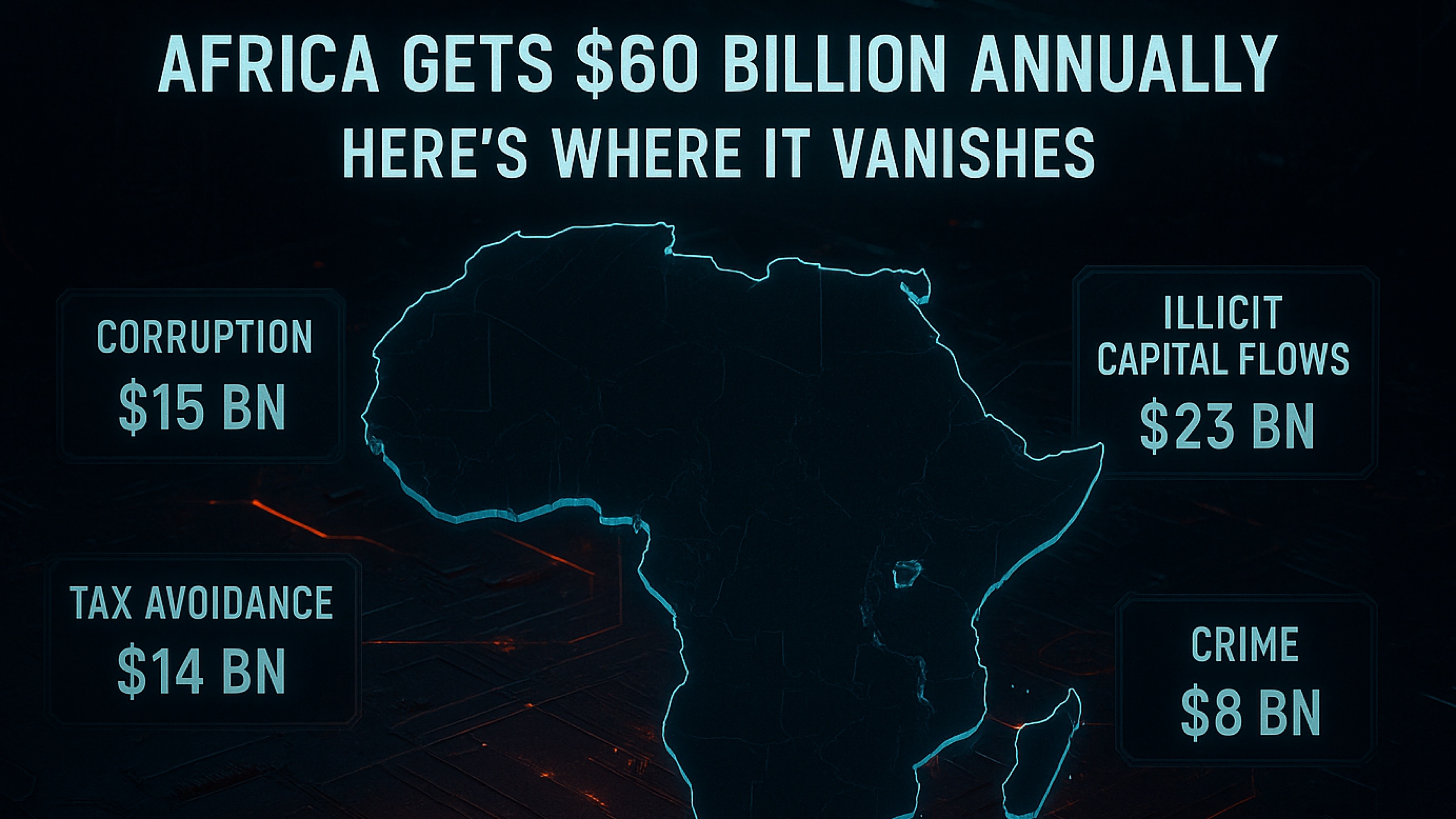
Africa Gets $60 Billion Annually: Where It Vanishes
Western guilt writes checks, but the money rarely reaches villages. Between corrupt politicians, bloated NGO salaries, and debt repayments to the same donors writing checks, Africa's aid economy is a multibillion dollar shell game that keeps the continent dependent while enriching everyone except ordinary Africans.
My Take
The aid to Africa model is broken by design, not accident. It preserves a neocolonial relationship where Western nations play savior while extracting resources, demanding policy compliance, and maintaining geopolitical influence. The real scandal isn't that aid doesn't work, it's that aid was never meant to create independent, self sufficient economies that might challenge Western economic dominance. China figured this out, which is why they're building actual infrastructure through Belt and Road loans (creating different dependency problems, admittedly) while Western donors still fund workshops about governance. If we actually wanted African development, we'd cancel debt, stop agricultural subsidies that undercut African farmers, enforce corporate tax compliance, and fund institution building over feel good projects. We'd let African nations set their own development priorities instead of imposing Washington Consensus economics. But that requires admitting the current system serves donor interests, not recipient needs. The aid industry employs hundreds of thousands of Westerners in comfortable careers built on perpetual African poverty. They'll fight harder to preserve that system than any corrupt minister. The progress happening in Africa is happening despite aid, not because of it. Ethiopian Airlines became Africa's most profitable carrier by ignoring Western consultants. African tech entrepreneurs succeed by building for African problems, not copying Silicon Valley. The continent has resources, talent, and increasingly good governance in several countries. What it needs is trade, investment, and to be left alone to build its own institutions. The charity model infantilizes an entire continent while enriching everyone except those it claims to help.
What Happens Next
The next major shift comes from African nations themselves, not donors. Kenya, Ghana, and Senegal are increasingly rejecting IMF conditions and exploring alternative financing through African Development Bank bonds and domestic capital markets. Rwanda already rejects certain categories of Western aid that come with governance lectures. By 2028, expect at least three major African economies to publicly refuse traditional aid packages in favor of commercial loans and South South cooperation with India, Gulf states, and yes, China. The symbolism matters more than the dollars. The real wildcard is digital currency and fintech disrupting traditional banking systems that facilitate capital flight. Nigeria launched the eNaira in 2021; if African nations create interoperable central bank digital currencies that track transactions transparently, corruption becomes exponentially harder. Blockchain based government procurement systems are already piloting in Ghana. Within five years, donor countries may face demands to send aid through transparent digital channels or not at all. That confrontation will expose how much of the current system depends on deliberate opacity. Meanwhile, climate change will force a reckoning. Africa contributes 3% of global emissions but faces the worst consequences: droughts, flooding, agricultural collapse. The West will face a choice: provide serious climate adaptation funding (estimates run $300 500 billion annually by 2030) or manage unprecedented migration flows. Unlike development aid, climate funding might actually materialize at scale because European voters understand migration threatens them directly. That money could finance the infrastructure Africa actually needs, or it could become another extraction scheme. History suggests the latter.
What History Tells Us
This pattern mirrors post World War II reconstruction, with one critical difference. The Marshall Plan pumped $13 billion ($150 billion in today's dollars) into Europe between 1948 1952, but that money rebuilt industrial capacity and came with minimal strings because America wanted strong allies against Soviet expansion. African aid emerged from 1960s decolonization with exactly the opposite intent: maintain dependence and resource access while providing moral cover for former colonial powers. When Ghana gained independence in 1957, Britain immediately imposed loan conditions requiring cocoa exports to British markets at below market prices. The template was set. The 1980s structural adjustment programs imposed by the IMF and World Bank devastated African economies. Countries were forced to slash government spending, privatize industries, and open markets to foreign competition. Zambia's copper mines were privatized for pennies, then resold at massive profits. Tanzania dismantled its healthcare system under IMF orders; infant mortality subsequently increased. By 1990, after a decade of structural adjustment, sub Saharan Africa's per capita income was lower than in 1980. The aid flowed throughout, but debt multiplied faster. This historical betrayal explains why African leaders increasingly view Western aid institutions with cynicism.