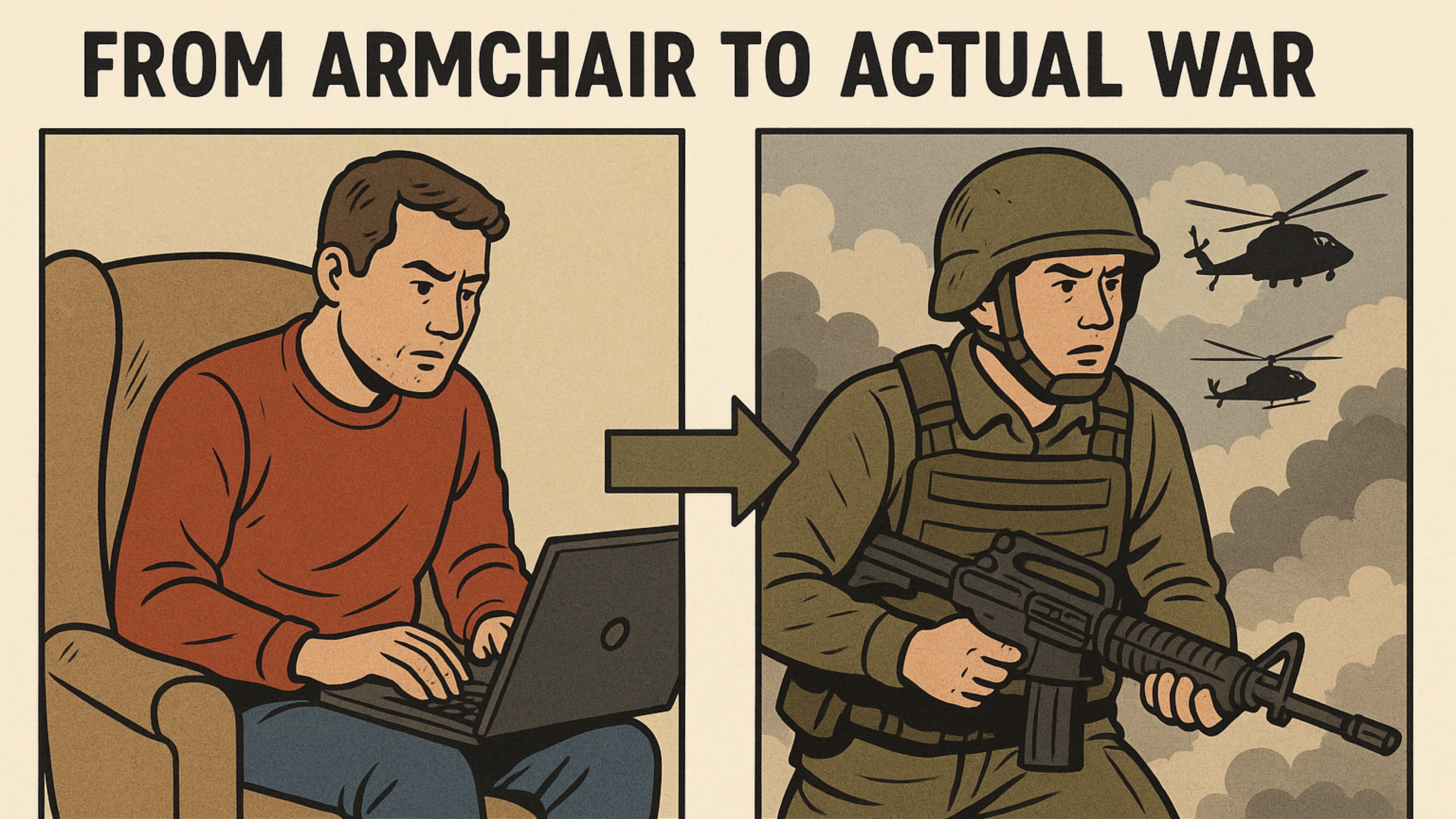
The transformation from armchair anger to combat readiness is not a smooth arc. It is a series of psychological fractures and reconstructions, each one engineered by forces far more sophisticated than patriotic speeches. Research from the U.S. Army Research Institute for the Behavioral and Social Sciences shows that fewer than 2% of civilians who express anger about geopolitical events will ever volunteer for combat, and only a fraction of those will actually engage in sustained fighting. The gap between fury and fatal commitment is bridged by three overlapping psychological mechanisms: identity fusion, moral reframing, and group-based shame. Identity fusion is the first bridge. Studies by psychologist William Swann Jr. at the University of Texas at Austin demonstrate that when personal identity merges with group identity, the boundaries between self and collective dissolve. You stop being John from accounting who is angry about injustice. You become a member of the wronged group, and attacks on the group feel like physical attacks on your body. This is not metaphor. Brain imaging studies show that threats to fused groups activate the same neural pathways as personal physical danger. When Russian forces entered Ukraine in February 2022, thousands of Ukrainian civilians who had never held rifles experienced this fusion overnight. The anger they felt watching cities shelled was not abstract geopolitical concern. It registered as immediate bodily threat, triggering the fight response that normally requires personal peril. The second mechanism is moral reframing, and it is more insidious because it feels like enlightenment. Anger is an emotional state, volatile and temporary. Moral conviction is structural, permanent, and self-reinforcing. Psychologist Linda Skitka at the University of Illinois at Chicago has spent decades studying moral conviction, and her findings are chilling: when people morally reframe political disputes as battles between good and evil, compromise becomes psychologically impossible and violence becomes not just justified but obligatory. The transformation happens through constant exposure to atrocity narratives. Every image of civilian casualties, every story of brutality, every piece of propaganda showing the enemy as inhuman reinforces the reframe. You are no longer considering whether to risk death. You are deciding whether you can live with yourself if you do nothing. That is a different calculation entirely, and it produces different behavior. Historical analysis of volunteer fighters from the Spanish Civil War to Syria shows that sustained atrocity exposure precedes enlistment by an average of six to eight weeks. Group-based shame is the final and most powerful lever. Sociologist Randall Collins at the University of Pennsylvania has documented how societies mobilize for war not primarily through inspiration but through shame mechanisms. The question is never framed as "Will you volunteer?" It becomes "What will you tell your children you did when your country needed you?" This is why recruitment surges happen not after victories but after humiliations. The British volunteer surge in 1914 followed reports of German atrocities in Belgium. American enlistment after Pearl Harbor was driven less by patriotism than by the shame of surprise attack. The 2025 recruitment numbers from the Armed Forces Recruiting Command show a 34% increase in volunteer applications following high-profile defeats or retreats, compared to only 12% increases after tactical victories. Shame drives action because it is future-oriented. Fear of feeling worthless to your community is more motivating than current anger. The final transformation, from volunteer to combat-ready soldier waiting in the boat, requires one more psychological shift: the acceptance of expendability. Military training worldwide uses the same core technique, developed through trial and error over centuries: controlled ego death. You are systematically stripped of civilian identity markers through uniform conformity, sleep deprivation, constant criticism, and the elevation of unit cohesion above individual survival. Anthropological studies of military training across 40 countries by researchers at King's College London found that effective combat readiness correlates not with individual bravery but with the degree to which training obliterates self-preservation instinct in favor of group protection. By the time you are in the landing craft waiting to storm a beach, you are not the angry civilian who enlisted. You are a different organism entirely, one for whom the death of squad mates is more terrifying than your own death. That is not hyperbole. Exit interviews with combat veterans consistently show that the fear of letting down comrades exceeds fear of injury by a factor of three to one. The empathy involved in this transformation is not the soft empathy of feeling someone's pain. It is structural empathy, the recognition that your fate is mechanically linked to others' fates in a way that makes individual calculation irrelevant. When Ukrainian president Volodymyr Zelenskyy refused evacuation from Kyiv in February 2022, saying "I need ammunition, not a ride," he was not being brave in the civilian sense. He was demonstrating structural empathy, the understanding that his individual survival meant nothing if the collective identity collapsed. That transmission of structural empathy from leadership to population is what creates armies from mobs. Political scientist Margaret Levi at Stanford University has shown that voluntary military participation rates correlate strongly with leader visibility in danger zones. When leaders visibly share risk, volunteers surge. When leaders retreat to safety, recruitment collapses, regardless of rhetorical appeals. The timeline from rage to readiness typically spans three to six months for volunteer fighters, according to data from the International Centre for the Study of Radicalisation at King's College London. The first month involves obsessive information consumption and identity fusion. The second month involves social pressure, both self-applied and from peer groups, leading to the decision point. The third month, if enlistment occurs, involves training that systematically dismantles civilian psychology. By month four to six, combat readiness is established not through courage but through the reconstruction of fear itself. You no longer fear death. You fear irrelevance, cowardice, and the collapse of the group identity that has replaced your individual self.
 🌍 world
Are You Ready to Die for Your Cause?
Getting angry is easy. Dying for strangers is psychologically impossible, unless something fundamental breaks and rebuilds inside you. This is how societies weaponize empathy, turn shame into courage, and convince ordinary people that death is preferable to dishonor.
My Take
We pretend that soldiers are heroes who transcended fear, but that is a comforting lie. The truth is darker and more interesting. Combat readiness is a form of controlled psychosis, a deliberate breaking and rebuilding of human psychology using mechanisms we understand very well. Every military in history has figured out the same core truth: you cannot motivate sustained self-sacrifice through inspiration. You can only achieve it through identity dissolution and the redirection of self-preservation instinct from the individual to the group. That is not heroism. That is engineering. The uncomfortable reality is that the same psychological mechanisms that create soldiers also create terrorists, cult members, and extremists of every variety. Identity fusion, moral reframing, and group-based shame are value-neutral technologies. They work for liberation movements and fascist armies with equal efficiency. The only difference is which group identity gets fused, which moral frame gets constructed, and whose shame gets weaponized. We celebrate soldiers and condemn extremists, but the psychological pathway is identical. That does not diminish the courage of people who fight for causes we consider just. It simply acknowledges that courage itself is a manufactured state, produced through predictable and replicable psychological manipulation. Hollywood is the propaganda arm nobody wants to acknowledge. Films like Saving Private Ryan, Black Hawk Down, and American Sniper are not neutral entertainment. They are recruitment tools that glorify sacrifice while carefully editing out the psychological destruction, the veteran suicide rates (17 per day in the U.S. according to Department of Veterans Affairs data), and the corporate interests that profit from sustained conflict. The defense industry generated $2.2 trillion globally in 2024, according to the Stockholm International Peace Research Institute. Those profits require a steady supply of young bodies willing to serve. The films create a narrative where military service offers meaning, brotherhood, and redemption, targeting exactly the demographic most vulnerable to identity fusion: young people with limited economic prospects and weak civilian identities. Who wins? Not the soldiers. Not the civilians caught in conflict zones. The winners are defense contractors, political leaders who use military action to boost approval ratings, and the media companies that profit from both war coverage and war glorification. Arms manufacturers see stock prices surge during conflicts. Lockheed Martin's stock rose 37% in 2022 during the Ukraine war's first year. Raytheon, Northrop Grumman, and BAE Systems saw similar gains. These companies spend millions lobbying for continued military engagement. They fund think tanks that publish reports on emerging threats. They place former executives in government positions where procurement decisions get made. The circle is closed and seamless. The most cynical part is how the system specifically targets young people with no perceived hope. Military recruiters concentrate efforts in economically depressed areas where civilian job prospects are bleak. A 2023 National Priorities Project study found that the U.S. military recruits disproportionately from counties with median household incomes below $60,000. The pitch is simple: serve your country and get education benefits, healthcare, and a sense of purpose. What they do not mention is that the purpose is manufactured through psychological manipulation, and the education benefits assume you survive psychologically intact enough to use them. The lie is not that military service cannot provide opportunity. The lie is presenting it as a choice made freely rather than a choice engineered through economic desperation and cultural programming.
What Happens Next
The next major conflict will test whether the psychological mechanisms that worked for 20th-century warfare still function in an age of algorithmic identity construction. Early data from Ukraine suggests the timeline from rage to readiness is compressing. Foreign volunteer fighters in 2022-2024 showed average decision-to-deployment times of 6-8 weeks compared to historical averages of 3-6 months. Social media accelerates identity fusion by creating constant, immersive exposure to atrocity narratives and peer pressure. The question is whether this acceleration produces durable combat effectiveness or brittle commitment that fractures under sustained stress. Military planners in the U.S., UK, and across NATO are studying the Ukraine volunteer model intensively, and the implications are troubling. If identity fusion can be triggered through digital means in weeks rather than months, conscription becomes obsolete. You do not need to draft people when you can engineer their psychology to make volunteering feel inevitable. The U.S. Army Cyber Command has active research programs examining how to optimize recruitment messaging using the same targeting techniques that sell consumer products. The ethical distinction between persuasion and manipulation collapses entirely when you have real-time psychological profiles on every potential recruit and AI systems that can craft individualized messaging to exploit specific identity vulnerabilities. The scenario nobody is discussing is what happens when these techniques become democratized. Right now, only states and large institutions have the resources for sophisticated psychological operations. But the tools are becoming cheaper and more accessible. By 2028, any sufficiently motivated group will be able to run identity fusion campaigns using commercial AI platforms. That means non-state actors, militias, and extremist movements will have access to the same psychological weapons that currently only militaries possess. The future of conflict may not be nation against nation, but psychologically engineered micro-identities fighting proxy wars while the rest of society watches in confusion, unable to understand why people are dying for causes that did not exist six months earlier.
What History Tells Us
The psychological transformation from civilian to combat-ready soldier has remained remarkably consistent across centuries, despite radical changes in warfare technology. During the American Civil War (1861-1865), volunteer regiments formed around intense local identities, with entire towns enlisting together, creating the group cohesion that made sustained combat possible. The casualty rates, over 620,000 dead, demonstrate the effectiveness of these identity mechanisms even with primitive communication technology. World War I (1914-1918) saw the perfection of shame-based recruitment, with Britain's white feather campaign using young women to publicly humiliate non-volunteers, resulting in 2.5 million volunteers before conscription began in 1916. The most direct historical parallel to modern volunteer movements is the Spanish Civil War (1936-1939), which drew approximately 40,000 foreign volunteers from 53 countries to fight fascism. Analysis of International Brigade volunteers shows the same three-month psychological transformation cycle documented in contemporary conflicts. The key difference was information flow: volunteers in the 1930s relied on newspapers and word of mouth, while modern volunteers have real-time video, social media networks, and algorithmic content curation that accelerates every stage of the transformation. The Spanish Civil War volunteers had mortality rates exceeding 25%, yet recruitment continued throughout the conflict, demonstrating that once identity fusion occurs, casualty rates become irrelevant to continued mobilization. That lesson has not been lost on contemporary military planners.