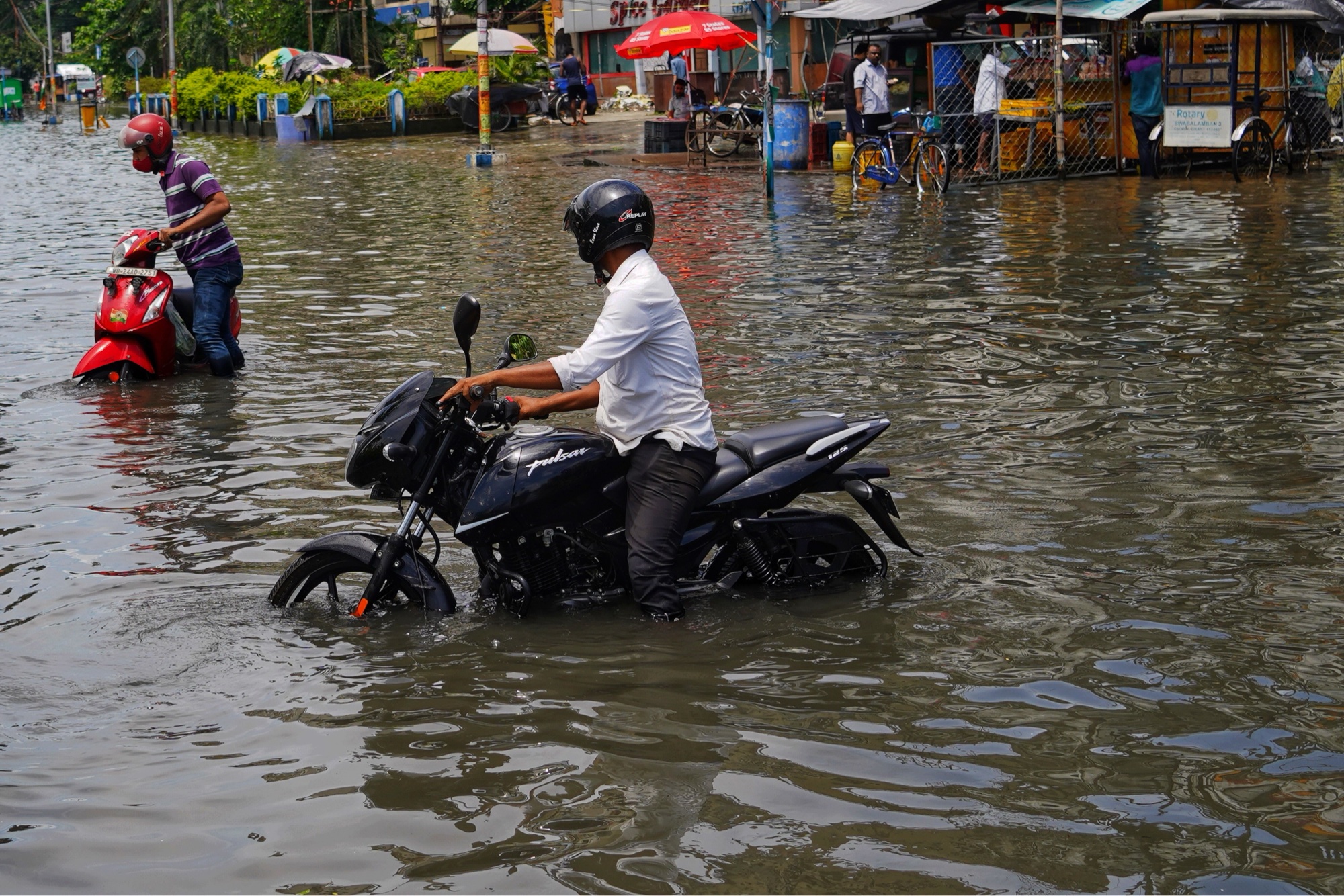
Bangkok woke up on Sunday to a city half-submerged. Waist-deep water swallowed stretches of Petchaburi Road, cars sat abandoned mid-street with only their roofs showing, and families paddled small boats down residential lanes that are normally choked with motorbike traffic. Bangkok Governor Chadchart Sittipunt declared all 50 districts of the capital a disaster-affected zone on Saturday, a formal step that unlocks faster funding and coordination powers for the Bangkok Metropolitan Administration after nearly two days of relentless rain. The numbers behind the declaration are stark. More than 330 millimetres of rain fell on parts of the city between Thursday afternoon and Sunday, according to the national weather agency, and the Bangkok Metropolitan Administration says roughly 52,000 households across the capital have been affected. Close to 4,900 people have been moved into more than 200 emergency shelters set up in schools, temples and community halls, with residents resting on cots and classroom floors, some with their dogs beside them. Nationally, Thailand's Department of Disaster Prevention and Mitigation says flooding is affecting more than 174,000 families across 25 provinces, with eight deaths confirmed as of Sunday morning, including a 58-year-old woman electrocuted in floodwater at a Bang Kapi housing complex. The flooding has paralysed daily life well beyond the shelters. Ninety-three roads were reported impassable at the height of the crisis, five major canals hit critical levels, and Bangkok Metropolitan Administration schools were ordered shut for Monday, with staff whose jobs don't require a physical presence told to work from home. Suvarnabhumi Airport has been hit by ground-handling disruption that delayed flights and left baggage backed up, while Don Mueang Airport stayed operational but suspended its metered taxi rank as floodwater crept along the surrounding roads. The government has stockpiled a million sandbags and deployed the army to run field kitchens and additional shelters. Prime Minister Anutin Charnvirakul cut short a diplomatic swing through Japan, the United States and the United Kingdom to fly home, landing at Don Mueang at 10:20 on Sunday morning before heading straight into flood briefings and a tour of affected districts. He has ordered government agencies to pool their data into a single coordinated response and has since promised faster delivery of food and toilets to displaced residents. It's a familiar playbook. Anutin, who also holds the interior minister portfolio, spent much of late November 2025 camped in Hat Yai after floods killed dozens across southern Thailand, a crisis some Thai commentators noted echoed former prime minister Thaksin Shinawatra's decision to base himself in Phuket after the 2004 tsunami. What makes this flood different from the catastrophe that drowned Bangkok in 2011, when floodwaters eventually killed more than 500 people nationwide and caused over a trillion baht in damage, is scale rather than intensity. Satellite data cited by Thai media shows the flooded area so far in 2026 running at a fraction of what was submerged by August 2011, and this year's rains have arrived under an El Nino pattern typically associated with drier conditions, not the La Nina surge that fed the earlier disaster. That makes the current chaos look less like a freak convergence of weather systems and more like a city whose drainage infrastructure simply cannot cope with an ordinary, if intense, monsoon burst. Residents living beside canals in districts like Bang Bua and Bang Kapi say their homes have sat underwater for more than a day at a stretch, and more than one described the current flooding as worse than what they lived through fifteen years ago. Across the border, the same weather system has pushed floodwaters into Cambodia, where more than 2,900 families have been evacuated and disaster officials there are tracking flooding across ten provinces, though they say Mekong River levels remain below alert thresholds and the immediate driver is localised heavy rain rather than an overflowing river system. Thai provinces from Phitsanulok in the north to Chanthaburi in the east are also under water, with local officials in Chanthaburi describing the fastest-moving flood surge residents there have seen in around fifteen years.
 🌍 world
Bangkok Drowns Again While Its Flood Plan Gathers Dust
Nearly 300 millimetres of rain in 48 hours has put every one of Bangkok's 50 districts under a disaster declaration, forcing thousands into school gyms and temple halls. Eight people are dead nationwide and the prime minister has flown home early, but the bigger scandal is the 350 billion baht flood plan that's been sitting on a shelf since 2011.
My Take
This is not really a story about weather. Thailand's meteorological department can be forgiven for a 48-hour deluge; no drainage system built for average rainfall handles 300 millimetres gracefully. What cannot be forgiven is that the country wrote itself a 350 billion baht flood protection master plan after the 2011 catastrophe and then let successive governments, coups and lawsuits strip it down to a shadow of the original ambition. Bangkok is a low-lying delta city sinking under its own groundwater pumping, ringed by canals that silt up and choke, and it keeps getting caught flat-footed by rain that, statistically, was always going to come back. Governor Chadchart deserves credit for moving fast on the disaster declaration and for personally showing up at shelters, and Prime Minister Anutin gets points for cutting a foreign trip short rather than managing a national emergency by video call. But speed of response after the water rises is not the same as prevention before it falls. A capital city that has now been declared a disaster zone twice in under a year, first in the south around Hat Yai and now across all fifty of its own districts, has a structural problem that sandbags and school gymnasiums cannot fix. The uncomfortable truth is that Bangkok's flood defences are a patchwork of half-finished projects, redesigned after the 2014 coup and never fully reassembled, while the city's population and the value of property sitting in the floodplain keep growing. Every year this gets kicked down the road is another year of compounding risk, and another round of families dragging waterlogged furniture out to the curb while officials promise, again, that this time the drainage will be faster.
What Happens Next
The immediate question is drainage speed. Bangkok officials estimate it will take two to three days to clear floodwater from city streets once the rain stops, and the weather agency has forecast further thunderstorms through the weekend that could reset that clock if heavy rain returns. Schools under the Bangkok Metropolitan Administration are closed for Monday and some city staff are working from home, decisions that will likely be revisited day by day depending on how fast canals drop back below critical levels. Prime Minister Anutin has ordered agencies to unify their data and speed up relief delivery, including food and sanitation supplies to displaced residents, and has previously floated compensation for farmers whose land is used as water retention zones during flood emergencies elsewhere in the country. Expect pressure to build in the coming weeks for the government to explain what happened to the 350 billion baht flood protection master plan drawn up after 2011, especially if damage estimates climb once the water recedes and the cleanup bill comes due. Suvarnabhumi Airport says it is adding ground-handling staff and replacement baggage equipment, so flight delays should ease within days rather than weeks, barring another major rain event. Further out, watch Cambodia's flood numbers along the Thai border and the provinces upstream of Bangkok, including Ayutthaya and Nakhon Sawan, where water flowing south toward the capital could extend the crisis even after Bangkok itself dries out. If the current El Nino pattern holds and rainfall genuinely eases as forecasters expect, this episode may end without approaching 2011's death toll, but the argument over why a modern capital city keeps flooding under ordinary monsoon rain is not going away.
What History Tells Us
Bangkok's 2011 floods killed more than 500 people nationwide, submerged large parts of the capital for weeks and caused an estimated 1.4 trillion baht in damage, roughly 13 percent of Thailand's GDP that year, with manufacturing supply chains disrupted worldwide. The government that followed drew up a 350 billion baht integrated water management plan focused on the Chao Phraya river basin, but the scheme ran into legal challenges, community opposition to large floodways and was substantially redesigned after the 2014 military coup, leaving Bangkok's flood defences a fraction of what was originally envisioned.