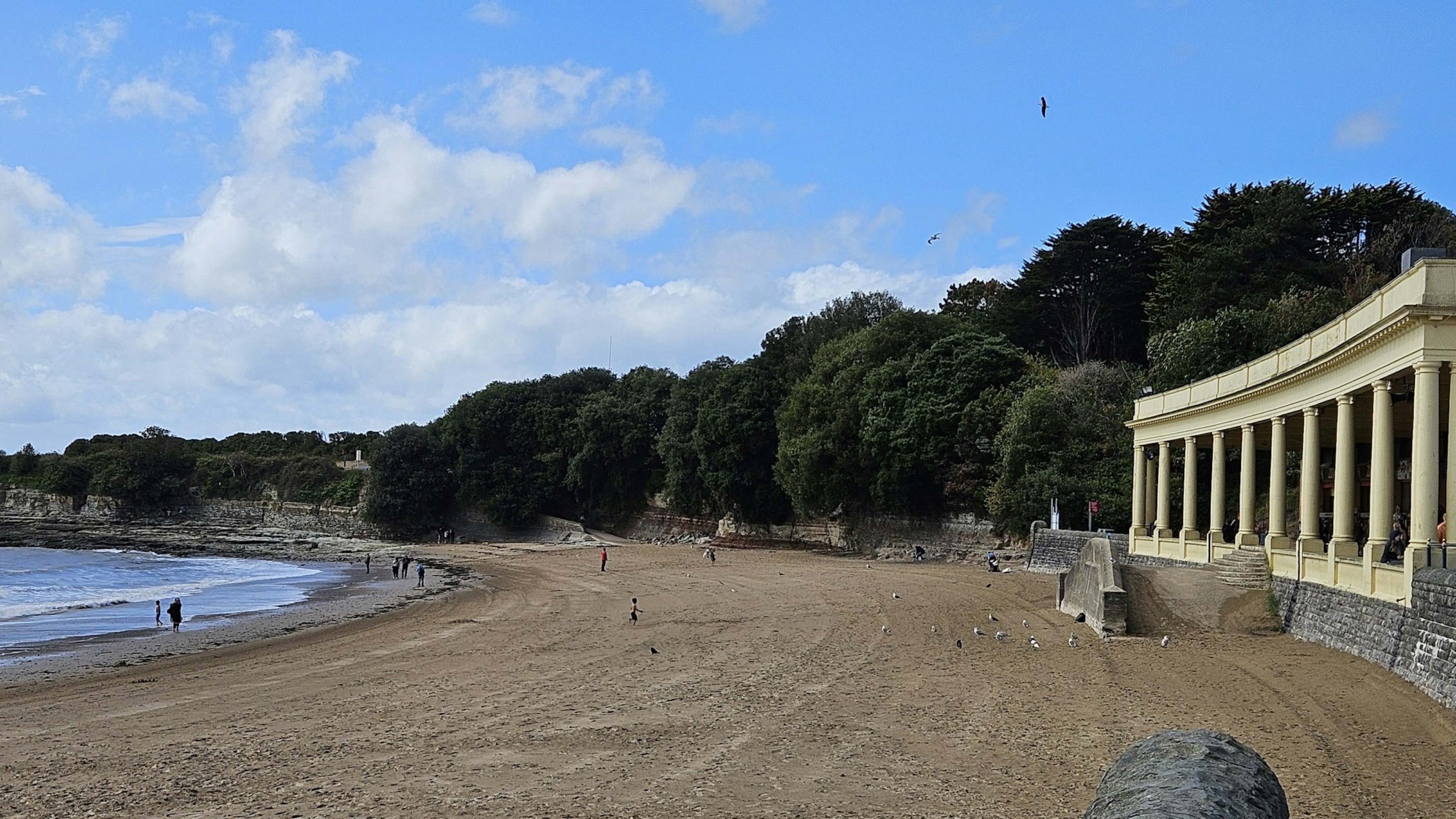
Barry Island sits off the south coast of Wales like a knuckle of rock that refuses to stay down. Technically not an island anymore since 1884, when the Barry Railway Company built a causeway connecting it to the mainland, this 2.5 square kilometer stretch of land has spent centuries punching above its weight. The island's name derives from Saint Baruch, a 6th century Welsh hermit who allegedly lived here in solitude, though archaeological evidence suggests the site was inhabited far earlier. Roman pottery shards discovered near Nell's Point in 1923 indicate maritime activity dating to the 2nd century CE (Common Era), likely linked to the Roman fort at nearby Caerau. What Saint Baruch made of the Roman sailors is anyone's guess, but the island's strategic position in the Bristol Channel made it valuable long before bucket and spade tourism arrived. The island's transformation from sleepy backwater to industrial powerhouse began with David Davies, the "Ocean King" coal magnate who revolutionized Welsh industry. Frustrated by monopolistic dock fees at Cardiff, Davies pushed through the Barry Dock and Railways Act of 1884, creating a rival port that would export Welsh coal to the world. By 1913, Barry Docks handled 11 million tons of coal annually, making it the largest coal exporting port on Earth. The railway causeway to Barry Island was both practical infrastructure and shrewd business - Davies knew workers needed recreation, and he positioned the island as the dockworkers' playground. The first pleasure pier opened in 1896, stretching 150 meters into the channel, with a pavilion hosting variety shows and, controversially, bare knuckle boxing matches that drew gamblers from Bristol and beyond. Local magistrates turned a blind eye because the fights brought money, though the Bristol Mercury newspaper railed against "barbaric Welsh entertainments" in 1899. The Edwardian era transformed Barry Island into a full scale resort. The Barry Island Pleasure Park opened in 1920 on the site of a former military encampment, featuring the iconic Haunted House ride (still operating today, making it one of Britain's oldest continuously running dark rides). The Log Flume, added in 1981, became legendary for being built partially over WWI (World War One) ammunition bunkers that were never fully cleared. Engineers discovered 37mm anti aircraft shells during 2003 maintenance work, leading to a brief evacuation and controlled detonation by Royal Engineers. The railway brought 200,000 visitors during peak summer weekends in the 1930s, with Barry Island Station handling more passengers than any station in Wales except Cardiff Central. Entrepreneurial locals rented out their front rooms as impromptu changing facilities for a shilling, creating a shadow economy that briefly made Barry the highest earning postal district per capita in Wales. World War II transformed the island yet again. The British Admiralty requisitioned the pleasure park in 1940, installing coastal defense guns and converting the pier pavilion into a signals station monitoring German U boat activity in the Bristol Channel. The island's strategic importance intensified after the Bristol Blitz of 1940 to 1941, with RAF (Royal Air Force) Barry Island established as a fighter station with Spitfires scrambling from a makeshift runway near Whitmore Bay. Few records survive because the station operated under extreme secrecy, but declassified documents from 1994 reveal that Barry Island pilots shot down seven German aircraft between 1941 and 1943, including a Heinkel He 111 that crashed into the channel just 400 meters offshore. Local fishermen recovered the wreckage in 1967, and fragments are displayed at the Barry Island Heritage Centre, though most visitors walk past without realizing what they're seeing. The post war decades brought decline. Cheap package holidays to Spain gutted British seaside resorts, and Barry Island suffered more than most. The railway service reduced frequency, the pier closed in 1971 (demolished in 1980 after storm damage), and by 1985 the island was synonymous with urban decay. The funfair limped along under various owners, closing entirely from 1995 to 1997. Then came an unlikely savior: BBC sitcom Gavin & Stacey, which premiered in 2007 and featured Barry Island as Stacey's hometown. The show's massive popularity triggered a tourism renaissance. Visitor numbers quadrupled from 2007 to 2010, hitting 800,000 annually. Marco's Café, featured in the show, became a pilgrimage site. Local property prices rose 23% between 2008 and 2012, reversing decades of decline. The Vale of Glamorgan Council invested £3.2 million in promenade improvements in 2015, and new attractions opened including a microbrewery in a renovated Victorian warehouse. Today's Barry Island exists in an odd temporal fold. The Pleasure Park still operates the original 1920 Haunted House alongside modern rides. Whitmore Bay beach holds Blue Flag status (awarded 2019, renewed 2025), yet the shingle reveals Victorian clay pipes and Georgian pottery when storms strip the sand. The old railway station, now Grade II listed, serves modern electric trains while preserving its 1920s canopy. Beneath the Vortex ride lie those WWI bunkers, and somewhere under the car park rest the foundations of Saint Baruch's 6th century cell, located by ground penetrating radar in 2011 but never excavated. The island attracts 400,000 visitors annually as of 2024, a mix of Gavin & Stacey pilgrims, Cardiff families, and a small but dedicated community of industrial archaeology enthusiasts who photograph the remaining dock cranes visible across the water. It is simultaneously tourist trap and time capsule, proof that places can hold multiple histories at once.
 🎬 entertainment
Barry Island: Wales's Forgotten Victorian Vice Den Turned Sitcom Star
Before it was Gavin & Stacey's beach, Barry Island was a smuggler's paradise, a railway tycoon's gamble, and a wartime military fortress. This tiny Welsh resort has more secrets than sand - from illegal boxing matches to Cold War bunkers still buried beneath the funfair.
My Take
Barry Island is Britain's accidental masterclass in resilience, and it deserves more credit than a sitcom punchline. This place survived industrial collapse, military occupation, and decades of neglect, then pulled itself back from the brink because a TV show made people remember seaside charm still matters. That's not luck, it's grit embedded in geography. The island's genius is its refusal to sanitize its past. You can ride the Haunted House over WWI munitions bunkers while eating chips from a café famous for fictional characters. That's delightfully, quintessentially British. What strikes me most is how Barry Island's story mirrors Britain's broader 20th century arc: industrial boom, wartime sacrifice, post industrial decay, tentative cultural renewal. Except Barry Island did it all in 2.5 square kilometers, which makes it a perfect case study. The island's survival suggests that heritage tourism works when it's authentic, messy, and unafraid of its own contradictions. Modern resort developers could learn from a place that keeps a 104 year old dark ride running instead of replacing it with another VR (Virtual Reality) experience. The island's next chapter depends on whether it can sustain momentum without Gavin & Stacey's cultural oxygen. The show's 2019 Christmas special drew 17.1 million viewers, but that was seven years ago. Barry Island needs to become more than a TV set, and the encouraging signs are there: local businesses reinvesting, sustainable tourism initiatives, actual respect for the island's layered history. If it can balance nostalgia with innovation, this little Welsh knuckle of rock will outlast us all.
What Happens Next
Barry Island faces a critical inflection point as the Gavin & Stacey effect enters its second decade. The BBC has given no indication of reviving the series beyond the 2019 special, which means the island must cultivate identity beyond sitcom nostalgia. The Vale of Glamorgan Council's 2023 to 2028 tourism strategy includes £1.8 million for "heritage interpretation infrastructure," bureaucrat speak for making the island's actual history more visible. Expect interactive exhibits about the WWII fighter station and the coal port era by 2027, competing for attention with Marco's Café selfie takers. The real wildcard is climate change. Barry Island's beaches have lost 15% of their sand volume since 2010 due to increased storm frequency, according to Cardiff University coastal erosion studies. The council's 2024 coastal defense assessment warns that Whitmore Bay could require significant intervention by 2030 to maintain its Blue Flag status. If the beach degrades, the tourism model collapses, and Barry Island returns to its pre sitcom decline. Seawall reinforcement costs are estimated at £7 to 12 million, and local government budgets are stretched thin. The most intriguing scenario involves the island becoming a model for sustainable heritage tourism. Several local businesses have formed the Barry Island Heritage Collective, pushing for UNESCO (United Nations Educational, Scientific and Cultural Organization) recognition of the industrial archaeology sites, particularly the surviving dock infrastructure and the buried Roman pottery sites. If they succeed in gaining designation by 2028 to 2030, Barry Island could transition from nostalgia tourism to genuine historical destination, attracting academic visitors and history enthusiasts year round rather than seasonal beachgoers. That would be the ultimate resurrection: Saint Baruch's island becoming a classroom for how Britain's industrial past shapes its post industrial future. But it requires vision, funding, and political will, three resources rarely found in abundance around British seaside towns.
What History Tells Us
Barry Island's boom and bust cycle mirrors countless British seaside resorts that flourished with Victorian railway expansion, only to collapse under post war foreign tourism competition. Blackpool, Brighton, and Margate all followed similar trajectories: industrial era playgrounds for urban workers, wartime military installations, then decades of decline. What distinguishes Barry Island is the velocity of its transformations and its recent reversal of fortune. Most comparable resorts remain in managed decline, their piers demolished, their funfairs closed. Barry Island's resurrection through television is historically unusual, perhaps unprecedented at this scale. The closest parallel is Alnwick in Northumberland, which leveraged Harry Potter filming locations at Alnwick Castle to rebuild its tourism economy, though that involved a medieval castle rather than a faded amusement park. The island's wartime role echoes Britain's broader coastal defense strategy during WWII. Every harbor, headland, and strategic beach from Cornwall to Scotland was fortified after the fall of France in 1940. The Bristol Channel's importance as a shipping route made Barry Island's position critical, just as Dover's proximity to occupied France made it Britain's most bombed town. The difference is that Dover's wartime history is exhaustively documented and commemorated, while Barry Island's fighter station and coastal guns remain largely forgotten, lost in the bureaucratic secrecy that classified such installations until the 1990s. This pattern of selective historical memory is common across Britain, where military heritage tourism focuses on "famous" sites while hundreds of smaller installations fade from collective consciousness.