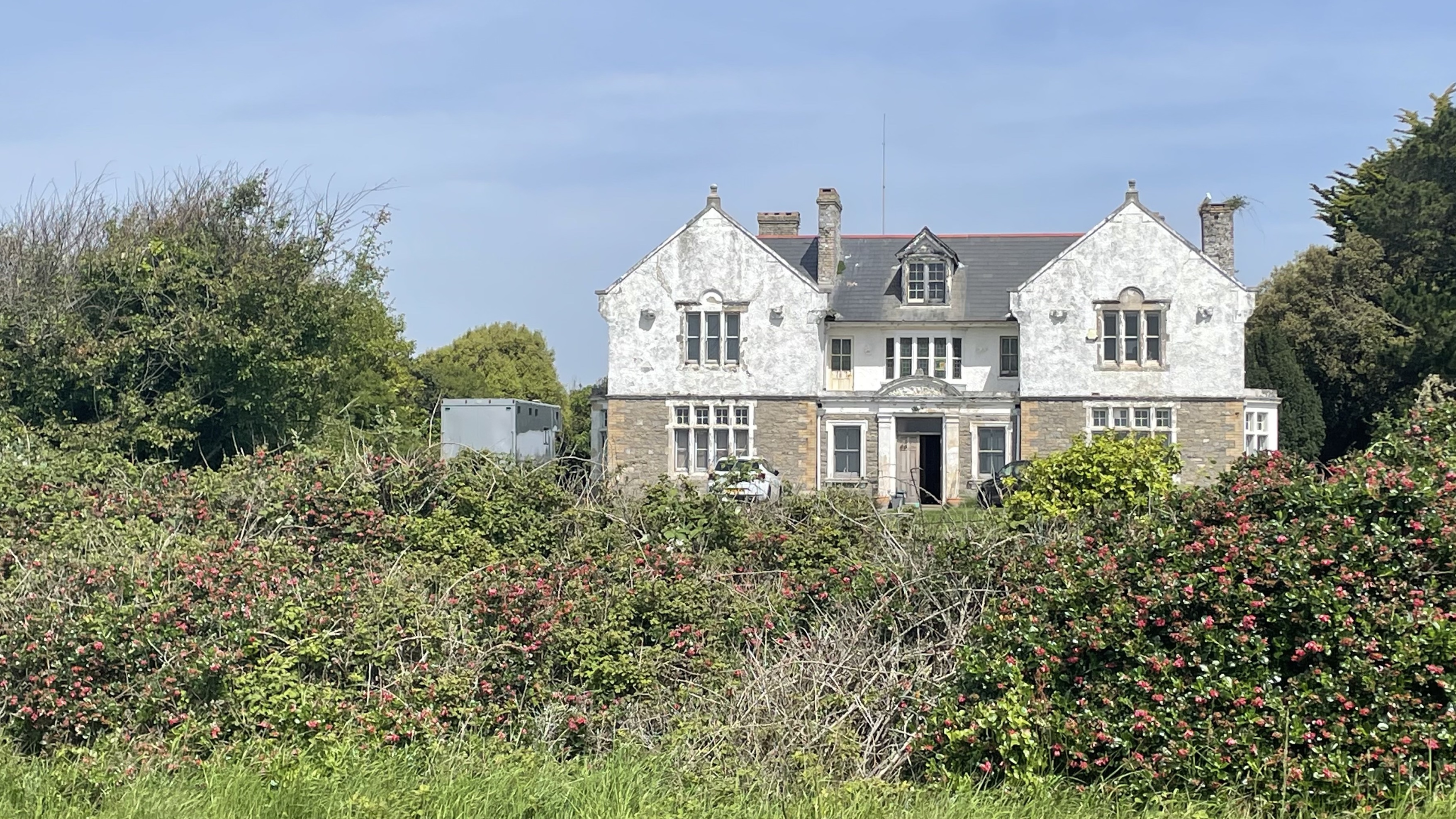
Friars Point House began life in 1858 as the Marine Hotel, a speculative venture by Francis Crawshay, heir to the Crawshay ironworks dynasty that built much of industrial Wales. Crawshay bought Barry Island in 1856, back when it was still technically an island at high tide, and decided a hotel would cater to Victorian tourists chasing sea air and moral improvement. The original building was modest, functional, nothing to write home about. Then in 1873, John Dillwyn Traherne bought the property and enlarged it into the Pier Hotel, presumably hoping Barry Island would become the next Brighton. It didn't. In 1894, the island passed to Lord Windsor, who demolished Traherne's additions and renamed the place Friars Point House. Why "Friars"? No medieval monastery ever stood here. The name appears to be pure invention, the Victorian equivalent of calling your subdivision "Fox Hollow Estates" when no fox has been seen in forty years. Lord Windsor's changes were modest, but the real transformation came around 1900 when Sir William Graham took over and remodeled the house in the Arts and Crafts Jacobethan style that was trendy among the Edwardian gentry. Graham added stone mullioned windows, gable parapets with ball finials, and an elaborate classical doorcase with a segmental pediment. By 1911 he was still tinkering, improving the grounds, planting trees, building terraces. The exterior tells the story of a house caught between identities. The ground floor is snecked rubble with yellow brick quoins, the upper floor painted pebbledash over freestone dressings, divided by a stringcourse. The main south facing front is symmetrical, three bays with shallow gabled wings. The central bay has a single story porch with that over the top classical doorcase featuring enriched plasterwork and paneled double doors. The wings have 3 light stone mullioned windows on the first floor with label arches over the central lights, and 4 light windows below with high transoms. A central gabled dormer sits above a splayed oriel with leaded and colored glass. On either side of the main first floor windows are heavily weathered stones projecting from the wall, possibly reused medieval corbels from some dismantled church or abbey. Graham was the kind of man who'd buy architectural salvage to give his house fake history. Inside, the house retains what Cadw (the Welsh historic environment service) calls a "well preserved interior," which is bureaucratic speak for "nobody's ripped out the good bits yet." You enter onto a galleried, wainscotted hall with a staircase featuring tapered newels and turned balusters. The doorcases, paneled doors, and enriched plaster ceilings survived the 20th century intact. The chimneypieces are the real prizes. The hall has a 3 arched overmantel and a 4 centered arched fireplace. The dining room, fully wainscotted, has a full height Art Nouveau chimneypiece that curves outward at the sides, a rare surviving example of the style. The drawing room has a Classical chimneypiece beneath a 3 well ceiling. These are the details that got Friars Point House its Grade II listing in 1994, categorized as a "good, locally important example of a small country house of the period." Barry Island itself transformed around Friars Point House. The Barry Railway Company built a pier and pleasure park starting in 1896, and by the Edwardian era the island was a working class resort, not the genteel retreat Crawshay and Traherne imagined. Butlin's opened a holiday camp here in 1966, bringing coach loads of families seeking affordable seaside holidays in chalets and entertainment complexes. The camp closed in 1996 after thirty years of operation, a victim of changing holiday habits as package tours to Spain became cheaper than a week in Wales. The site was demolished and redeveloped into a housing estate. Friars Point House sat awkwardly through all this, too grand for a funfair, too modest to be a proper country estate. Today it's privately owned, invisible behind hedges, while thousands of tourists swarm the beach a few hundred yards away without knowing it exists.
 🎬 entertainment
Barry Island's Forgotten Mansion: Where Coal Money Met Edwardian Ego
Friars Point House sits on Barry Island like a stone riddle nobody bothers to solve. Built in 1858 as a seaside hotel, remodeled twice, and now Grade II listed, this Welsh curiosity tells the story of three wealthy men who each tried to stamp their mark on a windswept rock. What remains is an Arts and Crafts time capsule that most locals walk past without a second glance.
My Take
Friars Point House is a monument to wealthy men's inability to leave well enough alone. Three owners, three names, three remodels, and for what? A house that was never quite grand enough to impress London society, never quite cozy enough to feel like home, and now sits frozen in Grade II aspic while Barry Island roars on around it. The 1900 Arts and Crafts remodel is competent but not brilliant, the kind of thing rich Edwardians did when they read too many William Morris essays and hired the second-best architect they could find. What fascinates me is the gap between the house's pretensions and its location. Barry Island was never going to be an aristocratic retreat. The working class owned this place from the moment the railway arrived, and no amount of ball finials or Art Nouveau chimneypieces could change that. Friars Point House is a period piece, sure, but it's also a reminder that architecture can't force a narrative. The island wanted to be a people's playground, and it won.
What Happens Next
Friars Point House will likely remain in private hands, invisible and underappreciated, until a developer or heritage trust decides it's worth saving publicly. The Grade II listing protects it from demolition but doesn't guarantee anyone will care. If Barry Island's recent regeneration efforts continue, someone might eventually realize a historic house could be a tourist draw, a period museum, or an upscale boutique hotel. The Art Nouveau chimneypiece alone deserves a pilgrimage. The darker scenario: the house continues to deteriorate slowly behind closed doors. Grade II listings are enforceable in theory but underfunded in practice. Cadw lacks the resources to monitor every listed building in Wales, and private owners can stall repairs indefinitely. Friars Point House could become another cautionary tale, a building saved on paper but lost to neglect. What nobody sees coming is a cultural shift where Edwardian country houses fall out of fashion entirely. We're already seeing it with smaller estates. If the next generation decides Victorian and Edwardian architecture is stuffy and irrelevant, listings won't matter. The house will survive physically but die culturally, which might be worse.
What History Tells Us
Friars Point House sits at the intersection of two major Victorian trends: industrial wealth buying land, and the middle class seaside resort boom. Francis Crawshay's 1856 purchase of Barry Island mirrors the behavior of coal and iron magnates across South Wales, who used industrial profits to acquire estates and build country seats. The Crawshays, the Guests, the Vivians, all these families tried to transform nouveau riche money into old fashioned landed gentry status through architecture. Most failed socially even if they succeeded architecturally. The hotel to house transformation reflects the chaotic development of Welsh coastal resorts between 1850 and 1914. Resorts like Llandudno succeeded through careful planning and aristocratic backing. Barry Island succeeded too, but as a working class destination, which doomed properties like Friars Point House to social irrelevance. By 1900, when Sir William Graham was installing his Art Nouveau chimneypieces, Barry Island was already too democratic for the house's Jacobethan pretensions. This pattern repeated across Britain: Blackpool, Margate, Skegness. Working class resorts killed nearby gentry houses by making the neighborhoods unfashionable.