The facility, located in Shanghai's Lingang Special Area between two phases of an offshore wind farm, became fully operational last week after a construction sprint that began in June 2025 and wrapped in October. HiCloud Technology, the operator, partnered with Shanghai Lingang Special Area Investment Holding Group, Shenergy Group, Shanghai Telecom, and CCCC Third Harbor Engineering to deploy pressure resistant subsea modules packed with GPU (graphics processing unit) clusters. China Telecom installed its own computing hardware inside to run AI (artificial intelligence) workloads, big data annotation, 5G infrastructure, and domestic LLM (large language model) development. The project started with a 2.3 MW (megawatt) demonstration phase before scaling to 24 MW total capacity. The cooling mechanism is brutally simple and eliminates the need for industrial chillers. Hot air from servers heats a refrigerant in copper pipes, turning it from liquid to gas. The gas rises through buoyancy to a cooling layer in the upper module, where it exchanges heat with seawater via a heat exchanger and condenses back to liquid. Gravity pulls the liquid refrigerant back down to the server room, creating a passive loop that requires zero additional power. Chinese state media claims the system hits a PUE (Power Usage Effectiveness) of around 1.15, meaning only 15% of total energy goes to non computing overhead. Conventional enterprise data centers typically run closer to 1.5 or worse, burning massive amounts of electricity just to keep equipment from melting. Developers say the underwater setup cuts electricity consumption by 22.8%, uses zero freshwater, and requires over 90% less land than equivalent terrestrial facilities. That last figure matters in coastal China, where real estate commands premium prices and industrial zoning fights are vicious. By sticking servers on the seafloor adjacent to wind turbines, the project sidesteps land acquisition entirely and taps renewable energy at the source, avoiding transmission losses and grid dependency. The direct wind to server connection is the key efficiency play here, not just the seawater cooling. But underwater computing is a maintenance nightmare. Saltwater corrosion, long term pressure sealing, subsea cable reliability, and hardware accessibility are all unsolved at scale. When a server fails on land, a technician swaps it in minutes. When a server fails 30 meters underwater in a sealed module, you're looking at an expensive recovery operation or accepting the loss until the entire module is hauled up for service. The Shanghai operators are betting on sealed modular systems, heavy redundancy, and remote monitoring to minimize physical intervention. That works until it doesn't, and the first major hardware failure will test whether this model can survive real world operational stress. Microsoft's Project Natick tested submerged data center capsules off California in 2015 and deployed a larger trial off Scotland's Orkney Islands in 2018. The Orkney deployment showed lower hardware failure rates underwater compared to land based equivalents, likely due to stable temperatures and the absence of oxygen and humidity fluctuations. But Microsoft quietly discontinued the project by 2024 without moving to commercial deployment, and the company has never publicly explained why. The prevailing theory is that maintenance costs and operational complexity outweighed the efficiency gains, or that hyperscale cloud economics just don't favor boutique underwater deployments when you can build massive land based facilities in cheap power regions. China's willingness to commercialize what Microsoft abandoned suggests either a different cost structure, a strategic push for energy independent infrastructure, or both.
 💻 technology
China Dumps Servers in Ocean, Slashes Energy Bills
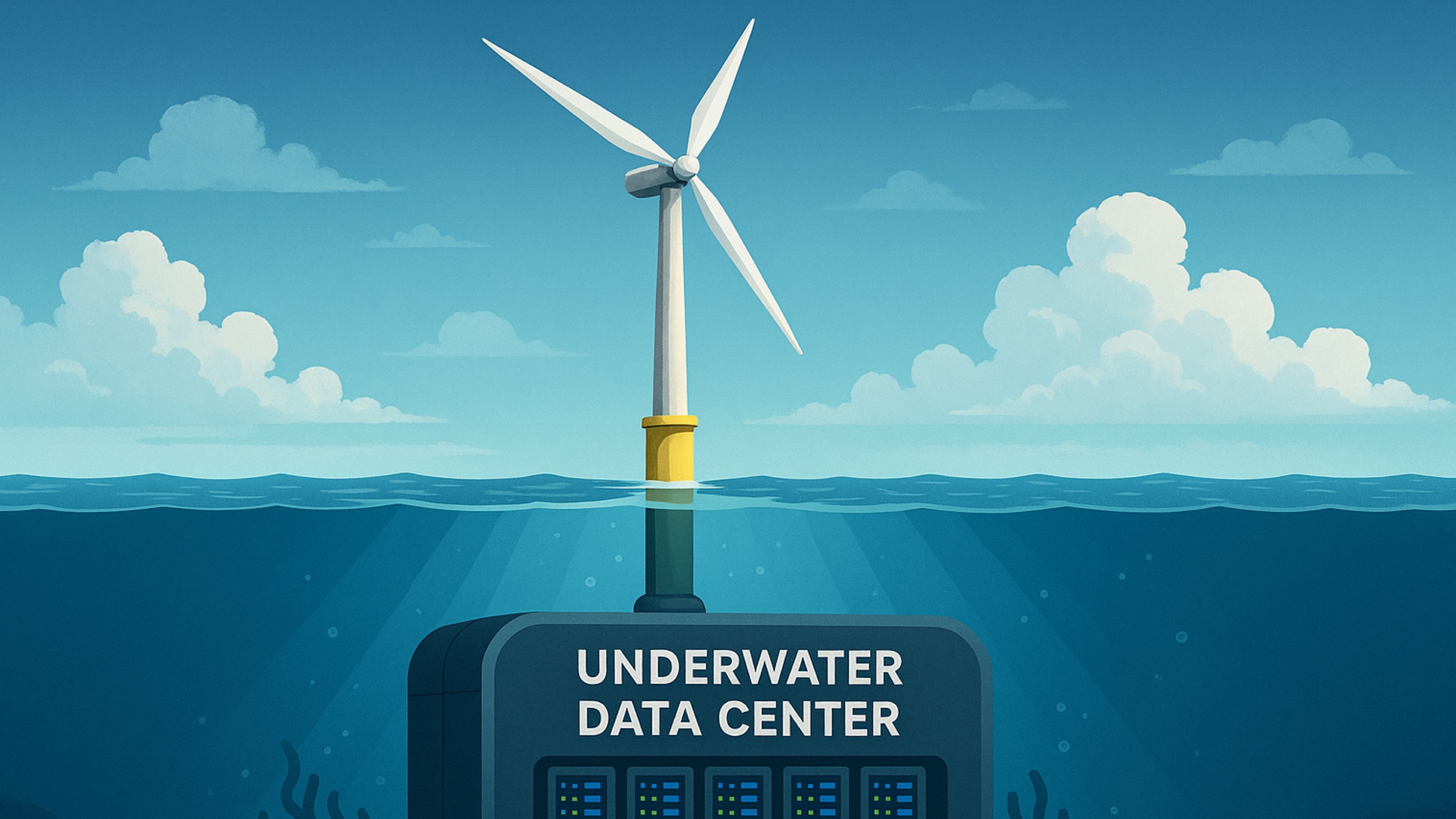
China just flipped on a $226 million underwater data center off Shanghai that runs on offshore wind and cools itself with seawater. Nearly 2,000 servers are sitting on the ocean floor, drawing power straight from turbines and skipping the massive cooling costs that plague traditional facilities. Microsoft tried this years ago and walked away; Beijing just went commercial.
My Take
This is Beijing playing the long game on energy independence and AI infrastructure sovereignty. The US and Europe are locked in a land grab for power hungry data centers, fighting over grid capacity and water rights while China is literally dropping servers in the ocean and plugging them into wind farms. That's not just an engineering flex, it's a strategic hedge against energy bottlenecks and foreign pressure on semiconductor supply chains. If you can run your AI development stack on renewable power you generate yourself, offshore where nobody can touch it, you've just insulated a critical technology stack from external disruption. The real test is whether this scales beyond a flagship project. One 24 MW facility is a rounding error in China's data center capacity, which is growing at double digit rates annually to support AI development, surveillance infrastructure, and cloud services. If underwater deployments can actually compete on cost and reliability at scale, expect to see these modules proliferate along China's entire coastline within five years. If the maintenance costs spiral or the first typhoon tears a module apart, this becomes an expensive proof of concept that never leaves Shanghai. Microsoft's retreat suggests the economics are marginal at best, but China has a history of subsidizing strategic tech until it becomes commercially viable. This could go either way.
What Happens Next
China will push at least three more underwater facilities into development by early 2027, targeting Guangdong, Zhejiang, and Hainan provinces where offshore wind capacity is already being built out. The next phase will test deeper deployments (50 100 meters) to access colder water and stronger currents for even better passive cooling. The real wildcard is whether China exports this model to Belt and Road partners who lack land based data center infrastructure but have coastlines and wind resources. Pakistan, Indonesia, and several African nations fit that profile and are already locked into Chinese infrastructure financing. If Beijing can package underwater data centers as turnkey sovereign cloud solutions for developing nations, it's not just building servers, it's building digital dependency. The counterplay nobody's discussing: Western navies suddenly have a new category of infrastructure to worry about in contested waters, and subsea data centers are a lot harder to monitor than land based facilities.
What History Tells Us
This echoes the Cold War playbook of hardening critical infrastructure against external threats. The Soviet Union buried command bunkers and communications hubs deep underground to survive nuclear strikes; China is now deploying data infrastructure underwater to insulate it from energy disruptions, physical attacks, and foreign pressure. The US did something similar in the 1960s with undersea SOSUS (Sound Surveillance System) arrays for tracking Soviet submarines, proving that critical tech can survive and operate in harsh ocean environments for decades. The difference is that data centers are active, power-hungry systems rather than passive sensors, and they're sitting in international shipping lanes rather than classified military zones. If this model proliferates, we're looking at a new category of strategic infrastructure that exists in a legal and operational gray zone between national sovereignty and open ocean.
Market Impact
This is bearish for traditional data center REITs (Real Estate Investment Trusts) like Equinix (EQIX, currently trading around $850, down 3% over the past month amid broader tech volatility) and Digital Realty (DLR, hovering near $155, relatively flat). If underwater deployments prove cost competitive, the value proposition of owning terrestrial data center real estate in high cost coastal markets starts to erode. The threat isn't immediate, but institutional investors will start pricing in alternative infrastructure models within the next 12 to 18 months. Conversely, this is modestly bullish for offshore wind developers and subsea cable manufacturers. Companies like Vestas (VWS.CO, trading around 150 DKK, up 8% this month on strong European wind demand) and subsea engineering firms like Subsea 7 (SUBC.OL, around 150 NOK, up 5% recently) could see increased interest if underwater data centers become a repeatable revenue stream. The AI chip angle is more complex: NVIDIA (NVDA, currently near $950, up 12% this month on continued AI demand) and AMD (AMD, around $160, up 9%) benefit from any expansion of GPU heavy computing infrastructure, whether it's on land or underwater. But if China's domestic chip producers like SMIC can supply the hardware for these facilities under US export restrictions, that's a long term negative for American semiconductor dominance in the Chinese market. Watch for any announcements about whose chips are actually inside those subsea modules.