The logic sounds simple: immigrants commit knife crimes, so fewer immigrants means less knife crime. Except the evidence demolishes that narrative at every turn. In the United Kingdom, where knife crime debates rage hottest, Home Office data shows British citizens commit the overwhelming majority of knife offenses. A 2023 analysis by the Office for National Statistics (ONS) found that knife possession and assault convictions correlate most strongly with age (peaking among males 15 to 24), deprivation levels, school exclusion rates, and local gang activity, not immigration status. Cities with high immigrant populations like London show knife crime concentrated in specific postcodes with deep-rooted gang histories, while immigrant-heavy boroughs like Newham actually saw knife offenses drop 12 percent between 2021 and 2024 according to Metropolitan Police statistics. The psychology behind blaming immigrants is older than statistics themselves. Social psychologists call it the "scapegoat mechanism" a mentality where communities facing complex problems with uncomfortable root causes such as poverty, mental health crises, police funding cuts, and youth services decimated by austerity, find the human brain craving a simple villain. Research from the University of Cambridge published in 2025 demonstrated that people shown identical crime statistics were 3.4 times more likely to support harsh policy responses when perpetrators were described as immigrants versus citizens. The study's lead researcher, Dr. Amara Chen, noted this bias persists "even when participants consciously reject prejudice" because pattern-seeking brains latch onto visible differences like ethnicity or accent when searching for explanations. Now imagine the deportation fantasy comes true. Every non-citizen vanishes overnight. What actually changes? The teenager in Glasgow who carries a blade because his older brother got stabbed last year still carries that blade. The county lines drug network moving heroin from Liverpool to rural towns still needs enforcers, still arms kids with knives, and still operates the same exploitation model it perfected over decades. The young man in Birmingham struggling with untreated trauma and zero mental health appointments still has the same unmet needs. The systemic factors that produce knife violence child poverty, affecting 4.3 million UK children as of 2024, crumbling youth services, where 80 percent of youth centers closed since 2010, normalized gang culture in specific neighborhoods, social media beef escalating to real-world violence none of that evaporates with deportations. The countries trying hardest to restrict immigration offer the clearest proof. Hungary sealed its borders, slashed refugee admissions to near-zero, and spent the last decade promoting Viktor Orbán's "illiberal democracy" centered on keeping foreigners out. Violent crime, including knife attacks, dropped marginally, but the decline matched trends across Europe, including countries that welcomed refugees. Hungary's knife crime rates fell at nearly identical percentages to Germany's, despite opposite immigration policies. The shared factors driving both declines? Economic recovery post-2015, demographic aging, which means fewer young males in the peak crime years, and improved emergency medical care keeping stabbing victims alive. A 2024 comparative criminology study from Leiden University examining 18 European nations found "no statistically significant correlation between immigration levels and knife crime rates when controlling for GDP, unemployment, and Gini coefficient." The most damning evidence comes from ethnically homogeneous societies. Japan has virtually no immigration (foreign-born residents represent just 2.3 percent of the population), yet Tokyo recorded 847 knife-related incidents in 2024, prompting national debates about mental health and social isolation. South Korea, similarly homogeneous and immigration-restrictive, saw high-profile knife attacks in Seoul subway stations throughout 2025, sparking discussions about copycat violence and declining community cohesion. If removing diversity solved knife crime, these societies would have crime-free streets. Instead, they wrestle with the same underlying drivers: alienated young men, mental health stigma, economic anxiety, and the simple availability of blades. The uncomfortable truth nobody wants to hear: knife crime is overwhelmingly a young male problem, not an immigration problem. Home Office data shows 89 percent of knife possession convictions in England and Wales involve males, with the highest rates among citizens aged 16 to 22. These are mostly not immigrants, they are the sons and grandsons of people who have lived in Britain for generations, growing up in neighborhoods where carrying a knife feels like survival, where stop-and-search has destroyed police trust, and where a decade of austerity closed every youth club and after-school program that might have offered an alternative. Immigration policy cannot address any of that. Deportations will not reopen those youth centers, will not create the legitimate employment opportunities that pull kids away from county lines, and will not rebuild the community networks that once kept young people safe.
 🏛️ politics
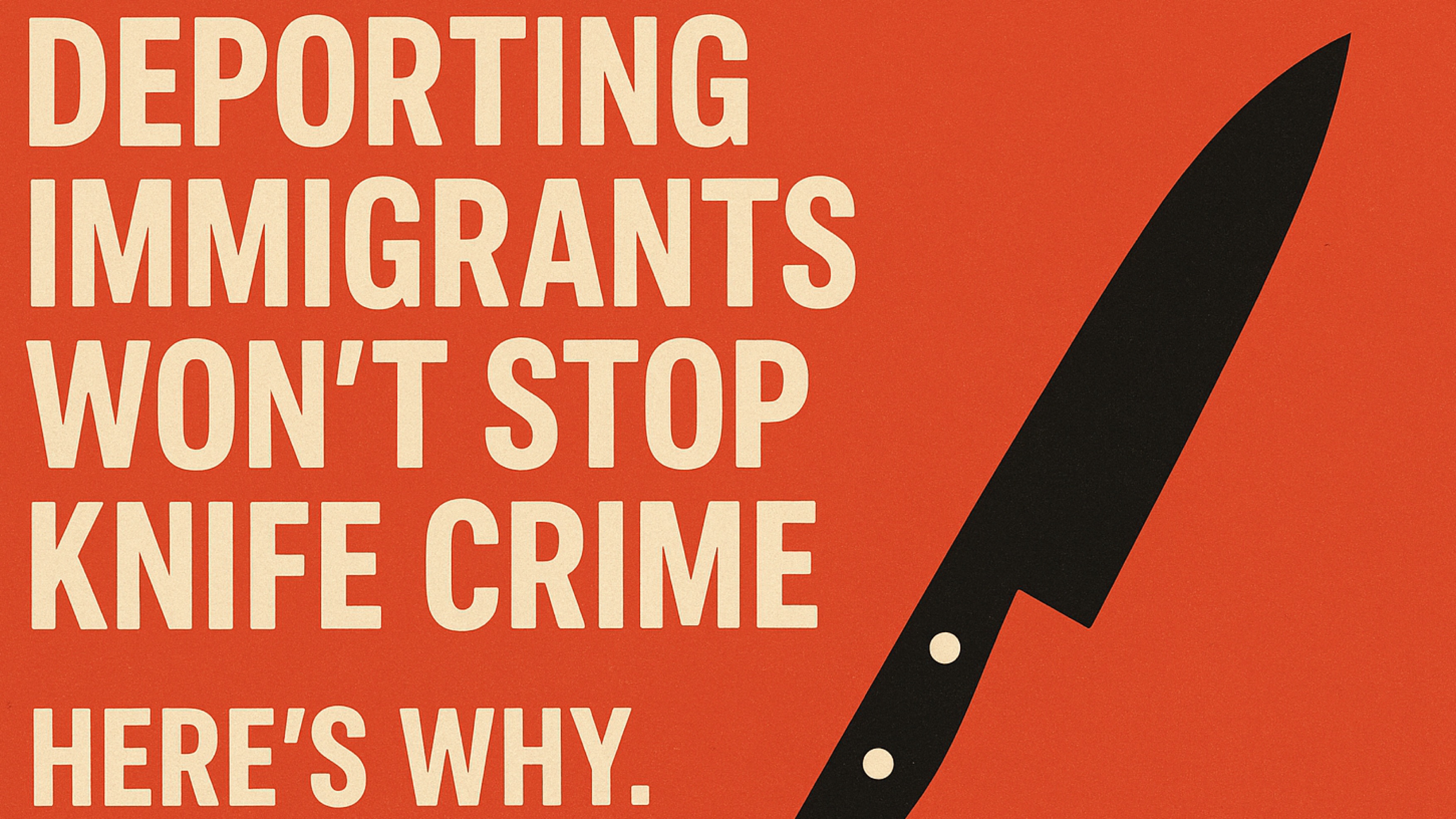
Deporting Immigrants Won't Stop Knife Crime. Here's Why.
Politicians and angry voters keep blaming immigration for knife violence, but the data tells a different story. Remove every immigrant tomorrow and you'd still wake up to the same stabbing statistics - because the real drivers of knife crime have nothing to do with where someone was born.
My Take
The immigrant-crime narrative persists because it offers something irresistible to politicians and frightened voters: a problem with a clear boundary and a simple solution. You can point at borders, you can count deportations, you can pretend you're taking decisive action. Confronting the actual drivers of knife crime means admitting decades of policy failures - the savage cuts to youth services, the normalization of stop-and-search policing that alienated entire communities, the housing crisis that concentrates poverty, the mental health system held together with string and hope. Those problems are hard, expensive, and politically uncomfortable. Blaming immigrants is cheap and plays well on social media. But here's what should terrify everyone pushing the deportation fantasy: it doesn't just fail to solve knife crime, it actively makes prevention harder. Every pound spent on immigration enforcement is a pound not spent on the youth workers who actually intervene before kids pick up blades. Every hour police spend checking visas is an hour not spent on community policing that builds trust and intelligence networks. Every politician screaming about immigrant crime is a politician avoiding the question of why Britain closed 80 percent of its youth centers in a decade. The deportation distraction isn't just ineffective - it's cover for the policy choices that created this mess in the first place. When the deportations happen and knife crime doesn't budge, what then? Find another scapegoat? At some point you run out of people to blame and have to face the mirror.
What Happens Next
Watch for the policy pivot that nobody's predicting: when knife crime stays stubbornly high despite immigration crackdowns, governments will quietly shift toward the evidence-based interventions they should have prioritized from the start. Scotland offers the template - after Glasgow earned the 'murder capital' label, Violence Reduction Unit (VRU) strategies treating violence as a public health issue, not just criminal justice problem, drove a 60 percent drop in knife deaths between 2006-2024 without any immigration policy changes. Expect England to steal that playbook within 18 months as political pressure mounts, rebranding the same community intervention strategies they defunded in 2010. The real wildcard: what happens when deportation advocates face undeniable proof their solution failed? Two scenarios emerge. Scenario one - the evidence-accepters grudgingly fund youth services and mental health support, claiming credit when knife crime eventually declines from those investments. Scenario two - the true believers double down, inventing new categories of people to blame (second-generation immigrants, mixed-ethnicity communities, anyone who 'doesn't share British values'), spiraling into increasingly authoritarian enforcement that still doesn't address the kids getting stabbed in Nottingham and Manchester. By 2028, look for a data reckoning. Criminologists will publish longitudinal studies comparing knife crime trajectories in deportation-heavy jurisdictions versus intervention-focused ones. The results will be stark and uncomfortable for the immigration hawks. That's when the real test comes: can societies admit they wasted years chasing the wrong solution, or do they invent new scapegoats to avoid confronting the poverty, trauma, and abandonment that actually drive kids to carry knives? My money's on politicians finding someone new to blame - taking responsibility for policy failure has never been their strong suit.
What History Tells Us
The pattern of blaming immigrants for domestic crime has repeated with depressing consistency across centuries. In 1890s America, newspapers blamed Irish immigrants for urban violence and knife attacks in Boston and New York, leading to brutal crackdowns that did nothing to address the actual drivers: overcrowded tenements, unemployment, and the endemic gang warfare between native-born groups like the Dead Rabbits and foreign-born Whyos. Crime persisted because the root causes (poverty, lack of opportunity, youth alienation) remained untouched. A century later, Britain's 1980s moral panic blamed Afro-Caribbean immigrants for knife and gun crime in London and Birmingham, culminating in aggressive policing like the 1981 'Swamp 81' operation that sparked the Brixton riots. Violence didn't decrease until economic conditions improved in the 1990s and community policing replaced confrontational tactics - changes that had nothing to do with immigration restriction. The lesson history teaches with brutal consistency: scapegoating visible minorities might win elections, but it has never, ever solved the crime problem it claims to address.