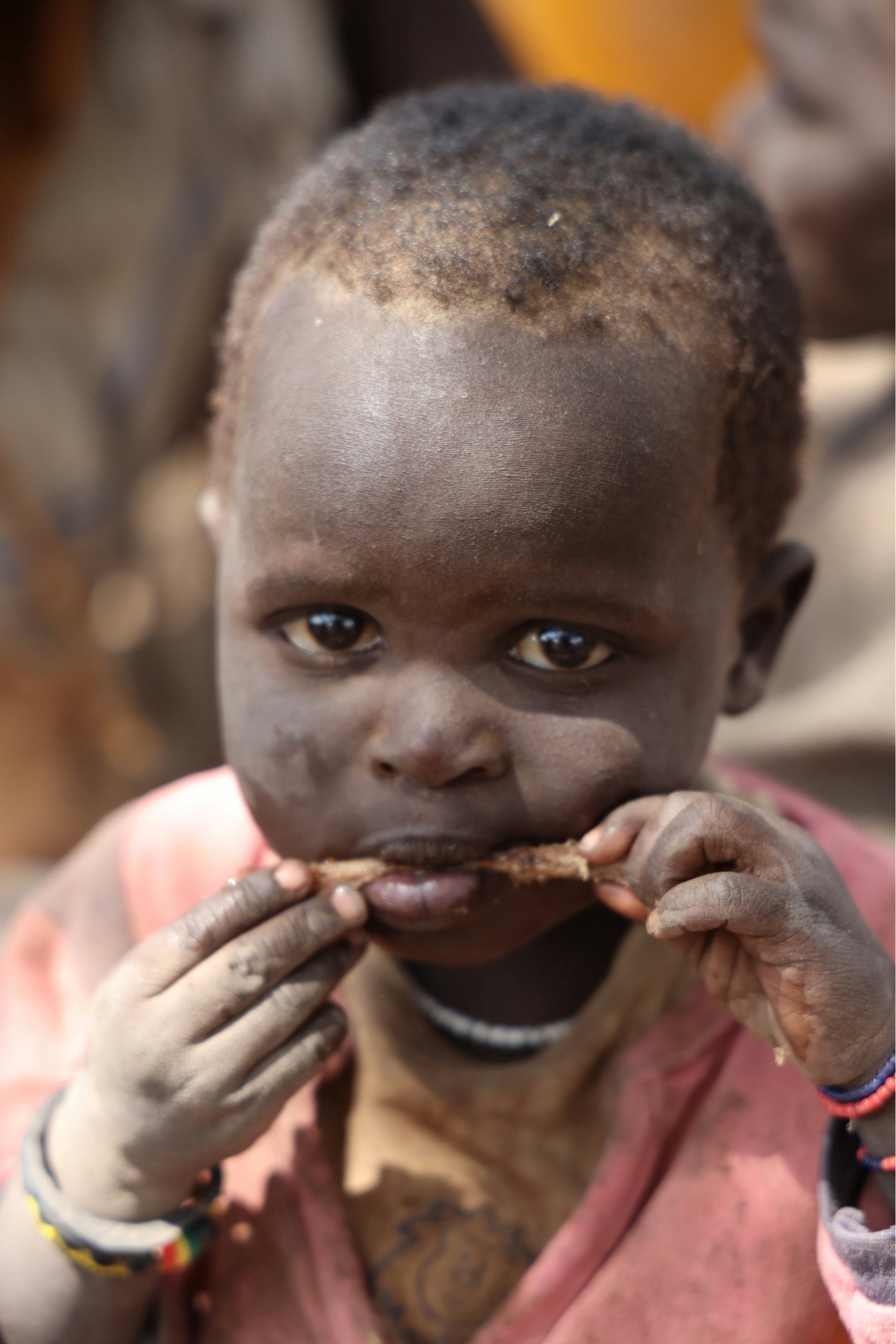
A woman in Mogadishu queues for a ration that will not come this month. A few thousand miles away, in boardrooms in Indianapolis and outside Copenhagen, executives are popping champagne over quarterly numbers that would make a small nation's finance ministry weep with envy. This is the split-screen reality of 2026: the same year in which the World Food Programme (WFP), the United Nations agency that keeps the world's hungriest people alive, warned it can now reach fewer than 5 percent of Somalis facing emergency hunger from October, is the year Eli Lilly is guiding investors toward as much as 83 billion dollars in annual revenue, driven almost entirely by two blockbuster weight-loss and diabetes drugs. Nutrition funding for Somalia's starving children has been completely depleted since the end of September. The obesity drug market, meanwhile, is sprinting toward 100 billion dollars a year. The global hunger numbers released this year are, by the UN's own admission, a mixed story dressed up as good news. The State of Food Security and Nutrition in the World 2026 report found that 645 million people faced hunger in 2025, representing 7.8 percent of humanity. That is down from 8.1 percent in 2024 and 8.6 percent in 2022, marking a third straight year of improvement. But strip away the spin and the numbers are still worse than before COVID-19 arrived: 61 million more people are hungry today than in 2019. Broader food insecurity is even starker. An estimated 2.1 billion people experienced moderate or severe food insecurity in 2025, and 2.69 billion people, close to a third of the planet, could not afford a healthy diet, at an average cost of 4.28 dollars a day, a figure that has risen 25 percent since 2020. Africa has now overtaken Asia as the continent with the most hungry people, with 309 million affected, a rise of 81 percent since 2010. The UN's own agencies concede the world is not on track to hit its Sustainable Development Goal of Zero Hunger by 2030: current projections put 510 to 520 million people still chronically undernourished by that deadline, a number that has crept upward because of the Middle East conflict's impact on fertiliser and energy prices. Layer the WFP's own 2026 Global Outlook on top of the UN's annual report and the picture darkens further. The agency estimates 318 million people face crisis-level hunger or worse this year, more than double the number recorded in 2019, with simultaneous famines confirmed in parts of Gaza and Sudan for the first time this century. Yet WFP's funding for 2026 sits at just under half of the 13 billion dollars it says it needs, forcing it to prioritise only 110 million of those 318 million people, roughly a third. In West and Central Africa alone, 55 million people were projected to suffer crisis-level hunger during the June to August lean season, with Mali recording a 65 percent surge in acute hunger in communities where rations were cut. In Nigeria, funding shortfalls forced WFP to scale back nutrition programmes affecting more than 300,000 children, and malnutrition in several northern states has deteriorated from serious to critical. None of this is abstract. It is measured in stunted five-year-olds and mothers rationing meals so their children eat. Now put the money next to the hunger. The UN's own costing puts the price of ending world hunger by 2030 at 93 billion dollars a year, less than 1 percent of the 21.9 trillion dollars spent globally on militaries over the past decade. WFP's entire ask for 2026, to reach 110 million of the world's hungriest people, is 13 billion dollars. It raised 6.5 billion dollars in total voluntary donations in the whole of 2025. Eli Lilly brought in almost 23 billion dollars in a single quarter this year, a 48 percent jump driven by its obesity drug Zepbound and diabetes drug Mounjaro, which together generated 36.5 billion dollars in 2025 alone. Lilly's full-year 2026 guidance of 80 to 83 billion dollars in revenue is not far off the entire UN estimate for ending world hunger outright. One pharmaceutical company's projected annual haul from two drugs sits within striking distance of the price tag for solving a problem that kills children. Novo Nordisk, the maker of Wegovy and Ozempic, has had a rockier year, with sales expected to shrink by up to 12 percent as patents near expiry and generic semaglutide prepares to launch in Canada, China, India and Brazil. But even Novo's diminished market value, down from a 600 billion dollar peak in 2024 to around 225 billion dollars, dwarfs anything the global hunger response has ever had at its disposal. The executives running these companies are not shy about their ambitions, and their public statements reveal exactly where the priorities sit. Lilly chief executive David Ricks told CNBC that "a billion people on the planet who could benefit from these medications" exist, adding the company is currently reaching about 20 million of them. That is a market-expansion statistic, not a mission statement about access or affordability. Novo Nordisk's chief executive Mike Doustdar has described his company's oral Wegovy pill launch as a "turnaround situation" for investors, with the drug priced from 149 dollars a month for a starter dose in the United States, a sum that remains entirely out of reach for the hundreds of millions of people the UN says cannot afford a basic healthy diet, let alone a branded pharmaceutical. Neither company's public communications reviewed this year contained a pledge, donation or structural commitment to global hunger or food security on anything approaching the scale of their own earnings calls. Their obesity drugs treat a condition of excess. Their silence on a condition of absence speaks just as loudly. This is the oldest paradox in the world economy dressed in a new lab coat. Roughly a third of all food produced globally is never eaten, lost to spoilage, waste or oversupply, according to longstanding estimates from the UN's Food and Agriculture Organization (FAO), even as families in Darfur and Gaza starve within sight of humanitarian convoys that cannot get through. FAO's director-general put it plainly this year: hunger, he said, "is not inevitable." It persists because of choices, about where capital flows, which crises get funded, and which get a press release. In wealthy nations the same absurdity plays out at street level, where it is entirely possible to be both overweight and malnourished, priced into ultra-processed calories because fresh, healthy food costs more per meal than a bag of crisps, while across an ocean a different set of people go without food entirely. Hunger and excess are not opposites in this economy. They are two symptoms of the same broken system of distribution. WFP's own leadership has started sounding less like a charity appeal and more like an indictment. Executive Director Cindy McCain called the simultaneous famines in Gaza and Sudan "completely unacceptable in the twenty-first century." UN Deputy Secretary-General Amina Mohammed was blunter still, warning that "the poorest pay the ultimate price" for conflicts and funding decisions made in rooms where they have no voice. Those rooms increasingly include shareholder meetings and product launch events for drugs that didn't exist a decade ago and now generate more cash in a single quarter than the entire humanitarian system can raise in a year.
 🌍 world
Diet Drug Billions Could End World Hunger. They Won't
Eli Lilly is on course to book up to 83 billion dollars in revenue this year selling appetite-suppressing injections to the world's wealthiest patients, while the United Nations says 318 million people are facing crisis-level hunger with barely half the funding needed to reach them. The maths is not complicated. The willingness to act on it is another matter entirely.
My Take
There is a specific kind of obscenity in a system that can manufacture, market and monetise a drug to help rich people eat less, faster than it can get a bag of grain to a child who has eaten nothing. Eli Lilly and Novo Nordisk are not villains for building effective medicines. They are villains, or at least deeply compromised actors, for treating the billions generated by those medicines purely as a shareholder return story rather than as a moral surplus that could, without denting a single dividend, close the entire funding gap for WFP's global hunger response several times over. Nobody is asking these companies to give away their drugs for free. The ask is smaller and more damning: that a fraction, a genuine, structural, publicly accountable fraction, of the tens of billions now flowing from Wegovy and Zepbound gets redirected toward the 318 million people the UN says are facing crisis hunger this year. That fraction has not materialised. Instead the public statements from both companies' leadership are about pill launches, market share and guidance upgrades. The same critique lands on the tech billionaires and AI founders who spend their public appearances talking about user growth, model scale and the next funding round rather than the price of a meal in Darfur. The industry's entire cultural language, more users, more compute, more followers, bigger valuations, has become a proxy for human worth in a way that has nothing to do with whether anyone actually eats. When the yardstick for success is engagement and market capitalisation, feeding people becomes a rounding error, something for 'someone else' or 'the UN' to handle, even as the wealth concentrating at the top of these industries could, by the UN's own numbers, end world hunger for less than 1 percent of what the world spends on weapons in a decade. The problem was never that ending hunger is expensive. The problem is that it has never been anyone with enough money's actual priority. None of this means philanthropy or drug innovation are worthless. It means the current model, where life-saving decisions about who eats and who doesn't are downstream of quarterly earnings calls, patent cliffs and growth targets, is a moral failure dressed up as a business success story. Hunger is not a natural disaster in most of the places it is killing people. It is a distribution failure that the world has, repeatedly and explicitly, priced at less than a hundred billion dollars a year to solve. That number exists inside a handful of corporate balance sheets right now. It is simply not being spent that way.
What Happens Next
Expect the divergence to widen before it narrows. Eli Lilly is guiding toward further growth in 2026 and beyond as its oral obesity pill and international expansion ramp up, with analysts already discussing a market capitalisation north of a trillion dollars. Novo Nordisk faces a harder road, with generic semaglutide due to reach Canada imminently and then China, India and Brazil, which will erode its pricing power but likely push both companies to chase volume in lower-income markets, a dynamic that could, incidentally, make these drugs marginally more accessible outside the wealthiest nations over the next two to three years. On the hunger side, WFP's 2026 Global Outlook already signals further ration cuts are coming in Somalia, Mali, Nigeria and Afghanistan unless donor governments, chiefly the United States, European Union member states and Gulf donors, reverse recent humanitarian funding cuts. The next full accounting will come with the 2027 edition of the State of Food Security and Nutrition in the World report, expected around July next year, which will show whether the fragile three-year decline in hunger rates holds or reverses under the weight of the Middle East conflict's impact on fertiliser and food prices. The UN's own projections already suggest the Zero Hunger 2030 target will be missed, with 510 to 520 million people still expected to be undernourished at the decade's end. Watch for pressure to build on pharmaceutical companies specifically. Lawmakers including members of the US Senate have previously investigated GLP-1 (glucagon-like peptide-1) drug pricing, and that scrutiny is likely to intensify as Lilly's profits climb further into record territory. Whether that translates into any commitment tying weight-loss drug windfalls to global hunger relief remains, as of now, entirely unannounced by either company.
What History Tells Us
Hunger amid plenty is not a new phenomenon, it is a recurring feature of how food gets distributed rather than how much of it exists. During the Bengal famine of 1943, grain exports from British-administered India continued even as an estimated two to three million people starved, a stark historical example of political and logistical choices determining who eats, independent of actual food scarcity. The pattern recurs in slower motion today: enough food is grown globally to feed everyone, yet roughly a third of it is wasted, while famine has been formally declared in parts of Sudan and near-famine conditions persist in Gaza. The mechanism has changed, from colonial administration to broken humanitarian funding pipelines, but the underlying truth has not: scarcity of food is rarely the actual constraint.
Market Impact
Eli Lilly's stock has been on a historic run, with the company's market value pushing toward and past the trillion-dollar mark on the back of Zepbound and Mounjaro sales, and its 2026 revenue guidance of 80 to 83 billion dollars beating Wall Street's prior consensus of roughly 78 billion dollars. Novo Nordisk has moved in the opposite direction, its market capitalisation falling from a 600 billion dollar peak in 2024 to around 225 billion dollars as Wegovy and Ozempic lose ground to Lilly's tirzepatide-based rivals and face looming patent expiry. Expect continued volatility for Novo as generic competition arrives market by market, while Lilly's trajectory looks set to keep climbing through 2026 unless its own oral pipeline or pricing pressure in the US intervenes. For investors, the obesity drug category remains one of the single strongest growth stories in global pharma; for the hunger relief sector, none of that growth has yet shown up on WFP's balance sheet.