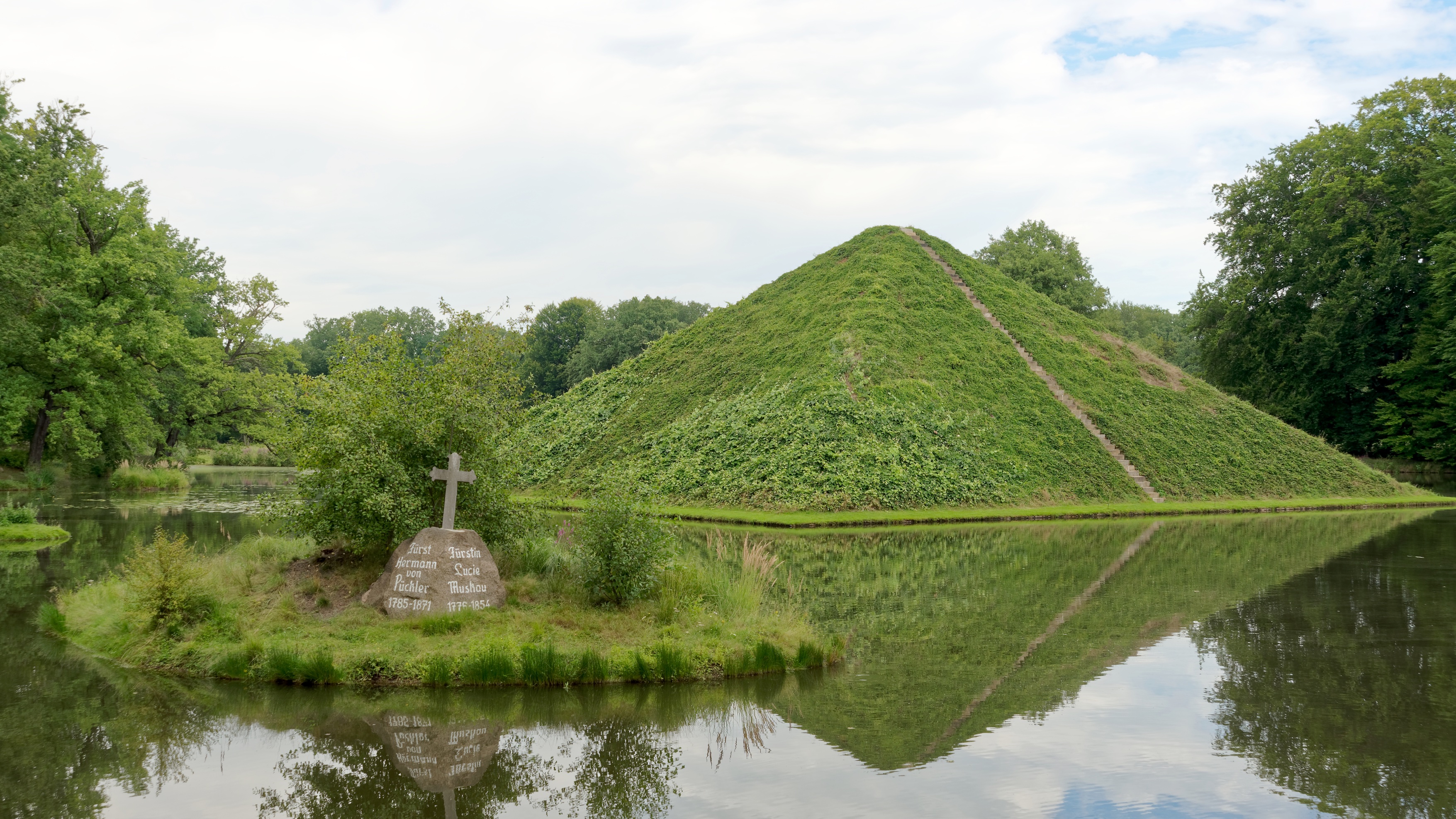
In Branitz Park near Cottbus, Germany, two pyramids rise from the landscape like a pharaoh's fever dream transplanted to Brandenburg. The Land Pyramid mimics the stepped design of Saqqara, while the Lake Pyramid - officially called the Tumulus - serves as the final resting place of Prince Hermann von Pückler-Muskau and his ex-wife Lucie. A tiny island in front holds their gravestones, marking one of history's stranger love stories and an even stranger legacy. Born in 1785 to a 15-year-old mother, Pückler-Muskau grew up under his grandfather's care before being shipped off to a Moravian Church boarding school at age nine. He called it a "Moravian hypocrisy-institute," and the experience turned him into a lifelong religious skeptic and pantheist who equated God with nature. After dropping out of law school, he stumbled through a military career that included a brief stint as military governor of Bruges during the Napoleonic Wars. But his real calling came during travels to England, where he discovered landscape gardening and became obsessed with creating "ideal parks." His first masterpiece, Muskau Park on the German-Polish border (now a UNESCO World Heritage site), nearly bankrupted him. The solution? Divorce his intellectual soulmate Lucie von Hardenberg - nine years his senior - and hunt for a rich English bride to secure a dowry. Lucie not only agreed but took assets from Hermann first to protect them from creditors. The plan failed spectacularly when English nobility locked their daughters away from the charming, notorious German prince. But Lucie found gold in Hermann's witty letters about high society, publishing them to massive commercial success - essentially inventing celebrity gossip journalism decades before tabloids existed. His adventures grew increasingly bizarre. He traveled to Sudan in 1837, bought four enslaved people at a Khartoum slave market to free them, and took an underage Ethiopian girl named Machbuba as both foster child and mistress. He pushed for military promotions into his 80s, famously oversleeping the Battle of Königgrätz at age 80 but still receiving honors afterward. At 86, he volunteered for the Franco-Prussian War and was denied. Through it all, Lucie remained devoted, managing his park designs while he gallivanted across continents. When death approached, Pückler-Muskau's final rebellion against church authority came through chemistry. Since cremation violated religious law, he ordered his heart dissolved in sulfuric acid and his body packed in quicklime. The pyramids he designed as his tomb, inspired by Egyptian travels, stand as monuments to a man who spent eight decades refusing to follow anyone's script. The only thing bearing his name that he didn't create himself? Fürst-Pückler-Eis - the vanilla-strawberry-chocolate ice cream (known as Neapolitan elsewhere) that a Cottbus confectioner cleverly named after serving it to the prince exactly once.
 🎬 entertainment
German Prince Dissolved His Heart, Built Egyptian Pyramids
Hermann von Pückler-Muskau wasn't your average 19th-century aristocrat. This German prince built two pyramids as his tomb, divorced his wife to hunt English heiresses (unsuccessfully), bought slaves to free them, and ordered his heart dissolved in sulfuric acid after death.
My Take
We sanitize historical figures into tidy narratives, but Pückler-Muskau refuses the treatment. Here's an aristocrat who divorced his wife to gold-dig in England, failed miserably, then watched her turn his gossipy letters into bestsellers. He freed slaves while keeping a teenage girl as his mistress. He volunteered for war at 86 and designed his own pyramid tomb complete with acid-dissolved organs. The contradictions don't resolve into a lesson - they just sit there, uncomfortable and human. What makes him fascinating isn't the pyramid theatrics or even the sulfuric acid finale. It's that Lucie stayed. Not as a doormat, but as a genuine partner who understood that loving someone chaotic doesn't mean enabling them - it means managing the park while they're buying slaves in Khartoum or proposing to English heiresses. Their relationship, conducted largely through divorce papers and garden blueprints, might be more honest than most marriages. And those pyramids in Cottbus? They're not just eccentric monuments. They're proof that you can reject every social convention, burn through multiple fortunes, and still leave something beautiful behind - even if a confectioner steals your name for ice cream.
What Happens Next
Branitz Park faces a curious immortality problem. UNESCO protections and German heritage laws mean these pyramids aren't going anywhere, but their creator's reputation swings wildly depending on which century's moral lens you apply. In the next decade, expect aggressive reinterpretation of the Machbuba relationship as German institutions grapple with their historical figures' colonial-era behavior. The park will likely add explanatory plaques that don't excuse but do contextualize - the same uncomfortable dance every European heritage site is doing right now. Meanwhile, Pückler-Muskau's real legacy lives in the 2,000-acre Muskau Park straddling the German-Polish border. As climate change accelerates, his pioneering landscape architecture - designed to work with natural flooding patterns rather than against them - looks increasingly prophetic. Landscape architects are already studying his water management techniques for modern urban parks. The pyramid might be the spectacle, but the UNESCO World Heritage designation on his actual park work suggests he'll outlast most of his aristocratic contemporaries. The ice cream will definitely outlast all of them.
What History Tells Us
Pückler-Muskau's pyramid tomb fits a broader 19th-century European obsession with Egyptian archaeology following Napoleon's 1798 invasion of Egypt. The Rosetta Stone's decipherment in 1822 triggered "Egyptomania" across Europe - wealthy collectors built obelisks, sphinxes, and pyramid follies on their estates. But while most aristocrats installed decorative novelties, Pückler-Muskau made his functional, designing a working burial site that merged genuine archaeological study with Romantic-era nature worship. His contemporary, British architect John Foulston, built a smaller Egyptian-style tomb in Devon around the same period, but Pückler-Muskau's scale and commitment - actual burial inside - distinguished his project. The practice reflected the era's secularization of death rituals, as Enlightenment thinkers increasingly rejected Christian burial conventions in favor of personalized, often pagan-inspired alternatives.