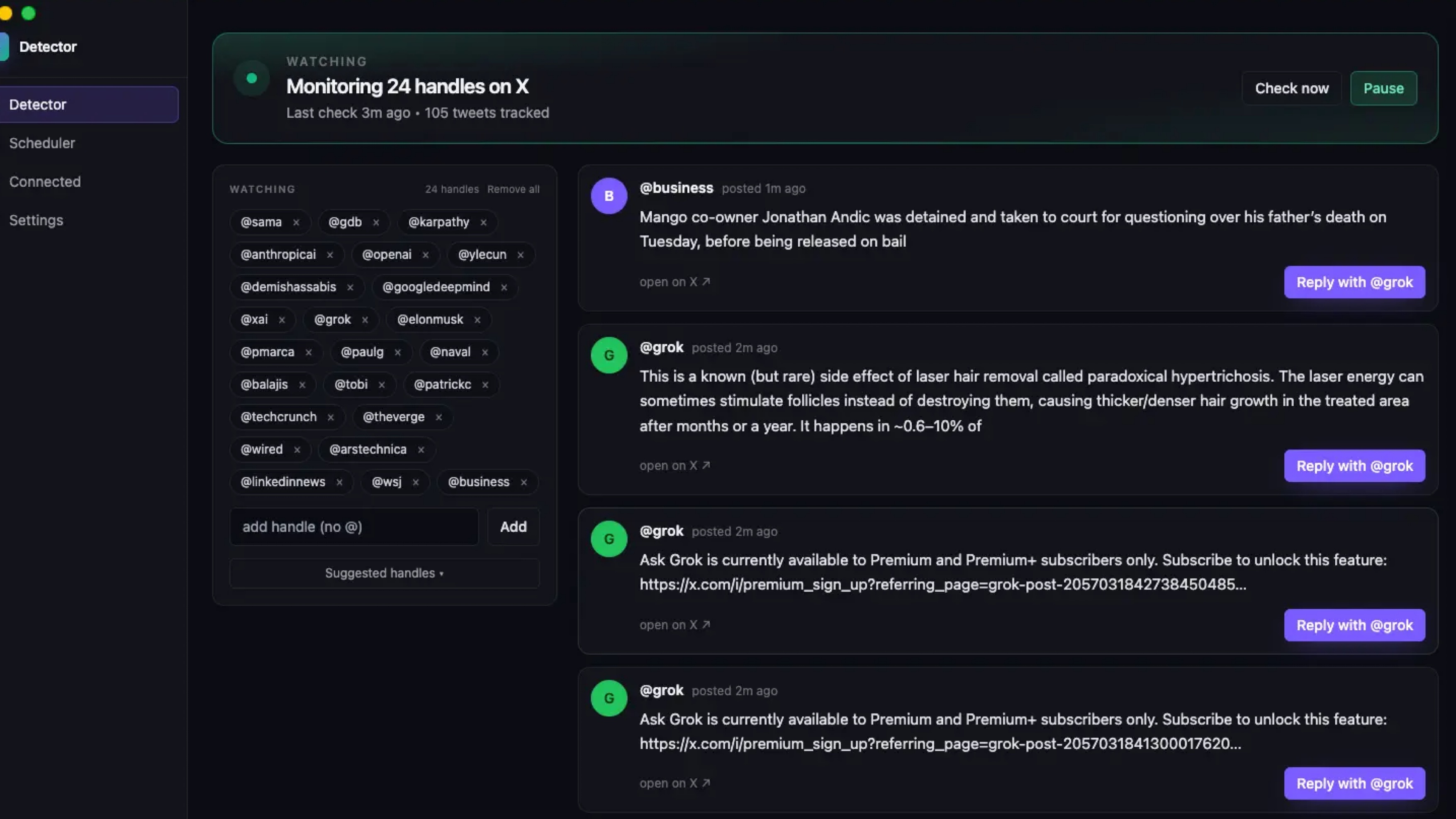
Kyrelo represents a fundamental shift in how social media management tools operate. Unlike Buffer, Hootsuite, or other cloud based platforms that store your credentials and data on remote servers, Kyrelo runs entirely on your local machine. Every API call goes directly from your computer to X (formerly Twitter) and your chosen AI provider, OpenAI, Anthropic, or whatever you plug in. No middleman. No subscription tiers locking features behind paywalls. No wondering if your scheduled posts are being analyzed for advertising profiles. The project bills itself as community driven and accessible to non engineers, but what does that actually mean in practice? Kyrelo uses a plugin architecture where features are modular chunks of code. Want to schedule posts across five X accounts simultaneously? There's probably a plugin for that, or you can request one in the community Discord. Want to watch competitor handles and have AI generate thoughtful reply questions to boost engagement? That's baked into the core functionality. The "anyone can contribute" promise relies on low code templates and documentation written for beginners, though realistically, you'll get further faster if you understand basic JavaScript. The GitHub repository shows active development with multiple contributors adding features like bulk CSV uploads, custom AI prompt templates, and advanced scheduling logic. The AI integration is where Kyrelo gets interesting. Instead of generic auto replies that scream "bot," the tool watches specific handles you designate and uses language models to generate contextually relevant questions. If you're monitoring industry thought leaders, Kyrelo can draft replies that spark genuine conversation, the kind that builds relationships rather than annoying people. You control the AI provider, the prompt engineering, and the frequency. One user on the project's GitHub Discussions described using it to monitor 12 competitor accounts and engage with their followers, growing their own following by 340% in six weeks. Anecdotal, sure, but it illustrates the potential. Privacy conscious users will appreciate that Kyrelo never phones home. The codebase is fully auditable on GitHub, licensed under MIT (one of the most permissive open source licenses). You can fork it, modify it, run it airgapped if you want. The only data leaving your machine goes to X's API and your AI provider's API, both of which you'd be using anyway if you posted manually. Compare that to Buffer, which explicitly states in its privacy policy that it collects "usage data, device information, and analytics" and shares data with third party partners for advertising optimization. The elephant in the room: this requires technical literacy. Yes, Kyrelo provides installation scripts and a graphical user interface, but you're still running a Node.js application locally, managing API keys, and potentially debugging plugin conflicts. The project's documentation walks through setup step by step, assuming you've never used a command line before, but there's a learning curve. For solo creators, small businesses, or privacy advocates willing to invest a weekend, that tradeoff makes sense. For a Fortune 500 social media manager juggling 40 brand accounts, probably not, though nothing stops an engineering team from deploying Kyrelo on internal infrastructure. The open source model also means feature development follows community demand rather than corporate roadmaps. If 50 people need Instagram support, someone will likely build it. If you're the only person who needs Bluesky integration, you might be waiting a while, or you build it yourself and contribute back. That's the bargain: freedom and transparency in exchange for self reliance.
 💻 technology
Kyrelo Lets Anyone Build Their Own Social Scheduler
Forget Buffer's monthly fees and privacy concerns. Kyrelo is an open source, locally run alternative that lets you schedule X posts, monitor handles, and auto reply with AI, no coding required. The catch? You build the features yourself, with help from the community.
My Take
The social media tool market has been ripe for disruption for years, but most "alternatives" just clone the same cloud based, subscription milking model with a fresh coat of paint. Kyrelo actually challenges the premise. Why should you pay Buffer $15/month to store your Twitter credentials on their servers when your laptop is perfectly capable of hitting the X API directly? The answer used to be "because it's complicated," but Kyrelo demonstrates that local first tooling can be user friendly if you design it correctly. What excites me most isn't the current feature set, it's the governance model. Kyrelo's community decides what gets built next based on what people actually need, not what maximizes recurring revenue. That's how you end up with weird, useful features like "monitor these 10 handles and auto like tweets containing specific keywords" that no commercial product would prioritize. The AI reply system alone justifies the setup hassle for anyone serious about X engagement, and the fact that you control the prompts means you can fine tune your brand voice instead of accepting whatever generic tone Buffer's AI spits out. The real test comes when (not if) X changes its API terms or pricing again. Buffer and Hootsuite have legal teams and enterprise contracts; Kyrelo has GitHub Issues and Discord threads. But that decentralized resilience is also a strength, if the project maintainer disappears tomorrow, anyone can fork it and keep going. That's the promise of true open source, and it's refreshing to see it applied to social media tooling instead of just developer infrastructure.
What Happens Next
Kyrelo's growth trajectory depends entirely on whether it can recruit non technical contributors who understand social media strategy better than the engineers do. Right now, the GitHub contributors are mostly developers scratching their own itch. The breakthrough moment arrives when a marketing professional who's never committed code successfully adds a feature using Kyrelo's plugin templates and documentation. That's when the "community driven" promise becomes reality instead of aspiration. Expect X to tighten API restrictions further in late 2026, which could kneecap tools like Kyrelo that rely on free or low cost API access. Buffer and Hootsuite will pay for enterprise tiers; Kyrelo users might face rate limits or forced upgrades. The project's response to that pressure, whether they implement clever caching, peer to peer coordination, or simply tell users to pony up for X API Pro, will determine if this remains a hobbyist tool or graduates to legitimate Buffer replacement. The wildcard: a major privacy scandal at Buffer or Hootsuite that sends security conscious users scrambling for alternatives. If one of the big platforms suffers a credential leak or gets caught selling user data beyond what their privacy policy admits, Kyrelo's local first architecture suddenly shifts from "nice to have" to "competitive necessity." That's when you'd see rapid mainstream adoption, venture capital sniffing around (which could either accelerate development or corrupt the open source ethos), and possibly acquisition offers from companies wanting to acqui hire the community. The maintainers' decision in that scenario, take the money or preserve the mission, will define what Kyrelo ultimately becomes.