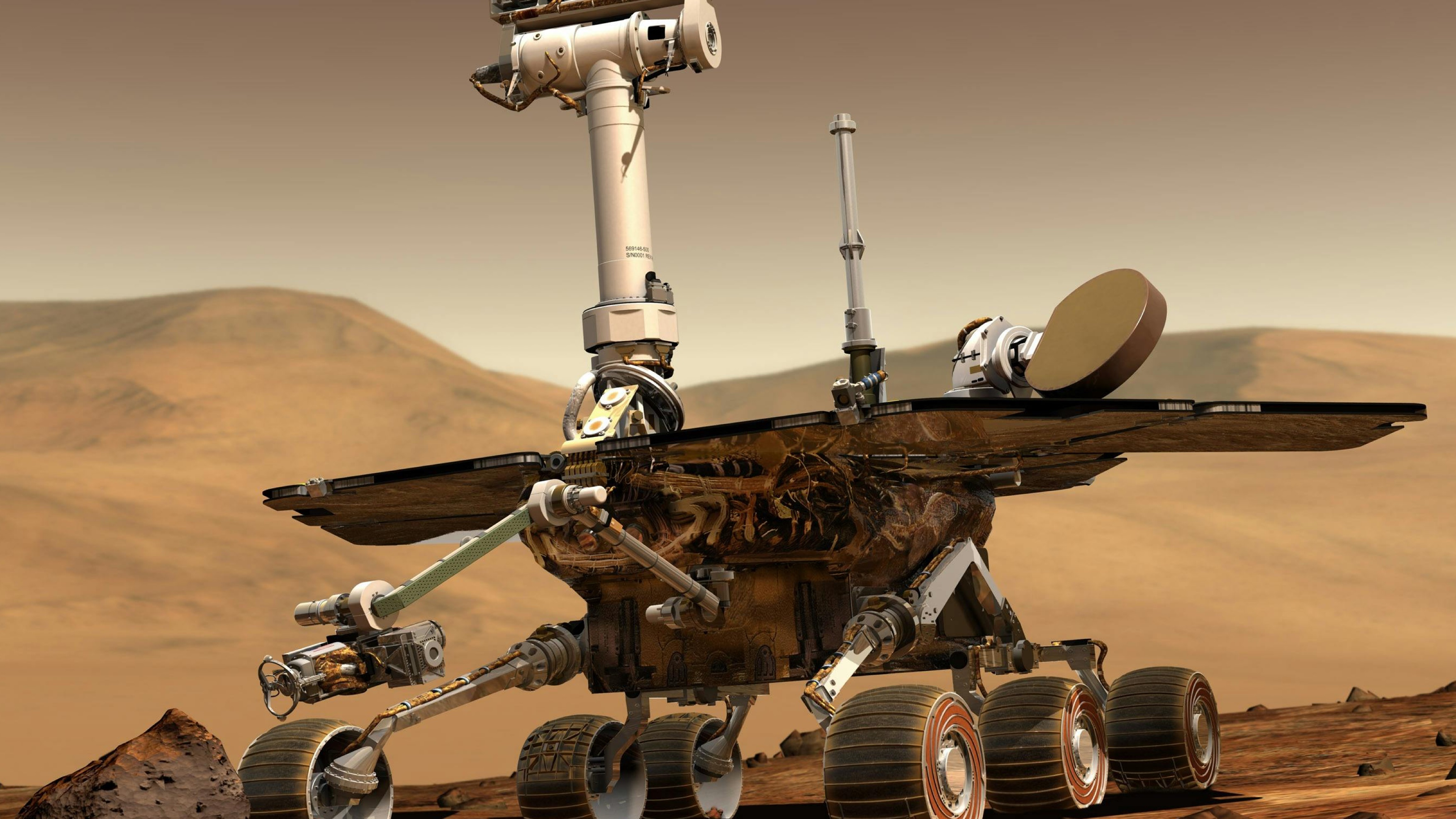
On April 25, 2026, NASA's Curiosity rover punched its rotary percussive drill into a Martian rock nicknamed Atacama, expecting a routine sample collection. What happened next was anything but routine. When the robotic arm tried to retract, the entire rock came with it, all 28.6 pounds of fractured sediment clinging to the drill sleeve like a stubborn barnacle. Atacama measured 1.5 feet across and six inches thick, making it one of the heftiest specimens Curiosity has ever attempted to sample. NASA had never seen a rock refuse to let go before. The stakes were immediately clear to mission control at the Jet Propulsion Laboratory (JPL) in Pasadena. Curiosity's drill is irreplaceable hardware on a rover that cost $2.5 billion to build and another $300 million annually to operate. Forcing the rock off could crack the drill bit, damage the robotic arm's joints, or worse: strand the entire drilling apparatus in a broken state. Without sampling capability, Curiosity's primary scientific mission would effectively end. The team couldn't afford to improvise wildly with a machine operating on a 14 minute communication delay each way. Engineers first attempted the simplest solution: vibrating the drill to shake Atacama loose, the mechanical equivalent of wiggling a stuck USB cable. It failed completely. Four days passed with the rock still attached, during which time Curiosity sat motionless in Gale Crater, unable to move or conduct other operations while supporting the unexpected passenger. NASA then tried reorienting the robotic arm to different angles while vibrating again. This time Atacama shed some sand but maintained its death grip on the drill sleeve. Two more days elapsed before the final attempt on May 1. JPL engineers tilted the drill further, then executed a complex maneuver combining rotation, vibration, and drill bit spinning simultaneously. They braced for multiple attempts, possibly extending the ordeal into a second week. Instead, Atacama gave way almost instantly, fracturing as it hit the ground. The rover's drill emerged unscathed after what mission scientists are calling one of the most nerve wracking operational anomalies in Curiosity's 14 year history on Mars. Curiosity has been exploring Mars since its spectacular sky crane landing in August 2012. The rover has drilled dozens of rock samples while climbing Mount Sharp, the three mile high peak at the center of Gale Crater. Previous drilling operations have fractured surface rock layers, but no sample had ever physically attached itself to the drill hardware. Atacama's composition, likely a combination of sedimentary layers with varying degrees of cementation, created the perfect storm for adhesion. NASA will analyze telemetry data to understand exactly what went wrong and update drilling protocols to prevent future hostage situations.
 🔬 science
Mars Rock Hijacks NASA Rover for Nearly a Week
Curiosity drilled into a 29 pound boulder and couldn't let go. For six agonizing days, NASA engineers sweated over a $2.5 billion rover stuck holding a rock 140 million miles from the nearest mechanic. The machine won, but barely.
My Take
This incident exposes the razor thin margin of error in planetary exploration. We romanticize Mars missions with glossy animations and triumphant press releases, but the reality is infinitely more precarious. One stuck rock nearly ended a multi billion dollar science program. No spare parts exist on Mars. No repair technicians can drive over. When something breaks 140 million miles away, you troubleshoot with whatever electrons you can push through the hardware, and you pray. What's remarkable is NASA's restraint. The agency could have forced the issue on day one, yanking the arm back and hoping for the best. Instead, engineers spent nearly a week modeling outcomes, simulating forces, and methodically testing incremental solutions. That patience saved the mission. It's also a preview of the challenges facing human Mars exploration: astronauts will need the same combination of technical virtuosity and patience when their equipment fails in similarly exotic ways. The Atacama incident also highlights an underappreciated fact about Mars geology: we still don't fully understand how rocks behave there. Lower gravity, extreme temperature swings, and completely different weathering processes create material properties Earth trained engineers can't always predict. Curiosity has now taught us that some Martian rocks are sticky in ways terrestrial rocks aren't. That's valuable data, even if it came wrapped in six days of pure stress for JPL's rover team.
What Happens Next
NASA will spend the next month conducting a forensic analysis of Atacama's composition using Curiosity's onboard spectrometers, trying to understand what made this rock so adhesive. The data could force a rewrite of drilling protocols for future Mars missions, including the Sample Return mission scheduled to retrieve Perseverance rover's cached samples in the early 2030s. If certain rock types pose attachment risks, mission planners may need to equip future rovers with mechanical release mechanisms or avoid drilling specific geological formations entirely. Curiosity itself will likely avoid Atacama like targets for several months while JPL validates the drill's performance through a series of test operations on softer rocks. Expect the rover to move to different areas of Mount Sharp where sedimentary layers are better understood and less likely to fracture into drill grabbing chunks. The incident will also accelerate development of more sophisticated drilling systems for future rovers, possibly incorporating real time force sensors that detect adhesion before a rock fully attaches. The wildcard scenario: what if Atacama's unique properties make it scientifically invaluable? If spectroscopy reveals unusual mineral compositions or organic compounds, NASA might send Curiosity back for a second drilling attempt using modified techniques. The rock that nearly killed the mission could become one of its most important discoveries, provided engineers are willing to gamble on drilling it again.
What History Tells Us
Mars missions have a brutal history of hardware failures at the worst possible moments. In 2004, the Spirit rover's right front wheel seized permanently, forcing engineers to drive it backwards for the rest of its mission. In 2018, the Opportunity rover died during a global dust storm when solar panels couldn't recharge batteries. The Soviet Union's Mars 3 lander functioned for just 14.5 seconds after touchdown in 1971 before going silent forever. NASA's Mars Observer probe disappeared entirely just before Mars orbit insertion in 1993, likely due to a fuel tank rupture. What makes Curiosity's Atacama incident unusual is the happy ending. Most Mars hardware failures are permanent and catastrophic. When the Mars Polar Lander crashed in 1999 after its descent engines cut off 40 meters above the surface, there was no troubleshooting and no second chances: just $165 million worth of metal scattered across the south polar region. Curiosity's ability to survive this crisis through patient, methodical problem solving represents a maturation of deep space operations. Modern rovers carry sophisticated enough sensors and redundant systems that even unprecedented failures can sometimes be reversed. The era of write off and move on may finally be ending.