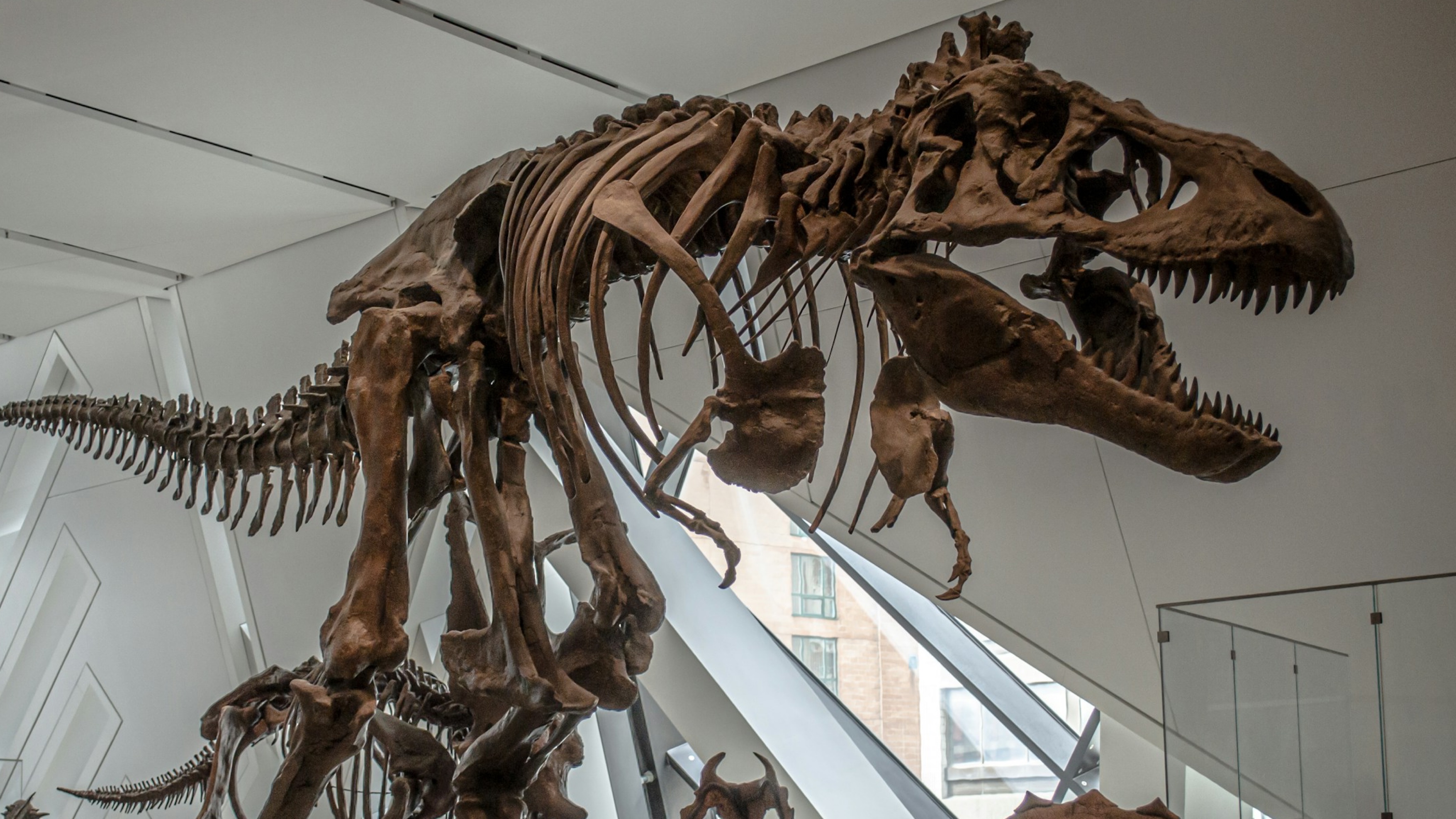
The commercial fossil trade has exploded into a multi hundred million dollar market where complete dinosaur skeletons routinely fetch eight figure sums at auction houses like Sotheby's and Christie's. What was once a niche market dominated by academic institutions and natural history museums has transformed into a playground for ultra high net worth collectors treating fossils like Basquiat paintings or vintage Ferraris. The inflection point came in 2024 when Citadel founder Ken Griffin paid $44.6 million for a near complete stegosaurus skeleton nicknamed "Apex," shattering the previous auction record of $31.8 million for a Tyrannosaurus rex named "Stan" sold in 2020. The mechanics of this market mirror the fine art world more than scientific procurement. Specialist brokers like Salomon Aaron at London's David Aaron gallery serve as middlemen between fossil hunters, preparators, and wealthy buyers who want a conversation piece that predates human civilization by 150 million years. Unlike museum acquisitions, which require peer review, provenance verification, and public accountability, private sales operate in relative opacity with far fewer ethical guardrails. A fossil discovered on private land in Montana or Wyoming can be legally excavated, prepared, and sold to the highest bidder without ever being studied by paleontologists. Museums are getting crushed by this dynamic. The Smithsonian's National Museum of Natural History, the Field Museum in Chicago, and similar institutions operate on public funding and donor contributions that can't compete with hedge fund money. When "Stan" the T. rex sold for $31.8 million, paleontologists worried it would disappear into a private collection forever. It eventually went to the Natural History Museum Abu Dhabi, but only because that institution had sovereign wealth backing. Regional museums in places like Montana and South Dakota, where many significant finds occur, have been completely shut out of major acquisitions for over a decade. The supply side remains legally complex and ethically fraught. In the United States, fossils found on federal land belong to the government and must be donated to museums, but fossils on private land are property of the landowner and can be sold commercially. This creates perverse incentives where ranchers and property owners hire commercial fossil hunters to extract specimens as quickly as possible, often with minimal documentation of the surrounding geology and context that scientists need to understand the find. Countries like Mongolia and China have stricter laws prohibiting fossil exports, yet black market smuggling persists. A Tyrannosaurus bataar skeleton was seized from a Florida fossil dealer in 2012 and repatriated to Mongolia after being illegally smuggled out. The cultural implications extend beyond museum displays. When complete dinosaur skeletons end up in private Manhattan penthouses or Silicon Valley estates, the scientific community loses access to specimens that could yield new insights into evolution, extinction events, and ancient ecosystems. A 2023 study in the journal PLOS ONE found that over 65% of scientifically significant fossil discoveries in the past decade remain in private hands and have never been formally described in peer reviewed literature. The information locked inside these bones (isotope ratios revealing diet, bone pathology showing disease, growth rings indicating lifespan) becomes decorative rather than data.
 📈 business
Rich Guys Hoarding T-Rex Bones Museums Can't Afford
The fossil market has gone full luxury asset class, with billionaires dropping tens of millions on dinosaur skeletons while natural history museums get priced out of their own collections. Ken Griffin's $45 million stegosaurus purchase two years ago wasn't an anomaly - it was a turning point that turned prehistoric bones into the new rare art.
My Take
Here's what grinds my gears about this whole situation: we're letting the ultra wealthy turn the fossil record into a status symbol while museums (the institutions actually equipped to study and share these specimens) are forced to run GoFundMe campaigns to acquire a decent triceratops skull. The argument that private collectors preserve fossils that would otherwise erode in badlands is garbage. These bones survived 70 million years of geological chaos; they can wait a few more years for proper scientific excavation rather than being jackhammered out by commercial crews racing to auction deadlines. The real kicker is that most of these billionaire buyers don't even know what they own. They hire consultants to tell them which fossil looks impressive in a foyer, then lock it away where no graduate student will ever CT scan its inner ear structure or sample its bone chemistry. It's intellectual vandalism dressed up as collecting. Museums are imperfect institutions with their own colonial baggage, sure, but at least their mission is public knowledge rather than private bragging rights. What we need is federal legislation treating commercially significant fossils like archaeological resources: requiring scientific documentation before sale and giving museums right of first refusal on major finds. The free market argument falls apart when you're talking about irreplaceable scientific specimens that reveal how life on Earth responded to mass extinctions. These aren't baseball cards or vintage watches. They're the only physical evidence we have of vanished ecosystems, and we're letting them become trophies.
What Happens Next
The next major fossil auction (likely at Sotheby's or Christie's within the next 18 months) will test whether the Griffin sale was a peak or a new baseline. If another specimen cracks $50 million, we'll see established art collectors diversify into fossils as inflation hedges, treating them like rare gemstones or Old Masters. The smart money is on a near complete Tyrannosaurus rex or a spectacularly preserved feathered dinosaur from China's Liaoning Province as the next record breaker, assuming it can be legally exported. Meanwhile, expect state level pushback in fossil rich regions. Montana's legislature has already floated bills requiring scientific documentation before commercial sale, and Wyoming could follow suit if ranchers realize they're being lowballed by middlemen who flip finds for 10x profit. The real wildcard is whether major museums form a buyer's consortium, pooling resources from institutions like the Natural History Museum in London, the American Museum of Natural History in New York, and wealthy university endowments to compete at auction. They tried this informally for the "Stan" sale and got blown out of the water, but coordinated fundraising could work if they move fast. The darker scenario nobody wants to admit: we're watching the end of public paleontology as we knew it. In a decade, the only world class dinosaur collections might be in countries with state funded museums (China, UAE, Qatar) or private facilities opened by tech billionaires who bought entire fossil sites in the Dakotas. Graduate students will need corporate sponsorships to access specimens, and groundbreaking research will happen behind NDAs rather than in open journals. That's not a prediction. It's already starting.
What History Tells Us
The fossil gold rush mirrors the 19th century "Bone Wars" between paleontologists Edward Drinker Cope and Othniel Charles Marsh, who raced to discover and name dinosaur species across the American West from 1877 to 1892. Their rivalry led to scientifically valuable discoveries but also reckless excavation, bribery of fossil hunters, and destruction of specimens to prevent competitors from studying them. The key difference: Cope and Marsh were at least contributing to scientific knowledge, even if unethically. Today's commercial fossil trade extracts specimens purely for profit with no guarantee they'll ever be studied. A closer parallel is the antiquities market for Egyptian, Greek, and Mesopotamian artifacts, which boomed in the early 20th century as wealthy collectors like J.P. Morgan and William Randolph Hearst bought looted treasures from archaeological sites. The 1970 UNESCO Convention on cultural property eventually established international norms against trafficking stolen antiquities, but enforcement remains patchy. Fossils occupy a legal gray zone: they're not "cultural property" under most definitions, yet they're scientifically invaluable and irreplaceable. We're replaying the same debate about whether unique historical objects belong in public trust or private hands, except this time the objects are 150 million years older.