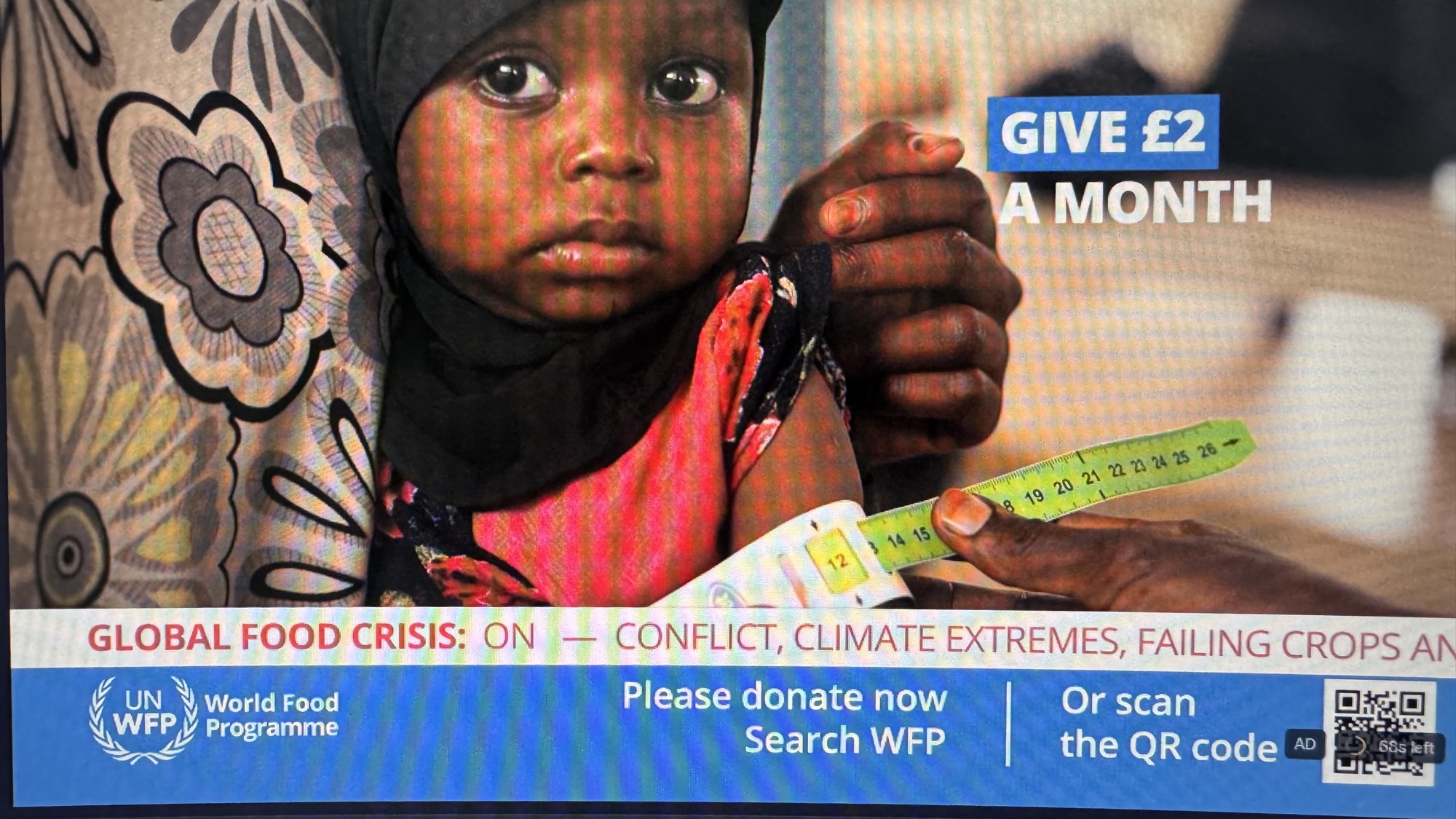
The image is instantly familiar: a small girl in a red patterned dress and a dark headscarf, held against a floral curtain, while an adult hand pulls a yellow colour-coded tape around her upper arm to check for malnutrition. A blue box in the corner reads GIVE £2 A MONTH. A ticker along the bottom scrolls GLOBAL FOOD CRISIS: CONFLICT, CLIMATE EXTREMES, FAILING CROPS. The World Food Programme (WFP) wreath logo sits bottom left, a QR code bottom right, and a small AD tag with a countdown clock confirms this is a paid television spot. It could have aired in 1996. It could air tonight. That sameness is exactly what makes people furious, and the anger is not irrational. What has changed, dramatically, is the money. WFP itself describes 2025 and 2026 as the years of the largest cuts to humanitarian assistance in its history. The agency's own history page states plainly that WFP has been forced to drastically cut rations in most of its operations as international humanitarian funding falls sharply, with a funding shortfall of over 60 percent, the highest in the organisation's history. Reporting from the Better World Campaign found that WFP's efforts are all the more remarkable considering it's operating on a budget that was slashed by 40% in a single year, with the United States, which previously contributed nearly half of WFP's budget, identified as the primary driver of that shortfall. The consequence, according to the same reporting, is that painful cuts have been unavoidable, including reduced rations in Gaza and suspended assistance for Syrian refugees in Jordan and Egypt, limiting or stopping aid across 28 countries. That funding gap raises the question a lot of angry viewers are asking out loud: if the shortfall is measured in the hundreds of millions, why does the burden keep landing on ordinary people's spare change rather than on a much smaller number of extremely wealthy individuals or the world's biggest military budgets? The numbers make the frustration hard to dismiss. Oxfam's January 2026 inequality report found that billionaire wealth jumped by over 16 percent in 2025, three times faster than the past five-year average, reaching a record $18.3 trillion. WFP and partner UN agencies have separately calculated that ending hunger worldwide by 2030 would cost roughly $93 billion a year, a figure UN officials have pointed out is less than one percent of the $21.9 trillion spent on military budgets globally over the past decade. Set against those numbers, WFP's reliance on £2-a-month appeals looks less like a deliberate trick and more like a structural default: the agency is funded almost entirely through voluntary contributions from national governments, with no mechanism to compel billionaires, corporations or defence ministries to make up a shortfall, so when the single largest government donor pulls back, public appeals become one of the only funding levers WFP can pull on its own. The country-by-country picture is brutal. In September 2026, WFP announced it was cutting food assistance in half in the occupied West Bank, at a moment when food needs have more than doubled since 2023 and 900,000 people are food insecure; assistance that had reached 400,000 of the most vulnerable people was scaled back to 200,000. WFP's own quarterly analysis found that 76 percent of households in the West Bank have experienced a significant decline in income, forcing families to sell assets and reduce the number and quality of their meals to survive. WFP Country Director for Palestine Shaun Hughes put it starkly: families who were once thriving and earning a living from their land are now unable to afford enough food, and WFP was being forced to prioritise the most vulnerable while cutting assistance to others despite widespread needs. WFP says it urgently requires an additional $386 million over six months just to serve the roughly two million food insecure people across Gaza and the West Bank combined. The same story repeats across continents. In the Democratic Republic of Congo, a record 28 million people, one in four of the population, are food insecure, including 10.3 million in the conflict-hit east, yet funding gaps meant only 1 million of a planned 2.3 million people in the highest emergency category actually received support in 2025. In Haiti, more than half the population, 5.7 million people, faces acute food insecurity, and WFP has been forced to suspend hot meals for displaced people and halve monthly rations. In Afghanistan, roughly 9.5 million people are food insecure against a $622 million six-month funding shortfall. Across West and Central Africa, WFP warned that 55 million people were expected to endure crisis levels of hunger or worse during the 2026 lean season, with more than 13 million children at risk of malnutrition, and in Nigeria funding shortfalls forced monthly assistance down from 1.3 million people during the 2025 lean season to just 72,000 by February. WFP's Executive Director, Cindy McCain, described it as a rising tide of acute hunger that threatens millions of the most vulnerable, warning that every ration cut means a child goes to bed hungry, a mother skips a meal, or a family loses the support they need to survive. So where does the money actually go when it does arrive? WFP funds its overhead through what it calls a Programme Support and Administrative budget, used to cover corporate overhead costs that cannot be linked directly with a particular project's implementation. Since 1996, WFP funding has operated on a principle of full cost recovery, meaning every donation is expected to also cover its share of logistics, warehousing, security and staffing, not just the food itself, and the agency has leaned on local purchasing of food to keep those costs down. Critics argue this system remains too opaque. Coverage of the agency's troubles has noted that UN agencies are notorious for their high administrative costs and the opacity of their spending, pointing to a 2008 Brookings Institution paper coauthored by aid researcher William Easterly that ranked large aid donors, including WFP, on transparency and efficiency criteria, a study still cited by skeptics as evidence that oversight of where the money goes has long been weaker than donors assume. There is also a fair question about how much of that stretched budget goes into the adverts themselves rather than into food. WFP does not publish a single global figure for its advertising spend, but the market it buys into gives a sense of scale: industry pricing guides put UK charity television advert production anywhere from around £5,000 for a basic edit up to £250,000 or more for a high-end version, before a single second of airtime is booked, and a peak-time slot on a major channel can cost up to roughly £35,000 on its own. WFP's own fundraising strategy documents describe a deliberate push into digital advertising to grow individual giving, on the logic that small recurring donations are a funding stream the organisation can build up itself without waiting on the next government budget cycle. That does not make the ads free or beyond scrutiny, but it does mean the appeal is less a distraction technique than one of the few income lines WFP actually controls while government funding is being cut around it. The corruption fears are not invented either, though the record is more complicated than a straightforward scam. In Ethiopia's Tigray region, investigations ordered by interim regional authorities into the diversion of food aid identified 186 suspects, including members of government and humanitarian bodies. WFP's own leadership in Ethiopia resigned amid that aid diversion probe, and in May 2023 the US Agency for International Development and WFP jointly suspended food aid to Tigray amid suspicions of large-scale diversion, pending investigation, before deliveries eventually resumed. That episode shows both halves of the picture the skeptics rarely hold at once: aid diversion by armed actors and officials genuinely happens, and when it is caught, the response has historically been suspension, investigation and leadership removal rather than a quiet cover-up, though it also proves the system can be gamed for months before anyone outside the region notices. The deeper reason hunger keeps recurring in the same places, decades apart, is that it is rarely one problem wearing different clothes. Conflict drives most of today's worst crises, from Gaza and the West Bank to the DRC's east and South Sudan, where 7.7 million people are acutely food insecure. Climate extremes compound it: WFP and the Food and Agriculture Organization have jointly appealed for resources to protect millions from El Niño-linked weather shocks that wreck harvests in the Sahel and Horn of Africa. Weak governance and corruption divert resources meant for the hungry, as Tigray showed. And population growth in fragile states means the same absolute number of poor harvests or lost wages pushes more people below the hunger line than it did thirty years ago. None of these forces are new; what is comparatively new is that the global response system meant to absorb the shock is now being funded at its lowest relative level in the organisation's history, at precisely the moment several of these crises are compounding simultaneously, and at a moment when the wealth of the people least dependent on that system has never been higher.
 🌍 world
Same Hunger Ads, Richer Billionaires, Hungrier World
A toddler having her arm measured for malnutrition under a blue GIVE £2 A MONTH banner looks almost identical to the charity appeals that ran on television in the 1990s, and that repetition is fueling public fury, especially with billionaire wealth hitting a record $18.3 trillion in 2025 while ending world hunger would cost a fraction of that. The uncomfortable truth is that the World Food Programme is not scamming anyone, it is being starved of government cash itself, right as conflict and climate shocks push more people than ever toward famine.
My Take
People are not wrong to feel conned when the same appeal, the same tape measure around the same tiny arm, has been playing on their screens since before some of them could vote. But the anger is aimed at the wrong villain. The evidence does not show a charity industrial complex quietly pocketing billions while children starve for show. It shows an organisation that, by its own admission, is currently operating with the biggest funding hole in its 65-year history, cutting rations in real time in more than two dozen countries, right as the number of people who need it has spiked in Gaza, Sudan, Haiti, the DRC and the Sahel simultaneously. The anger about billionaires is not misplaced either, and it deserves to be taken seriously rather than waved away. Oxfam's own tally shows billionaire wealth jumping by more than 16 percent in 2025 alone, three times faster than the previous five-year average, to a record $18.3 trillion, while WFP and UN partners put the entire annual price tag for ending world hunger at around $93 billion, well under one percent of what the world spent on militaries over the past decade. That contrast is genuinely obscene, and it is reasonable to ask why a handful of the wealthiest people on the planet, or a sliver of global defence budgets, could not simply close a gap that instead gets passed down to viewers being shown a hungry toddler and a QR code. But "a few billionaires could fix this overnight" and "therefore the system asking the public is a con" are two different claims. WFP has no power to tax billionaires or redirect military spending; it can only request voluntary contributions from governments and voluntary donations from individuals, and right now the single biggest government tap has been turned down hardest. If the system is rigged, it is rigged in the sense that hunger relief is effectively optional for the richest governments, companies and individuals on earth, and semi-compulsory, through guilt and a countdown clock, for everyone else. That is a real structural failure, and it is a fair thing to be furious about, but it is a different failure from the one the ads are usually accused of. That does not mean the system is clean. The Tigray diversion scandal proves that food aid can be captured by exactly the armed actors and corrupt officials the skeptics fear, and the fact it took outside investigators to surface 186 suspects should worry anyone who donates on trust. The Brookings-style critiques of UN overhead and transparency are also not fringe conspiracy, they come from serious aid economists, and they deserve to keep being repeated loudly until agencies publish cleaner numbers on where every dollar lands, including what is spent on marketing itself. But the honest answer to "why hasn't this been solved in thirty years" is that hunger was never a single problem with a single fix. It is conflict, climate, governance failure and population pressure arriving in the same postcodes at the same time, and the tool built to respond to all four at once is currently being defunded by the very governments that used to fund it most, even as private fortunes at the very top of the wealth ladder keep compounding. The ad on the screen looks unchanged. The emergency behind it has quietly got both better, in the long global trend, and dramatically worse, in the last eighteen months, and both of those things are true at once.
What Happens Next
WFP says it needs an additional $386 million over the next six months just to hold the line in Gaza and the West Bank, on top of far larger shortfalls already reported in Afghanistan, the Democratic Republic of Congo, Haiti and across West and Central Africa. Whether that money arrives depends heavily on decisions in Washington, since the United States has historically supplied close to half of WFP's total budget and its pullback is the single largest driver of the current shortfall; any reversal or further reduction in US contributions will show up within months as ration cuts or restorations on the ground. Expect more of the same triage in the immediate term: WFP has already signalled that further pipeline breaks, meaning total suspensions of food deliveries in specific countries, are a live risk wherever funding gaps are largest, and country directors from Kinshasa to Kabul to Ramallah will keep making public appeals rather than quiet ones, a shift in tone from an agency that used to fundraise mostly through TV adverts and is now fundraising through crisis briefings instead. On the accountability side, watch for whether the Tigray-style pattern repeats: any new diversion allegations in an active conflict zone will likely trigger the same playbook of suspension, external investigation and leadership changes that followed the Ethiopia case, rather than either total inaction or full transparency. Donor governments and independent auditors are the actors most likely to force any real change in how overhead and security costs are reported, and pressure from aid-effectiveness economists for cleaner public accounting of the Programme Support and Administrative budget is only going to grow louder as the funding pool shrinks and every dollar is scrutinised harder. Expect the billionaire-wealth comparison to keep resurfacing too. With Oxfam and other campaigners publicising the gap between record billionaire fortunes and the relatively modest cost of ending hunger, calls for wealthier individuals, corporations and defence budgets to take on more of the burden will likely grow louder, even though no binding mechanism currently exists to compel any of them to do so, leaving voluntary government funding and public appeals as the system's only real levers for now.
What History Tells Us
The World Food Programme was created in 1961 as an experiment in delivering food aid through the United Nations system, meaning the organisation has now operated through more than six decades of famines, wars and funding cycles, from Cold War-era emergencies through the 1990s television appeal era to today's overlapping crises in Gaza, Sudan and the Sahel. The recurring pattern, boom periods of donor generosity followed by sudden retrenchment, is not new; what current reporting suggests is different this time is the scale, with WFP's own history page describing the present funding shortfall of over 60 percent as the highest in the organisation's history.