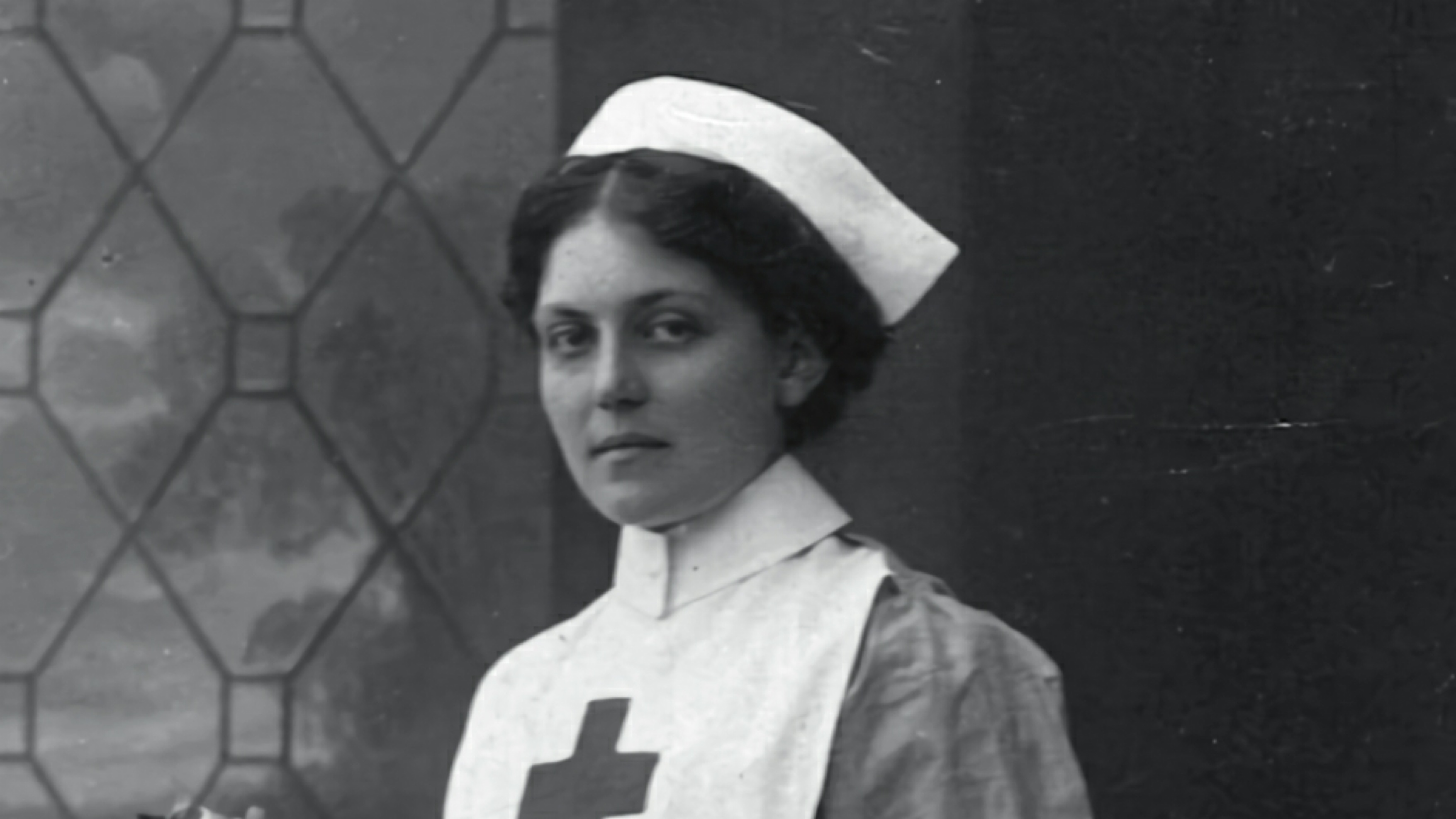
Violet Constance Jessop was born in 1887 in Argentina to Irish immigrant parents, the eldest of nine children. By age 16, she'd survived tuberculosis that doctors said would kill her. By 21, after her father died and her mother fell ill, she became a stewardess on ocean liners to support her siblings one of the only jobs available to working class women that paid decent money. The White Star Line hired her despite initial rejections because she was "too pretty" and might distract male passengers. She uglied herself up deliberately, wearing plain clothes and no makeup, just to get the job. That decision saved her life three times. On September 20, 1911, Violet was working aboard the RMS Olympic when it collided with the British warship HMS Hawke off the Isle of Wight. The Olympic, the largest ship afloat at the time, suffered massive damage to its starboard side. The impact ripped a hole below the waterline and crumpled steel plating. Violet felt the jolt, watched passengers panic, and helped maintain order as the ship limped back to port. Nobody died, but the Olympic needed months of repairs. Violet went right back to work when it reopened. The sea was her livelihood, and fear was a luxury she couldn't afford. Six months later, on April 14, 1912, Violet transferred to the Olympic's newer, supposedly unsinkable sister ship: RMS Titanic. She was 24 years old, working first class cabins, serving wealthy Americans and British aristocrats. At 11:40 PM, the ship struck an iceberg. Violet later described the sound as "a grinding, scraping noise." Officers ordered women and children into lifeboats. Violet didn't want to go she'd seen the Olympic survive worse damage but a superior told her to get in lifeboat 16 and set an example. An officer literally handed her someone else's baby as she boarded, telling her to look after it. She spent the night in a lifeboat watching the Titanic sink, listening to 1,500 people drown in the freezing North Atlantic. When rescue ship Carpathia picked up survivors the next morning, a woman ran up and snatched the baby from Violet's arms without a word of thanks. Violet never learned who the baby was. You'd think that would be enough. But Violet needed the money, so she kept working for White Star Line. In 1914, World War I broke out. Violet volunteered as a Red Cross nurse and was assigned to HMHS Britannic, the third and final Olympic class ship, converted into a hospital ship. On November 21, 1916, while sailing through the Aegean Sea near the Greek island of Kea, the Britannic struck a mine laid by a German U boat. The explosion ripped open the ship's hull. Violet was eating breakfast when it happened. The Britannic sank in just 55 minutes faster than Titanic but most of the 1,066 people aboard escaped because it happened in daylight, in calm seas, with functional lifeboats. Violet jumped from the sinking ship and was nearly killed when a lifeboat's propeller sucked her underwater. She suffered a severe head injury that caused headaches for the rest of her life. Thirty people died in the Britannic disaster. Violet wasn't one of them. After the war, Violet kept working on ships for another 30 years. She sailed the Caribbean, crossed the Atlantic hundreds of times, and retired in 1950 at age 63. She bought a small cottage in Suffolk, England, tended her garden, and lived quietly until her death from congestive heart failure on May 5, 1971, at age 83. Her memoir, "Titanic Survivor," wasn't published until 1997 26 years after she died. Today, maritime historians know her story, but the general public doesn't. There's no statue, no museum exhibit, no biopic. James Cameron put fictional characters in "Titanic" while Violet Jessop who actually lived through it remains invisible.
 🎬 entertainment
She Survived All Three Sister Ships. Nobody Remembers.
Violet Jessop cheated death on the Olympic, Titanic, and Britannic the three largest passenger ships ever built. She nursed soldiers, served tea to millionaires, and walked away from disasters that killed thousands. History forgot her anyway.
My Take
We remember Titanic passengers like John Jacob Astor and Molly Brown because they were rich or dramatic. We forget Violet Jessop because she was working class, female, and survived instead of dying photogenically. History loves martyrs and millionaires. It has no use for stubborn women who refused to drown. Violet's story deserves better than a footnote. She didn't just survive three disasters she kept showing up for work afterward because she had no choice. That's not heroism in the Hollywood sense. That's something harder and more real. The truly remarkable part isn't that she survived plenty of people survived those disasters through luck. It's that she chose to keep working on ships afterward, knowing exactly what could happen. That takes a kind of courage we don't talk about enough: the courage of people who can't afford to be traumatized, who have bills to pay and siblings to feed, who get back on the horse because the alternative is starvation. Violet Jessop didn't have the luxury of a nervous breakdown. She had to serve tea to first class passengers the next week. We should remember her not because she was lucky, but because she was tough.
What Happens Next
Violet Jessop's story is experiencing a quiet renaissance among maritime history enthusiasts and feminist historians who are excavating forgotten women's narratives. Within the next few years, expect a serious push for a biographical film or limited series several production companies have optioned her memoir rights multiple times, but none have pulled the trigger yet. The sticking point is always the same: how do you make a movie about someone who survived three famous disasters without making it feel like "Final Destination" at sea? The answer is to focus not on the spectacle but on the aftermath what it meant to be a working class woman in Edwardian England with no safety net, forced to return to the exact job that nearly killed you three times. The bigger cultural shift is already happening. TikTok history creators have discovered Violet in the past two years, and her story regularly goes viral with millions of views. That's creating bottom up pressure for mainstream recognition. The National Maritime Museum in Greenwich has begun featuring her more prominently in their Titanic exhibitions, and there's talk of a permanent exhibit about working crew members not just wealthy passengers in maritime disasters. If that happens by 2028, Violet becomes the face of it. The wild card nobody's discussing: what if researchers find the baby? Violet held that child in lifeboat 16 for hours, and the mother's identity was never recorded. Genealogists using DNA databases and Titanic passenger manifests could potentially trace descendants. Imagine the media storm if someone comes forward in 2027 saying "my grandmother was that baby." That's the kind of human connection that finally gets Violet the biopic, the statue, the recognition she deserved 50 years ago. History is written by the survivors, but sometimes it takes a century for people to listen.
What History Tells Us
Violet Jessop's invisibility fits a familiar pattern: history systematically erases working class women, especially those who don't fit neat narratives of victimhood or heroism. During the Titanic era (1912), class divisions were so extreme that third class passengers were physically locked below deck while first class passengers boarded lifeboats. Crew members like Violet occupied an even stranger space they were essential to the ship's operation but socially invisible to the wealthy passengers they served. This mirrors broader early 20th century labor dynamics where domestic workers, nurses, and service staff were simultaneously indispensable and disposable. The three Olympic class ships represented the peak of Edwardian hubris massive technological achievements built on the backs of coal stokers, stewards, and engineers who worked 18 hour days for subsistence wages. When ships sank, newspapers listed first class casualties by name but lumped crew deaths into statistical footnotes. Violet's three disaster survival would have made her famous if she'd been a passenger. As crew, she was barely mentioned in contemporary accounts. This erasure continued throughout the 20th century: most Titanic historians focused on the engineering failure or the wealthy victims, not on workers like Violet who simply showed up, did their jobs, and went home. Only in recent decades, as social historians have pushed for more inclusive narratives, has her story begun to resurface.