Adolf Hitler devoted significant portions of Mein Kampf to propaganda theory, and one theme appears repeatedly: ignore the intellectuals. In Chapter Six, he argued that propaganda must be aimed at the "broad masses" rather than educated elites. His reasoning was brutally pragmatic. Intellectuals, he wrote, demand complexity, evidence, and nuance. They analyze arguments, spot contradictions, and resist emotional manipulation. The masses, he claimed, had limited attention spans and absorbed information through repetition and feeling rather than logic. This wasn't a moral judgment in his eyes, it was tactical. If you want to move millions of people, you don't waste time convincing professors. The specific techniques Hitler outlined have become disturbingly familiar:
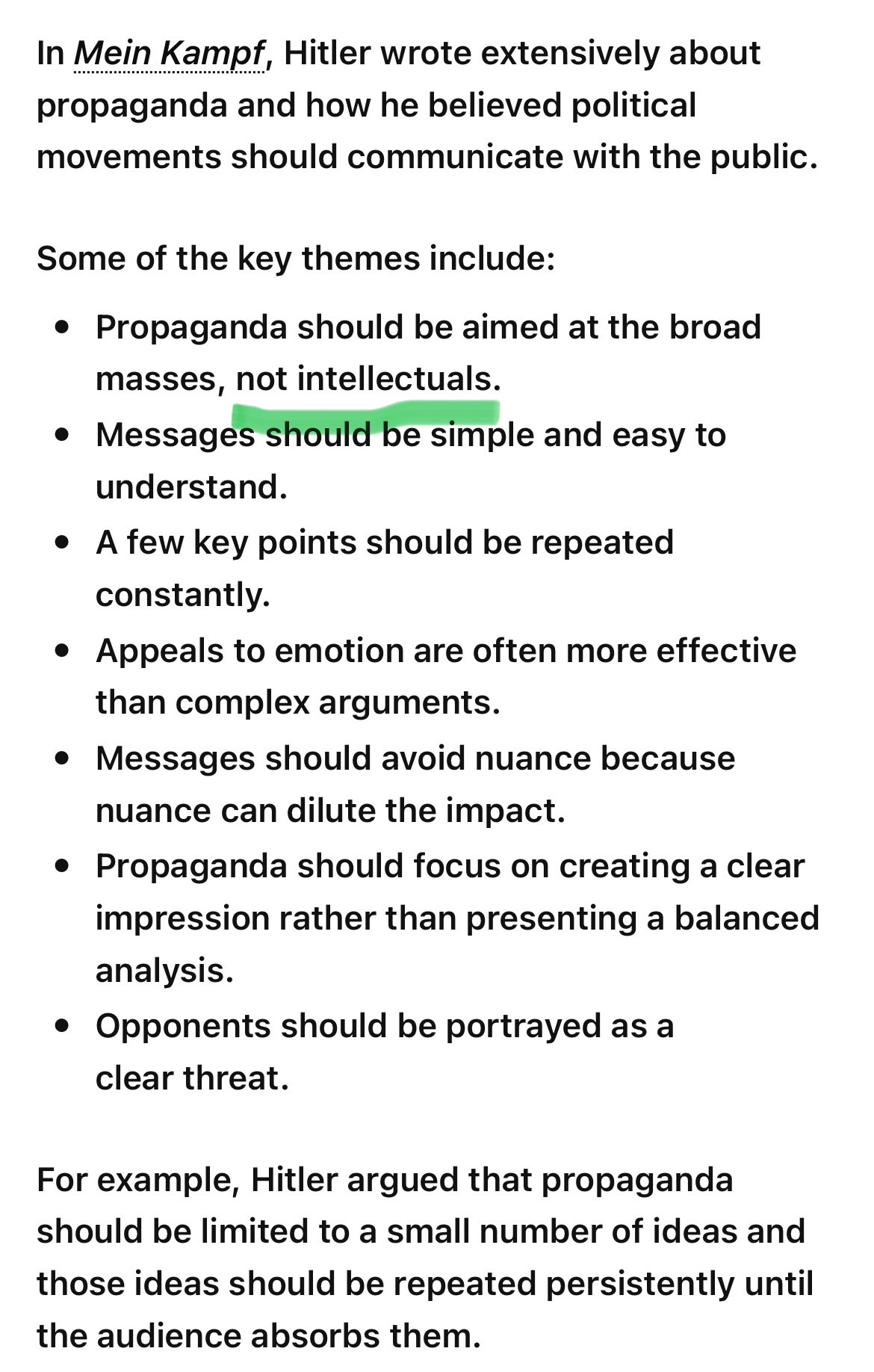
- Keep messages simple and avoid complexity
- Repeat a few key ideas relentlessly until they become unquestioned truths
- Appeal to emotion rather than reason
- Strip out nuance because it weakens impact
- Create clear enemies and frame them as existential threats
- Focus on creating impressions, not balanced analysis
- Never acknowledge opposing viewpoints have merit
Hitler argued that propaganda should limit itself to "a few points" repeated "persistently" until even the least attentive member of society has absorbed them. He explicitly rejected the academic approach of presenting multiple perspectives or acknowledging complexity. In his view, propaganda's job was to create a singular, powerful impression, not to educate or inform. Here's the uncomfortable truth: these techniques work, and they didn't originate with Hitler. Edward Bernays, often called the father of public relations, used similar methods in the 1920s to sell everything from cigarettes to war bonds. Modern advertising relies on repetition (think of any jingle you can't forget), emotional triggers (insurance ads featuring family tragedies), and simple messages ("Just Do It"). Political campaigns in 2026 still reduce complex policy debates to three-word slogans and repeated attack lines. The techniques are neutral, the application determines whether they're used to sell sneakers or scapegoat minorities. Research from Yale University's Program on Climate Change Communication and the University of Pennsylvania's Annenberg Public Policy Center has consistently found that simple, emotionally resonant messages outperform detailed policy arguments in changing behavior and attitudes. A 2023 study in the Journal of Experimental Political Science found that voters exposed to simplified, emotionally charged campaign messages were 40% more likely to remember the candidate's position than those who received nuanced policy briefings. The intellectuals might prefer the briefing, but they're not the target audience. Why intellectuals specifically? Hitler believed educated elites were already politically committed and harder to sway. They had frameworks for analyzing information and resisted crude emotional appeals. Worse, from a propagandist's perspective, they might publicly criticize the message and create doubt among others. The masses, he argued, had no such filters. They responded to strength, certainty, and emotion. They wanted simple answers to complex problems. Give them an enemy to blame, a hero to follow, and a slogan to chant, and you could move mountains. The danger wasn't the techniques themselves but what Hitler layered onto them: dehumanization, conspiracy theories, scapegoating of Jews and other minorities, and authoritarian goals. When you combine effective communication methods with genocidal ideology, you get the Third Reich. When you combine them with selling soap, you get Procter and Gamble. The tool is morally neutral until you examine what it's building. Now here's where it gets genuinely terrifying: social media algorithms have industrialized Hitler's propaganda playbook at a scale he could never have imagined. X (formerly Twitter), Facebook, TikTok, Instagram, every major platform optimizes for "engagement," which is corporate speak for emotional reaction. The algorithms don't reward nuanced policy analysis or careful fact-checking. They reward simple, emotional, repetitive content that makes people angry, afraid, or outraged enough to share. A 2024 study from MIT's Media Lab found that false information spreads six times faster on X than accurate information, precisely because lies can be simpler and more emotionally satisfying than complex truth. The platforms have essentially automated the exact propaganda techniques Hitler described. Their recommendation engines push users toward increasingly extreme content because extreme content generates engagement. Their autoplay features create repetition loops where you see the same simple message dozens of times across different accounts. Their design actively discourages reading long-form analysis (X's character limits, TikTok's video format, Instagram's visual focus). They've built Hitler's dream propaganda machine, except it runs on advertising revenue instead of totalitarian ideology. What makes this especially dangerous is the lack of independent verification. When you see a claim on X, X's Community Notes system is the fact-check mechanism, but it's crowdsourced from X users with all their biases and manipulation potential. When you see a claim on Facebook, Meta's fact-checkers are chosen and paid by Meta. When you see a claim on TikTok, ByteDance controls what gets flagged. The platforms are marking their own homework, and they have every financial incentive to let engaging (read: emotionally manipulative) content spread. There's a straightforward solution that platforms will fight tooth and nail: mandatory independent fact-checking. Every post containing a factual claim should have a fact-check button that routes to an AI system operated by a competitor. X posts get checked by Claude (Anthropic) and ChatGPT (OpenAI). ChatGPT results get checked by Grok (xAI) and Claude. Claude outputs get checked by Grok and ChatGPT. Rotate the systems to prevent any single company from becoming the arbiter of truth. Make it a legal requirement, like nutrition labels on food. The technology exists right now. A consortium of AI companies could build this in six months. The only obstacle is political will and corporate resistance. Why would this matter? Because right now, a false claim can circulate for days or weeks before any fact-check catches up, and by then millions have already absorbed it through repetition (Hitler's key technique). An instant, independent fact-check button means the nuance and complexity Hitler wanted to eliminate could travel alongside the simple emotional claim. Users could choose to click or not, but at least the option exists. At least there's friction in the system. At least someone other than the platform profiting from engagement gets to weigh in. The platforms will argue this violates free speech, but requiring nutrition labels doesn't ban food, it informs consumers. They'll argue it's technically impossible, but they already have the API (Application Programming Interface) infrastructure to call external services for ads, they can do it for facts. They'll argue it's too expensive, but they're spending billions on content moderation already, and this would be cheaper and more consistent. The real reason they'll resist is simpler: fact-checking reduces engagement, and engagement is their business model. A user who pauses to verify a claim is a user who isn't scrolling to the next ad. We're living through the scaled-up, algorithmically optimized version of the propaganda techniques Hitler theorized about in 1925. The difference is that instead of one dictator controlling the message, we have decentralized manipulation where anyone can deploy these techniques and the platforms amplify whoever does it most effectively. That's arguably more dangerous, because there's no single point of failure to resist or reform. It's propaganda as infrastructure, propaganda as the water we swim in, propaganda so constant and varied that we've stopped recognizing it as propaganda at all.