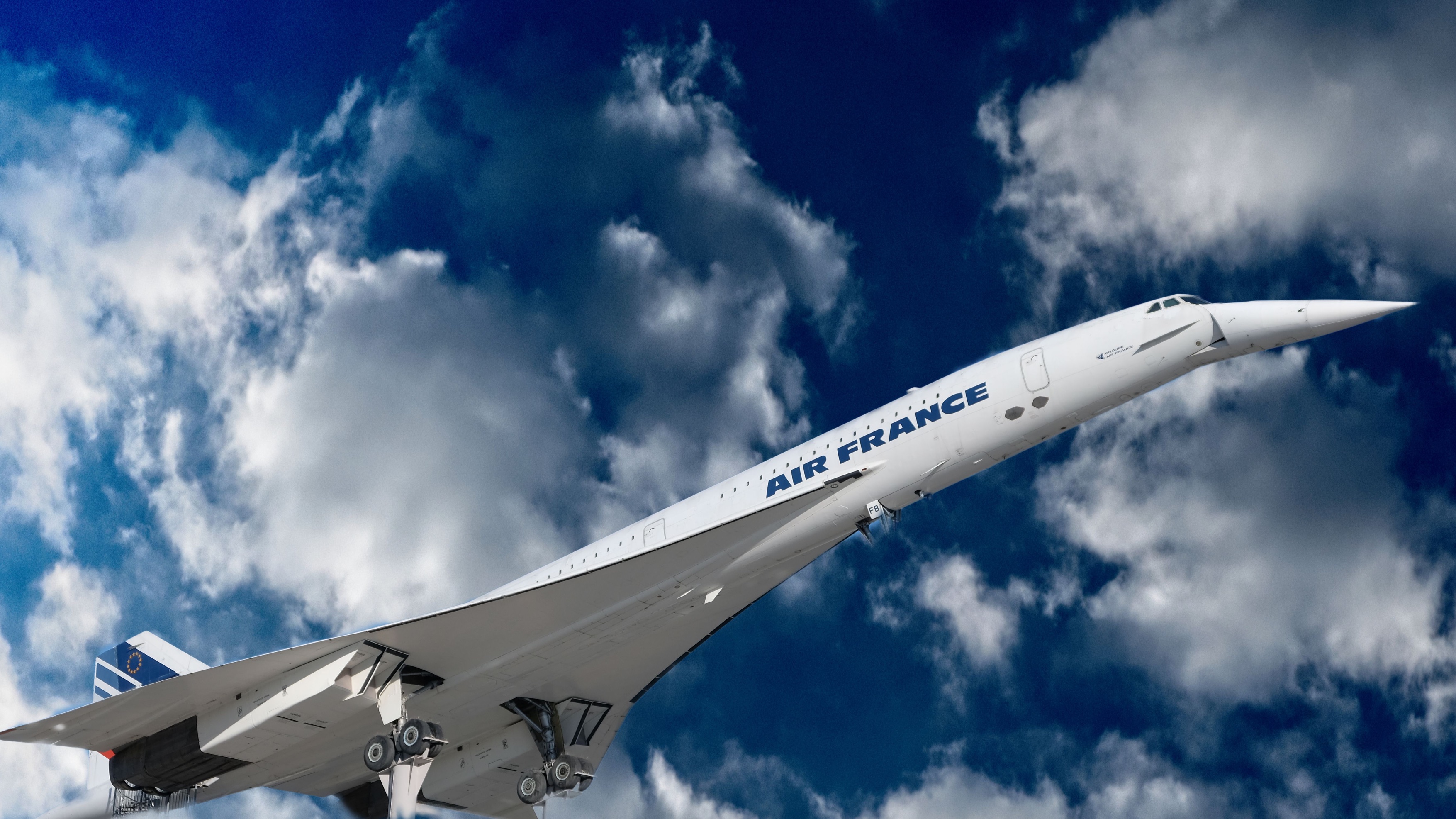
The Concorde was a magnificent failure. It could cross the Atlantic in three and a half hours, but it guzzled fuel like a Formula One car, rattled windows with sonic booms, and cost a fortune to operate. When Air France Flight 4590 crashed in 2000, killing 113 people, it was the beginning of the end. By 2003, both Air France and British Airways had permanently grounded their fleets. The dream of routine supersonic travel died with a whimper, not a bang. But here's the thing about dreams in aviation: they never really die, they just get reengineered. Right now, we're in the middle of a supersonic renaissance that makes the Concorde look like a prop plane. Boom Supersonic, a Denver-based startup backed by American Airlines and United Airlines, is building the Overture, a Mach 1.7 aircraft designed to carry 64 to 80 passengers. The company just broke ground on its manufacturing facility in Greensboro, North Carolina in 2024, with plans for commercial service starting around 2029. United has already placed orders for 15 aircraft with options for 35 more. The price point? Boom claims tickets will cost about the same as current business class fares, not the stratospheric $12,000 round-trip Concorde tickets (adjusted for inflation). Then there's NASA (National Aeronautics and Space Administration), which is taking a different approach entirely. The X-59 QueSST (Quiet SuperSonic Technology) aircraft, built by Lockheed Martin, is designed to create a sonic "thump" instead of a boom, measuring around 75 decibels instead of the Concorde's ear-splitting 105. The aircraft completed its rollout in 2024 and is currently in flight testing phase. If successful, it could convince the FAA (Federal Aviation Administration) to lift the 1973 ban on overland supersonic flight in the United States, which has been the single biggest regulatory barrier to commercial supersonic travel. NASA plans to fly the X-59 over several U.S. communities starting in 2026 to gather data on public response to the quieter sonic signature. But supersonic is just the appetizer. The main course is hypersonic, and it's absolutely bonkers. Hypersonic flight means Mach 5 and above (over 3,800 mph), and several companies are dead serious about making it happen for commercial passengers. Venus Aerospace, based in Houston, is developing Stargazer, a hypersonic spaceplane designed to carry 12 passengers at Mach 9, which would make a San Francisco to Tokyo flight take one hour instead of eleven. The company completed a successful test of its rotating detonation rocket engine in 2024, a breakthrough that dramatically improves fuel efficiency at hypersonic speeds. Hermeus, another startup, is working on Quarterhorse, a Mach 5 aircraft initially designed for military applications but with clear commercial ambitions. The company has already secured contracts with the U.S. Air Force and completed multiple flight tests of their engine technology. The technological hurdles are immense, but they're being knocked down one by one. Modern computational fluid dynamics and materials science have solved problems that were science fiction in the Concorde era. New titanium alloys and ceramic matrix composites can withstand the extreme heat generated at hypersonic speeds (the nose of a Mach 9 aircraft reaches temperatures over 3,000 degrees Fahrenheit). Engine designs like rotating detonation engines and combined cycle propulsion systems promise fuel efficiency that would make hypersonic flight economically viable. Sustainable aviation fuel (SAF) development is advancing rapidly, addressing the environmental concerns that plagued the Concorde. Companies like Boom are designing their aircraft to run on 100% SAF from day one. Here's the blue-sky thinking that could actually happen: by 2035, we could see a three-tiered aviation market. Subsonic flights (what we have now) become the budget option, like taking the bus. Supersonic flights, operating on carefully planned routes that avoid populated areas or using quiet boom technology for overland routes, become the new business class standard, shaving hours off long-haul flights. And hypersonic point-to-point spaceplanes, initially serving ultra-premium passengers and urgent cargo, begin to establish routes between major global hubs. Imagine boarding a spaceplane in New York at 7 AM and arriving in Sydney at 9 AM the same day, having traveled through the edge of space at Mach 7. The aircraft would use rocket engines to reach suborbital altitude, cruise above most of the atmosphere (reducing drag and sonic boom concerns), then glide down to the destination. The wildest part? Some engineers are thinking even bigger. Reaction Engines in the UK is developing SABRE (Synergistic Air-Breathing Rocket Engine), a hybrid engine that breathes air like a jet at low speeds but switches to rocket mode for space access. Their ultimate vision is a single-stage-to-orbit spaceplane that could theoretically reach any point on Earth in under two hours, or continue into orbit for space tourism or satellite deployment. SpaceX's Starship, while primarily designed for Mars missions, has been explicitly mentioned by Elon Musk as a potential Earth-to-Earth transport system, with theoretical flight times of 30 minutes for anywhere on the planet. It sounds absurd until you remember that reusable rockets were considered impossible fantasy until SpaceX made them routine.
 💻 technology
Supersonic Travel Is Back, And It's Getting Wild
The Concorde died in 2003, a victim of bad economics and worse optics. But two decades later, supersonic flight is roaring back with a vengeance. The question isn't if we'll break the sound barrier again, but when we'll shatter every speed record imaginable.
My Take
The return of supersonic travel is inevitable, but hypersonic is where things get genuinely revolutionary. We're not talking about incremental improvements, we're talking about fundamentally changing how humans think about distance and time. A world where you can have breakfast in London, lunch in Singapore, and dinner back home in Los Angeles isn't science fiction anymore, it's engineering. The real barrier isn't technology, it's regulatory courage and environmental responsibility. The FAA and international aviation authorities need to move faster on updating decades-old rules written when Nixon was president. At the same time, these aircraft absolutely must be designed for sustainability from the ground up. We can't repeat the Concorde's mistake of treating fuel efficiency and environmental impact as afterthoughts. The good news is that modern companies seem to understand this. Boom, Venus, and Hermeus are all incorporating SAF compatibility and efficiency improvements that the Concorde engineers never imagined. If I had to bet, supersonic commercial service returns by 2030, hypersonic test routes launch by 2040, and by 2050, my kids will think it's perfectly normal to vacation on another continent for a long weekend. The age of slow travel is ending, and frankly, it's about damn time.
What Happens Next
The X-59 community overflights in late 2026 and 2027 will be the inflection point. If the data shows people genuinely don't mind the sonic thump, the FAA will face enormous pressure to revise overland supersonic rules by 2028, and that's when the floodgates open. Boom will push hard to get Overture certified and flying by 2029, and United will want to launch service on its most premium routes immediately (think Newark to London, San Francisco to Tokyo). If the first year of commercial supersonic service goes smoothly with no major incidents, you'll see every major airline scrambling to place orders. The wildcard nobody's talking about enough is China. While American and European companies are playing by Western certification rules, Chinese aerospace manufacturers have been quietly developing their own supersonic and hypersonic programs with far fewer regulatory constraints. If a Chinese company debuts commercial hypersonic service first (even if it's just domestic routes initially), it will light a fire under Western aerospace like nothing else. The new space race won't be about reaching the Moon, it'll be about reaching the other side of the planet before lunch. The scenario that keeps aviation executives up at night isn't technological failure, it's a single catastrophic accident. If a next-generation supersonic aircraft goes down in the first five years of commercial service, especially with casualties, it could set the entire industry back two decades just like the Concorde crash did. That's why these companies are being obsessively cautious with testing and certification, even if it means delaying service launches. One disaster could kill the dream for another generation. But if they get it right, if supersonic becomes as safe and routine as subsonic flight is today, then hypersonic becomes not just possible but inevitable. And after that? The only limit is physics, and even physics has been known to negotiate.
What History Tells Us
The Concorde's commercial service from 1976 to 2003 represents aviation's first major step backward. After decades of relentless progress toward faster, higher, farther, the industry retreated to slower subsonic aircraft because they were simply more profitable. It's reminiscent of how the Apollo program put humans on the Moon in 1969, then NASA didn't return for over 50 years. Both cases show that technological capability doesn't guarantee commercial viability or sustained public support. The Soviet Union's Tupolev Tu-144, often called "Concordski," flew even before the Concorde but suffered from worse economics and a fatal crash at the 1973 Paris Air Show. It lasted only two years in passenger service (1975-1977). The parallel lesson: being first matters less than being sustainable. Today's supersonic revival seems to have learned from both the Concorde's operational failures and the Tu-144's safety disasters. Modern companies are prioritizing economics and safety over pure speed records, which suggests they might actually stick around this time.
Market Impact
Boom Supersonic remains private, but its major backers (United Airlines and American Airlines Group) have significant skin in the game. United Airlines Holdings (UAL, currently trading around $45 after recent volatility) and American Airlines Group (AAL, around $12) have placed orders worth billions if Boom delivers. A successful Overture test flight program in 2027-2028 would likely boost both stocks as investors price in competitive advantages in premium long-haul markets. The aerospace manufacturing sector stands to benefit enormously. General Electric (GE, trading near $165) is developing engines for supersonic applications through its partnership with Boom. Lockheed Martin (LMT, around $440) is building NASA's X-59 and has deep expertise in supersonic flight from military programs. The real speculative play is in advanced materials and propulsion systems. Companies developing ceramic matrix composites, titanium alloys, and specialized coatings could see massive orders if hypersonic aviation takes off. Hexcel Corporation (HXL) and Howmet Aerospace (HWM) are established players in advanced aerospace materials, currently trading around $60 and $95 respectively. A successful demonstration of commercial hypersonic flight by 2028-2030 would likely drive significant gains in this sector. Conversely, a major setback or accident would crater these stocks as the entire supersonic/hypersonic sector faces renewed scrutiny. The risk-reward ratio is enormous, which is exactly what makes this market so compelling for investors with long time horizons.