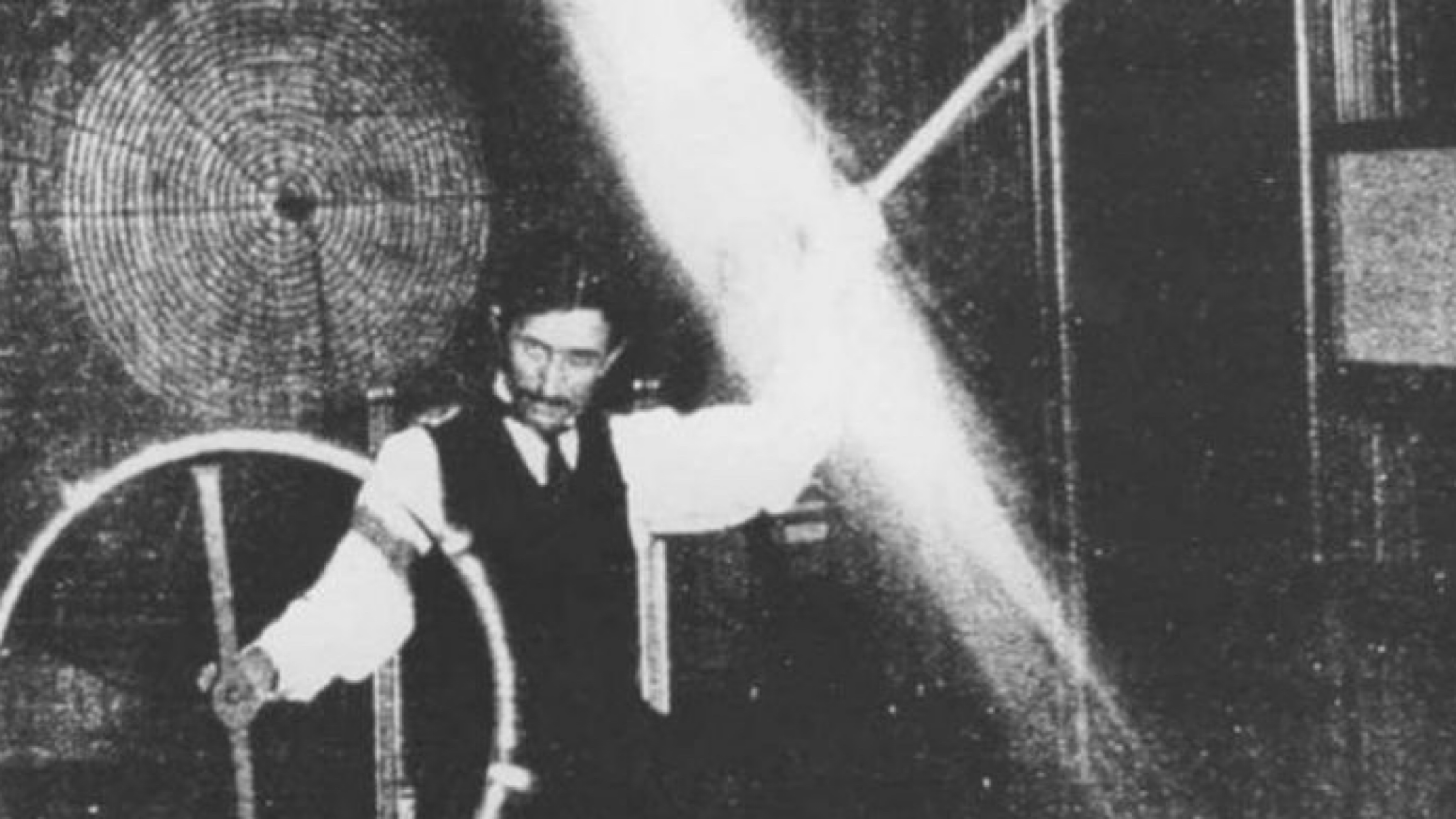
Nikola Tesla walked into the New Yorker Hotel on January 7, 1943, fed pigeons on the windowsill, and died alone with unpaid bills stacking up. The man who gave us alternating current (AC) power distribution, the induction motor, and the Tesla coil spent his final years pitching particle beam weapons to the War Department and ranting about wireless energy transmission. His contemporaries thought he'd lost it. Eighty three years later, Tesla's "crazy" ideas are literally reshaping civilization. If Tesla materialized in 2026, he'd probably have a mental breakdown in the first 48 hours, then immediately start fixing things. Wireless charging pads? Child's play compared to his Wardenclyffe Tower vision of beaming electricity through the atmosphere. Electric vehicle infrastructure? He invented the AC induction motor in 1887 that now powers every Tesla Model 3 rolling off the Fremont assembly line. The global renewable energy transition? Tesla was screaming about hydroelectric power and "free energy from nature" when Thomas Edison was still burning coal to light up Pearl Street. According to research from the Tesla Science Center at Wardenclyffe, his 1901 plans for wireless power transmission anticipated modern resonant inductive coupling by a century. Tesla's patent portfolio reads like a blueprint for modern civilization. His most significant patents include:
- U.S. Patent 381,968 (May 1888): Electro Magnetic Motor - the polyphase AC induction motor that powers everything from factory equipment to electric cars today
- U.S. Patent 382,280 (May 1888): Electrical Transmission of Power - the system for transmitting AC electricity over long distances
- U.S. Patent 381,970 (May 1888): System of Electrical Distribution - Tesla's polyphase power distribution system still used globally
- U.S. Patent 454,622 (June 1891): System of Electric Lighting - high frequency alternators for efficient lighting
- U.S. Patent 645,576 (March 1900): System of Transmission of Electrical Energy - the theoretical foundation for wireless power transmission
- U.S. Patent 649,621 (May 1900): Apparatus for Transmission of Electrical Energy - the practical apparatus for wireless transmission, basis for Wardenclyffe Tower
- U.S. Patent 685,012 (October 1901): Means for Increasing the Intensity of Electrical Oscillations - the Tesla coil transformer used in radio transmission
- U.S. Patent 723,188 and 725,605 (March 1903): System of Signaling and Apparatus for Signaling - radio transmission systems that predate Marconi's widely recognized patents
- U.S. Patent 1,061,142 (May 1913): Turbine - Tesla's bladeless turbine design for engines
- U.S. Patent 1,119,732 (December 1914): Apparatus for Transmitting Electrical Energy - advanced wireless transmission methods
- U.S. Patent 1,655,114 (January 1928): Method of Aerial Transportation - vertical takeoff and landing aircraft concepts
Here's the brutal reality: every single one of Tesla's patents has expired. U.S. utility patents filed before June 1995 lasted 17 years from issue date; patents filed after that get 20 years from filing date. Tesla's last patent was issued in 1928, meaning it expired by 1945 at the latest. The entire Tesla patent portfolio entered the public domain between the 1900s and 1940s. This is precisely why modern companies can freely use his AC motor designs, Tesla coil configurations, and wireless transmission principles without paying a cent in royalties. It's also why Tesla Inc. could legally name itself after him without licensing fees. The irony is savage: if Tesla's patents were still valid under modern law (20 years from filing), some filed in the early 1900s would have only expired in the 1920s. But even if we applied today's patent terms retroactively, everything would have expired by 1948. Tesla's most revolutionary work, the wireless power transmission patents from 1900 to 1914, has been free to use for nearly 80 years. Yet nobody successfully commercialized it at scale until companies like WiTricity (founded 2007, based on MIT research) and Emrod (founded 2019) started applying modern materials science to his century old designs. Here's what a resurrected Tesla could actually accomplish in today's world:
- Fix the electrical grid: Tesla's original AC polyphase system from the 1890s still underpins global power distribution, but it's a patchwork mess. He'd take one look at the Texas grid failures during Winter Storm Uri (February 2021, 246 deaths, $195 billion in damages) and redesign the whole thing with distributed generation and wireless backup systems. His 1893 work on high frequency alternators directly applies to modern smart grid frequency regulation.
- Crack wireless power at scale: Wardenclyffe Tower failed in 1906 because J.P. Morgan pulled funding ("if anyone can draw on the power, where do we put the meter?"). Today's venture capital ecosystem would throw billions at scalable wireless transmission. Current wireless charging tops out around 15 watts over inches; Tesla's resonant transformer patents describe megawatt scale transmission over miles. A 2021 study in IEEE Transactions on Power Electronics confirmed the mathematical feasibility using modern materials.
- Revolutionize renewable storage: Tesla's obsession with high frequency alternating currents and his experiments with earth resonance at Colorado Springs (1899) presaged modern concepts in supercapacitors and grid scale energy storage. He'd look at lithium ion gigafactories and immediately start sketching solid state alternatives using his rotating magnetic field principles. His 1891 lectures at Columbia described energy storage through magnetic field rotation, essentially a blueprint for flywheel energy storage systems now deployed by Beacon Power and others.
- Rebuild electric aviation: Tesla proposed electric aircraft propulsion in a 1928 interview, describing "a perfectly smooth, noiseless plane driven by electric motors." He'd tear into today's battery chemistry limitations (current lithium ion delivers roughly 250 Wh/kg; jet fuel packs 12,000 Wh/kg) and probably pivot to his wireless power transmission ideas for in flight charging corridors. Airbus and Boeing are currently hemorrhaging cash on hybrid electric concepts that Tesla would solve with resonant coupling stations along flight paths.
- Expose the quantum computing bottleneck: Tesla's intuitive understanding of wave resonance and his experiments with high frequency electromagnetic phenomena put him decades ahead on quantum coherence concepts. He'd walk into an IBM quantum lab, look at the dilution refrigerators keeping qubits at 15 millikelvin, and start sketching room temperature superconductor designs based on his 1899 notes about earth's electromagnetic resonance (the Schumann resonance, confirmed in 1952).
The real tragedy is what Tesla couldn't do in his own era. He filed over 300 patents but died with $2,000 in debts. His Wardenclyffe project collapsed because investors wanted metered electricity, not free wireless power. George Westinghouse bought his AC patents in 1888, then tore up the royalty contract in 1897 to save Westinghouse Electric from bankruptcy, costing Tesla millions. According to Smithsonian Institution records, Tesla's estate was seized by the Office of Alien Property (he was a Yugoslav citizen) and his papers weren't declassified until 1952. Imagine if he'd had Y Combinator funding and access to modern semiconductors. Today's tech giants are essentially executing Tesla's century old roadmap. SpaceX's Starlink constellation? Tesla proposed global wireless communication via ionospheric reflection in 1904. Tesla Powerwall batteries? Named after a guy who described distributed home energy storage in 1931. The wireless charging mat under your iPhone? Tesla demonstrated wireless power transfer at the 1893 World's Columbian Exposition in Chicago. Even DARPA's directed energy weapons research traces back to Tesla's "teleforce" particle beam proposals from 1937. A 2019 analysis in the journal "Technology and Culture" documented how 23 separate modern technologies directly cite Tesla's original patents. The man was so far ahead that we're still catching up. His 1900 article "The Problem of Increasing Human Energy" reads like a Singularity University whitepaper, proposing solar power, geothermal energy, and even artificial intelligence through "self acting" machines. If Tesla were alive today, he wouldn't just work for a tech company, he'd probably start three, revolutionize energy and transportation, then get canceled on Twitter for his bizarre pigeon obsession and his lifelong celibacy pact. But give him a lab, a budget, and some patience for 21st century bureaucracy, and he'd solve climate change before his first TED Talk.