For the past several days a river of charged particles moving far faster than the Sun's normal exhale has been sweeping past Earth, and the planet has barely blinked. The source is a coronal hole, a gap in the Sun's outer atmosphere where the magnetic field opens straight out into space instead of looping back down, letting solar material escape at speeds that can top 700 kilometres a second. According to the US Space Weather Prediction Center's own three day outlook issued this week, a positive polarity coronal hole high speed stream was the driver, and forecasters concluded that no G1 or stronger geomagnetic storm was expected because of it. That sounds like a non-event, and mostly it was. Solar wind observers tracking the arrival described conditions holding at Kp 4 for most of a day, the marker of an unsettled to active magnetic field that sits just below the threshold NOAA uses to declare an official storm. Kp 5 is where the G1 minor storm category begins. This stream nudged the needle without crossing the line, then began to fade, with forecasters expecting quiet to unsettled conditions afterward as the stream's influence tapered off. Coronal holes are not rare, dramatic, or even particularly newsworthy events. They form when the Sun's magnetic field fails to trap the outward flowing plasma, most often near the solar poles but sometimes rotating down into positions that point directly at Earth. Because the Sun rotates roughly once every 27 days, a long lived coronal hole can swing back into an Earth facing position again and again, delivering the same modest jolt of fast wind on a schedule regular enough that space weather physicists sometimes call these recurring events co-rotating interaction regions. Researchers studying the Czech power grid have described how these regions form when a stable fast stream from a coronal hole plows into the slower solar wind ahead of it, compressing the plasma and magnetic field into a turbulent boundary that reaches Earth every solar rotation for as long as the hole persists. The reason the public almost never hears about any of this comes down to scale and timing. Coronal mass ejections, the Sun's genuinely violent outbursts, hurl billion tonne clouds of magnetised plasma outward in a single explosive burst, and when one is aimed at Earth, satellites like NOAA's DSCOVR (Deep Space Climate Observatory), parked a million miles away at the L1 gravitational balance point, can typically give only 15 to 60 minutes of warning before the shock front arrives. Coronal hole streams are the opposite kind of threat. They are slow building, well understood, and because the hole itself can be watched rotating across the solar disk for a week before its stream lines up with Earth, forecasters often see them coming days in advance. Predictable and survivable does not make headlines the way sudden and spectacular does, so the steady background hum of these events passes almost entirely unremarked outside specialist bulletins. There is also a seasonal twist working in the background right now. Earth just passed through the September equinox, and geomagnetic activity reliably spikes around both equinoxes due to a well documented mechanism called the Russell-McPherron effect, named for the geophysicists who first described it in 1973. The geometry of Earth's orbit around the equinoxes makes it statistically more likely that the interplanetary magnetic field carried on the solar wind will point southward relative to Earth's own field, and a southward pointing field couples far more efficiently with the magnetosphere, feeding more energy in and making auroras and minor storms more likely for a given solar wind speed. It is why aurora chasers talk about an aurora season clustered around March and September regardless of where the 11 year solar cycle happens to sit. That cycle context matters too. Solar Cycle 25 hit its peak sunspot activity around October 2024, and researchers now generally agree the Sun has entered the declining phase of the cycle, a trend expected to continue through 2026 and beyond. Fewer sunspots means fewer flares and fewer coronal mass ejections, but coronal holes do not follow the same rulebook. They tend to become more prevalent and persistent in the years around solar minimum, so as the dramatic Sun quiets down, the steady drip of coronal hole streams becomes proportionally a bigger share of the space weather Earth actually experiences. None of this stopped anything on the ground this week. There was no radio blackout warning, no radiation storm, no grid operator bulletin about induced currents. When a coronal hole stream does get strong enough to matter, the physics is well catalogued: geomagnetically induced currents in long conductors like power transmission lines and pipelines, degraded accuracy in GPS (Global Positioning System) signals as the ionosphere gets disturbed, and drag on low orbit satellites as the upper atmosphere heats and expands. Researchers modelling the Czech transmission grid have traced exactly this chain, from the ionospheric disturbance that scrambles radio wave propagation and GPS accuracy through to the currents induced in the ground itself. This week's stream simply was not strong enough to push any of that machinery into the danger zone.
 🔬 science
The Sun Keeps Hitting Us and Nobody Notices
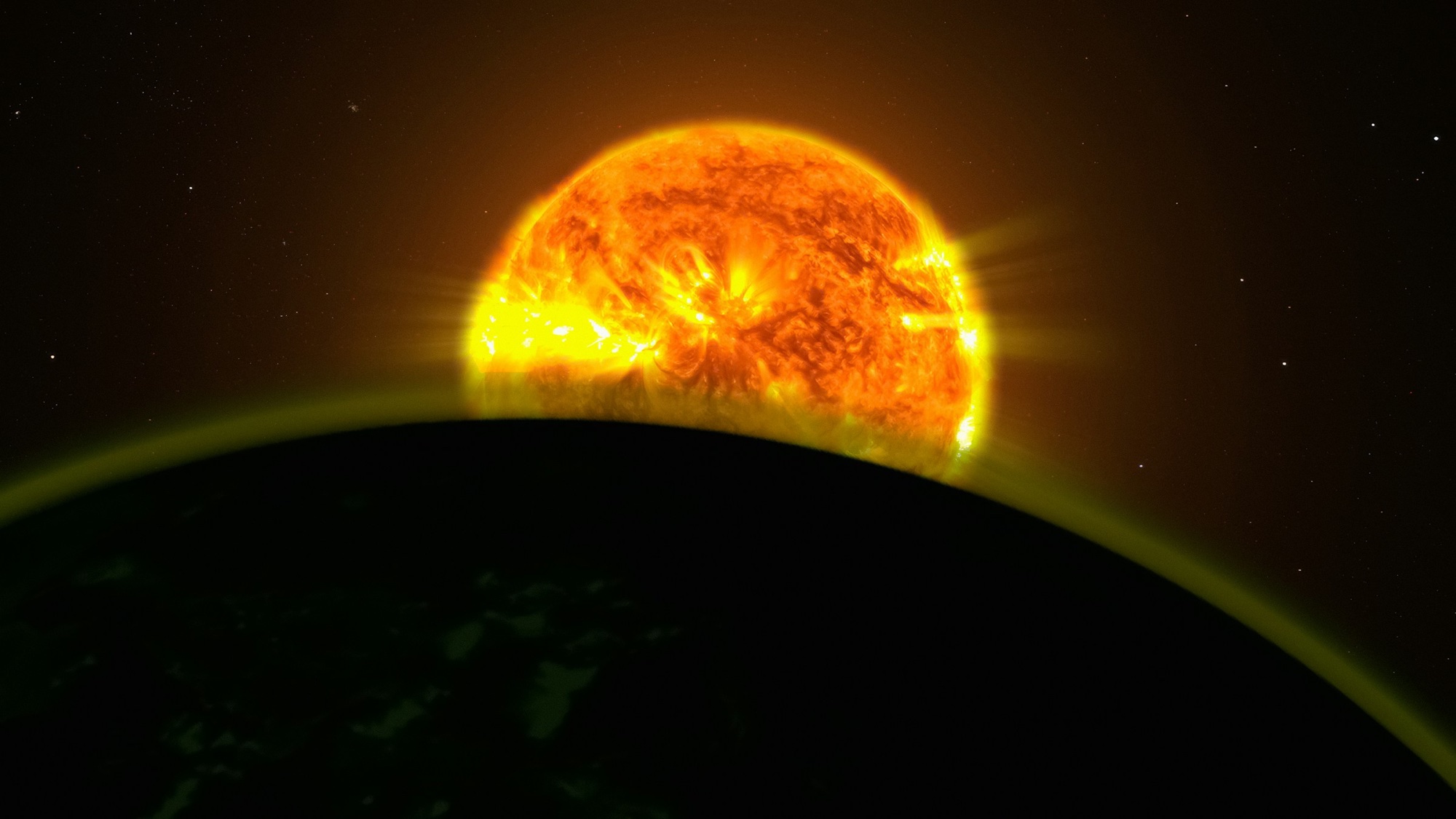
A fast stream of solar wind pouring out of a hole in the Sun's atmosphere has been buffeting Earth's magnetic field all week, nudging conditions to active levels without tripping a single storm warning. It is the most ordinary kind of space weather there is, and that is exactly why almost nobody outside a small community of forecasters ever hears about it.
My Take
The instinct to treat 'the Sun did something to Earth' as automatically alarming is understandable and almost always wrong. Space weather forecasters spend their working lives watching a slow, largely benign conveyor belt of solar wind streams roll past the planet, and the loudest thing that happens most weeks is a Kp index nudging up to 4 and a few extra aurora photos out of Scandinavia. That is not a cover up. It is just not a story, and treating every coronal hole as a countdown to catastrophe does a disservice to the actual science, which is genuinely fascinating without any embellishment. What should worry people, mildly, is not this week's stream but the complacency it can breed. The infrastructure that would actually suffer in a serious event, transformers, GPS dependent logistics, satellite constellations that keep multiplying in low Earth orbit, has never been tested against a truly extreme storm in the modern digital era. The 2024 Gannon storm reached G5 extreme levels and gave researchers a real world stress test, compressing Earth's plasmasphere and disturbing ionospheric conditions across entire continents. Events at that scale happen roughly once every 20 to 25 years. The gap between routine coronal hole hums like this one and a Carrington scale monster is enormous, and the public's inability to tell the two apart is the actual problem, not the Sun. Give forecasters credit here. The three to four day lead times now achievable for coronal hole streams, and the frameworks tracking recurring co-rotating interaction regions across solar rotations, represent real, unglamorous scientific progress that rarely gets a headline of its own. That is precisely why it is worth writing about occasionally, on a week when nothing happened, so that the next time something does happen, people have some sense of the difference between a shrug and a genuine emergency.
What Happens Next
The current stream is already waning, with forecasters expecting quiet to unsettled conditions as its influence fades out over the next day or so, though isolated active periods and a chance of aurora at high latitudes remain possible through the tail end of the disturbance. Because the Sun rotates roughly every 27 days, the same coronal hole could swing back into an Earth facing position in late October, potentially delivering a near identical, near invisible repeat performance if the hole survives that long, which persistent holes near solar minimum often do. Looking further out, the bigger structural story is the continuing decline of Solar Cycle 25 from its October 2024 peak. Expect coronal mass ejections and X class flares to keep tapering off through the rest of 2026, while coronal hole driven streams, less flashy but more persistent, make up a growing share of the space weather agencies actually have to track. NOAA's Space Weather Prediction Center will keep issuing its three day and 27 day outlooks through routine channels, and satellite operators and grid managers will keep quietly absorbing the minor jolts without public announcement, which is exactly the system working as intended. The one scenario worth actually watching for is a large, long duration coronal hole opening up near the solar equator and staying Earth facing for an extended stretch, since a genuinely fast, genuinely persistent stream can still produce isolated G2 or G3 storms even during a declining solar cycle. Nothing on the current forecast horizon suggests that is imminent, but it is the kind of development specialist bulletins would flag well before it became a headline anywhere else.
What History Tells Us
The benchmark for how bad this can get remains the Gannon superstorm of May 2024, a G5 extreme event triggered by a series of coronal mass ejections from a single, unusually large active region, which compressed Earth's plasmasphere and pushed auroras to unusually low latitudes across multiple continents. Superstorms of that intensity occur roughly once every 20 to 25 years, making this week's coronal hole stream, which never even reached the minor G1 threshold, a difference not just of degree but of an entirely different category of event.