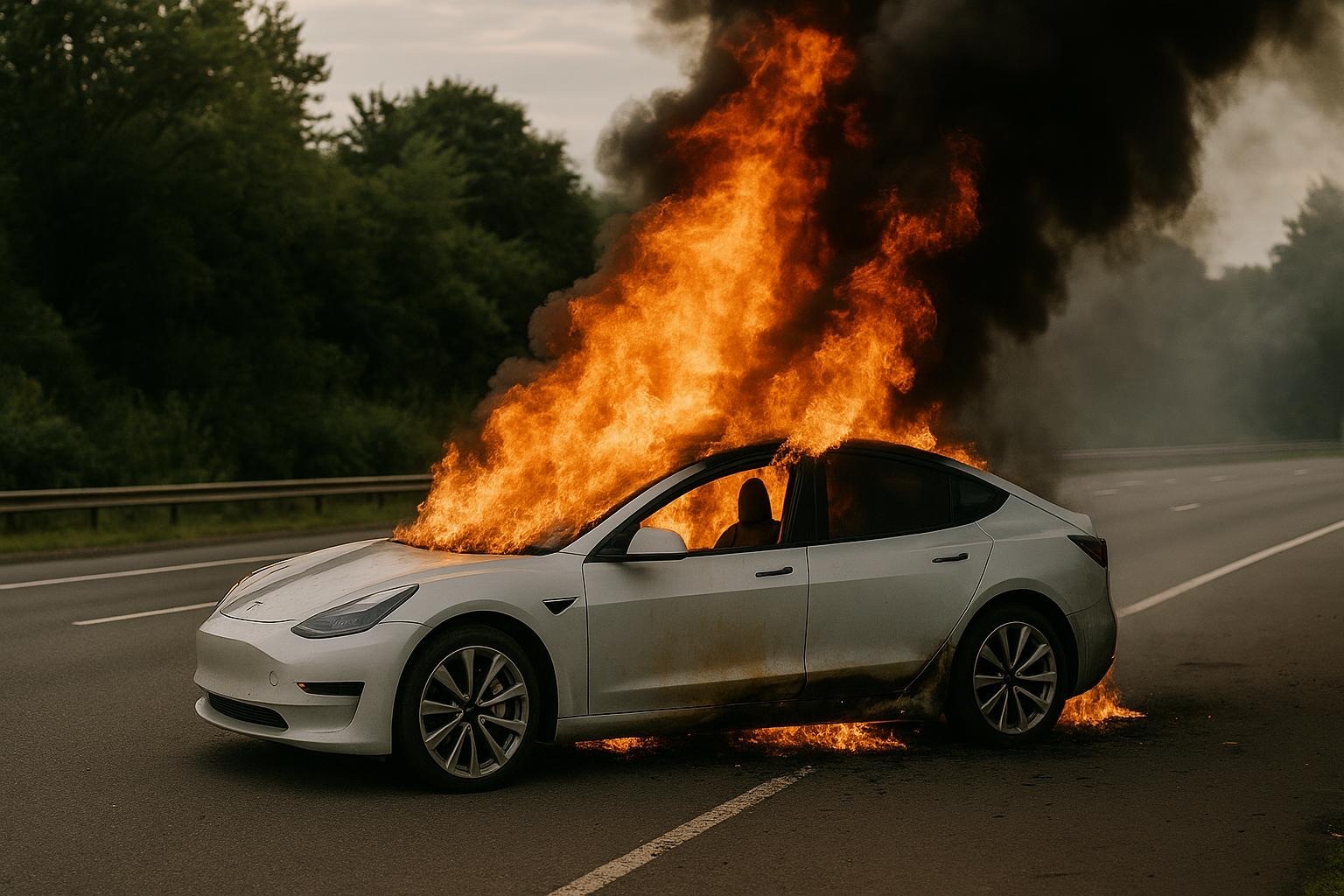
Just after 1 a.m. on October 29, 2025, Samuel Tremblett lost control of his 2021 Tesla Model Y on Route 138 in Easton, Massachusetts, near the Raynham town line. The car veered off the northbound lane, crossed into the southbound lane, and slammed into a tree about 20 feet into the woods. The impact was violent, but Tremblett survived it. He was conscious. He had his phone. He called 911. "I'm stuck in a car crash," he told the dispatcher, his voice urgent. "I can't get out, please help me." The Tesla had erupted into flames immediately after impact, and Tremblett was trapped inside. "I can't breathe. It's on fire. Help please. I'm going to die." The transcript of that call, included in the wrongful death lawsuit his mother filed in February 2026, is harrowing. As the fire intensified, his pleas became more desperate: "I'm dying. Help. Help." First responders arrived quickly, but they couldn't save him. Body camera footage shows officers approaching the fully engulfed vehicle, flames shooting from every window. "I can't even hit it with the fire extinguisher," one officer radioed to dispatch. "There was just one explosion." Police reported four explosions in the first 10 minutes on scene. The lithium-ion battery pack had entered thermal runaway, a condition where damaged batteries overheat and ignite in a fast-spreading inferno that's nearly impossible to extinguish. It took firefighters four hours to put out the blaze. Samuel Tremblett's body was found in the back seat, burned beyond recognition. He died from catastrophic thermal injuries and smoke inhalation. The lawsuit filed by his mother, Jacquelyn Tremblett, in U.S. District Court for the District of Massachusetts alleges that Tesla's "unreasonably dangerous design" killed her son. The 2021 Model Y, like most Tesla vehicles since 2014, features sleek, flush-mounted electronic door handles that extend automatically when you approach with the key fob. Inside, the door handles are also electronic, not mechanical. When the car loses power in a crash, which is exactly what happens when a battery system is damaged or an electrical fire starts, those handles stop working. The doors won't open from the inside or outside. Tesla does equip its vehicles with manual door releases, but the lawsuit argues they're not clearly marked or intuitive to use, especially for someone who needs to exit quickly while flames and smoke fill the cabin. In the Model Y, the front manual release is a small cable located near the window switches. The rear manual release is hidden under the carpet. Even if Tremblett knew about these releases, which most Tesla owners don't, finding and operating them while the car is on fire and filling with smoke is another matter entirely. The lawsuit doesn't specify whether Tremblett attempted to use the manual release, but it notes the "location and markings are not readily discernible." This isn't an isolated incident. According to a Bloomberg investigation cited in multiple lawsuits, at least 15 people have died in the past decade after becoming trapped in Teslas when the electric doors wouldn't open during emergencies. Other victims include Michael Sheehan, whose family filed a lawsuit after his Cybertruck caught fire in a 2024 crash in Baytown, Texas, and Jeffrey and Michelle Bauer, whose children claim the couple was trapped in their Tesla after a crash caused the electronic door systems to fail. In September 2025, the National Highway Traffic Safety Administration (NHTSA) opened a preliminary evaluation into 2021 Tesla Model Y vehicles after complaints that electronic door handles became inoperative due to low battery voltage, leaving children trapped inside and forcing adults to break windows. Samuel Tremblett was a Syracuse University student who worked as a model and had launched a successful clothing line as a fashion designer. He was from South Easton, Massachusetts. His mother is seeking $25 million in compensatory damages and demanding a jury trial. Tesla has not responded to the lawsuit or to multiple requests for comment from media outlets. In December 2025, two months after Tremblett's death, Tesla updated its website to state that after a serious collision is detected, the doors will automatically unlock for emergency access. But that feature may not work on older models like Tremblett's 2021 Model Y, and it does nothing for crashes where the electrical system fails before the collision detection system can trigger.
 🌍 world
Trapped and Burning: How Tesla Doors Killed Samuel Tremblett
Samuel Tremblett, a 20-year-old Syracuse University student, survived crashing his Tesla into a tree. What killed him was something far worse: he couldn't get out. As flames consumed his 2021 Model Y on a Massachusetts highway, the car's electronic door handles failed, turning a survivable accident into a death trap. His desperate 911 call, now part of a wrongful death lawsuit, exposes a design flaw linked to at least 15 deaths.
Fact checked - 15 claims 29 Aug 2026 · 14 with sources
My Take
This is corporate negligence dressed up as innovation. Tesla knew its door handle design was trapping people in burning cars and kept selling vehicles anyway. A Bloomberg investigation documented at least 15 deaths over a decade. Multiple lawsuits have been filed. The NHTSA opened investigations. And Tesla's response? A website update in December 2025, two months after Samuel Tremblett burned to death, promising that doors will "automatically unlock" in serious collisions. Too little, too late, and probably ineffective when the electrical system is already compromised. The fundamental problem is this: Tesla prioritized aesthetics and aerodynamics over basic survivability. Flush door handles look sleek and reduce drag. But when something as simple as opening a door depends on electricity, and that electricity fails in the exact moment you need it most, a minor crash becomes a death sentence. Tesla vehicles score top marks in passive safety tests, earning 5-star ratings from NHTSA and Top Safety Pick+ awards from the Insurance Institute for Highway Safety. But those tests don't measure what happens after the crash, when you're conscious and trapped and the car is on fire. Samuel Tremblett survived the impact. The car killed him anyway. That's not innovation. That's a design defect, and Tesla should be held accountable for every single death.
What Happens Next
The Tremblett lawsuit is moving through U.S. District Court in Massachusetts with a case number of 1:26-cv-10567. Multiple class action lawsuits targeting Tesla's door handle design are also pending, including one filed in California federal court in March 2026 representing owners of 2023-2026 Model S vehicles. These cases seek not just damages but injunctive relief, meaning courts could effectively ban the door handle design even without congressional action. Congress is already moving. In January 2026, Representative Robin Kelly (D-IL) introduced the SAFE (Securing Accessible Functional Emergency) Exit Act, which would require NHTSA to issue performance and labeling requirements for electric vehicle doors and mandate easy-to-find manual releases for each door. In July 2026, NHTSA announced plans to introduce new rules addressing safety risks surrounding electronic door handles, though the agency declined to open a federal investigation into 2022 Tesla Model 3 door handles specifically. The real pressure is coming from China, which has banned cars with retractable door handles from being sold starting in 2027 unless automakers fit mechanical release systems on both sides of the vehicle. That regulatory change will likely force Tesla to redesign its entire door system globally. For the families of victims like Samuel Tremblett, no regulatory change will bring their loved ones back. But if these lawsuits and investigations force Tesla to retrofit existing vehicles or recall millions of cars to install proper mechanical door handles, they might prevent the next death. Tesla announced in September 2025 that it was working on a redesign of its door handles, but the company has provided no timeline and no details. Until those changes are implemented, every Tesla on the road with electronic door handles remains a potential death trap.
What History Tells Us
The automotive industry has faced door-related safety crises before, but they typically involved doors opening during crashes, not staying shut. In the 1950s and 1960s, weak door latches led to thousands of ejections and deaths, prompting federal safety standards. The difference with Tesla is that the company moved backward, replacing reliable mechanical systems with electronic ones that fail precisely when they're needed most. This parallels the broader tension in automotive design between innovation and safety, where new technologies often introduce unforeseen risks. The Ford Pinto's exploding gas tank in the 1970s, General Motors' ignition switch defect in the 2000s, and now Tesla's electronic door handles all share a common thread: companies prioritizing cost or design over occupant safety, and people dying as a result.