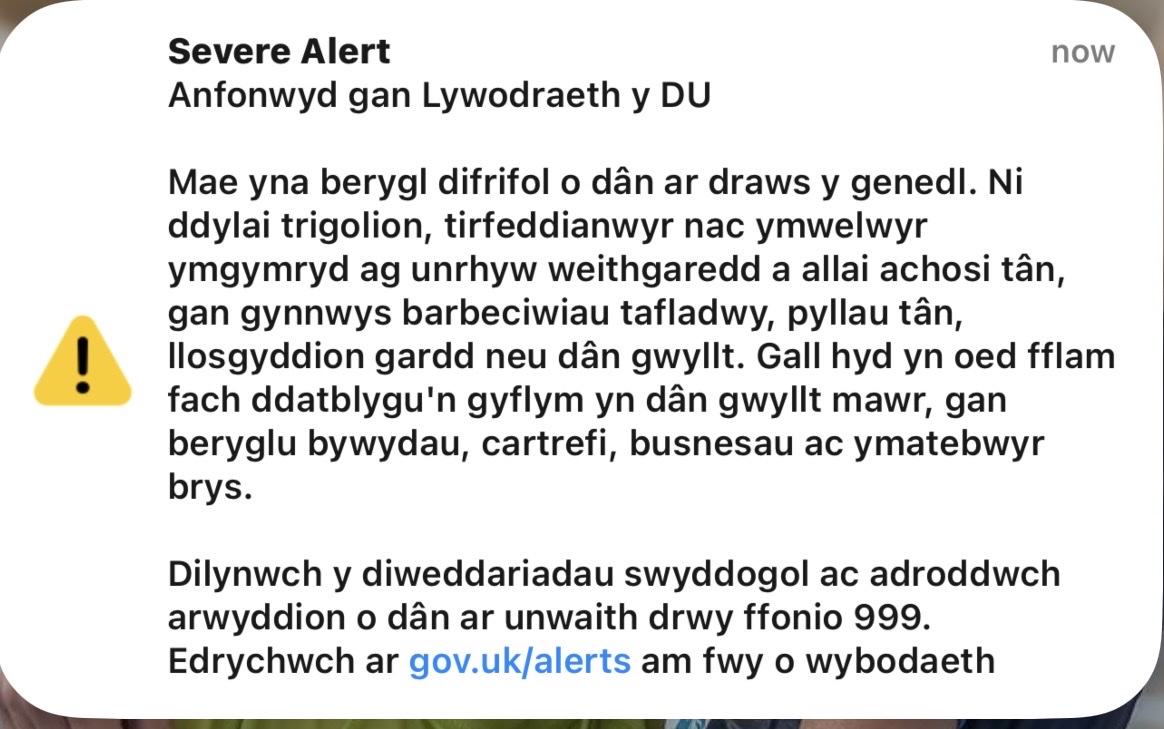
According to current reports as of August 14, 2026, the UK is experiencing an extreme heatwave combined with prolonged drought conditions that have created unprecedented wildfire danger. The Met Office (the UK's national weather service) has issued red warnings for fire danger across much of England and Wales, with temperatures exceeding 35 degrees Celsius (95 degrees Fahrenheit) in some regions. The emergency alert system, which was tested in 2023 and deployed during specific regional emergencies since then, has now been activated nationwide for only the third time in its operational history. The government alert, sent in both English and Welsh, warned of serious wildfire risk nationally and advised people not to light fires, throw cigarettes, or use barbecues, fire pits, or garden fires. The message emphasized the threat to lives, homes, businesses, and emergency responders, directing people to follow official updates at gov.uk/alerts and to call 999 only for genuine emergencies. View the current alerts The wildfire risk comes after one of the driest summers on record. Firefighters across the country are already stretched thin, battling multiple blazes from Cornwall to Yorkshire. The London Fire Brigade reported responding to over 200 grass and woodland fires in the past week alone, a figure that matches their entire August total from last year. Fire services are operating under what they call 'Operation Escalate,' pulling in off-duty personnel and requesting mutual aid from neighboring regions. The government's decision to use the emergency alert system reflects the severity of the situation. These alerts, which override normal phone settings to produce a loud siren-like sound, are reserved for situations posing immediate risk to life. Previous nationwide deployments included severe flooding warnings in 2024 and a major storm system in early 2025. The system can reach approximately 90 percent of mobile phones in affected areas, regardless of whether users have downloaded specific apps or signed up for notifications. Local authorities across England and Wales have imposed strict fire prevention measures. Several national parks, including the New Forest, Peak District, and Snowdonia, have closed public access to wooded areas and implemented total fire bans. Railway companies have reported signal failures and speed restrictions due to track temperatures, while highways agencies are warning of road surface damage. The Environment Agency has declared drought conditions across seven regions, with hosepipe bans affecting over 20 million households. Public health officials are simultaneously warning vulnerable populations about heat exposure. NHS England reported a 40 percent spike in heat-related hospital admissions over the past 72 hours, with elderly patients and those with respiratory conditions particularly at risk. The dual threat of wildfire smoke and extreme heat has prompted schools in several counties to close early or cancel outdoor activities. Air quality monitoring stations in areas downwind of active fires are recording 'very poor' ratings, prompting advice for people with asthma and other respiratory conditions to stay indoors. Climate scientists are pointing to this event as further evidence of changing weather patterns in the UK. Dr. Sarah Mitchell from the University of Reading's Department of Meteorology notes that fire seasons, once virtually unknown in Britain, are becoming an annual occurrence. 'What we're seeing is Mediterranean-style fire risk in a landscape and infrastructure never designed for it,' she said in a statement released today. 'Our vegetation, our buildings, our emergency response systems, they're all calibrated for a wetter, cooler climate that no longer exists for weeks at a time each summer.'
 🌍 world
UK Government Sends Emergency Wildfire Alert to Every Phone
If your phone screamed at you today, you're not alone. The UK government just deployed its emergency alert system nationwide, warning of severe wildfire risk as temperatures soar and tinder-dry conditions create what officials are calling a 'catastrophic' fire danger across England and Wales.
My Take
Here's what nobody wants to say out loud: the UK is fundamentally unprepared for this new reality. We're a nation that built an entire identity around being rainy and overcast, and now we're getting emergency alerts about wildfires like we're California or Australia. The infrastructure can't handle it, the emergency services are stretched beyond breaking, and we're still pretending this is an anomaly rather than the new normal. The real scandal isn't the heatwave itself, it's the decades of willful ignorance that got us here. Climate scientists have been warning about exactly this scenario since the 1990s, but successive governments kicked adaptation funding down the road, prioritizing short-term budgets over long-term survival. Now we're paying the price with overwhelmed fire brigades, buckling railways, and a health service that can barely cope with routine summer demand, let alone a climate emergency. And let's be honest about what that emergency alert really means: the government is terrified. They don't send nationwide phone alerts for fun. This is the equivalent of standing on the deck of the Titanic and finally admitting we might want to think about the lifeboats. The question is whether we'll use this wake-up call to actually invest in fire prevention infrastructure, updated building codes, and proper emergency response capacity, or whether we'll just wait for the rains to return and go back to pretending everything's fine.
What Happens Next
The immediate priority is getting through the next 72 hours without loss of life. The Met Office is forecasting that the current high-pressure system will persist through the weekend before cooler Atlantic air finally pushes in early next week. Until then, fire services will remain on maximum alert, with military assistance potentially being called in if the situation deteriorates further. The Ministry of Defence has already put personnel on standby for potential deployment to support firefighting operations. Longer term, this event will force a reckoning with Britain's climate adaptation strategy. Expect emergency parliamentary sessions, rushed funding announcements, and a flurry of reports on infrastructure resilience. The real test will be whether this translates into sustained investment or just becomes another crisis that fades from memory once the weather cools. Insurance companies are already signaling that premiums in high-risk areas will rise substantially, potentially making some properties effectively uninsurable. The political fallout will be significant. Opposition parties are already demanding answers about why fire service budgets were cut by 20 percent over the past decade while climate risks increased. The government will face tough questions about whether it took climate projections seriously enough when planning infrastructure spending. This could become a defining issue heading into the next general election, with voters in affected areas likely to punish whichever party they blame for leaving them vulnerable.
What History Tells Us
Britain has experienced devastating fires before, but they've historically been rare enough to be individually named and remembered. The Great Fire of London in 1666 destroyed much of the city, while moorland fires in the hot summer of 1976 burned across northern England. More recently, the 2018 heatwave saw significant fires on Saddleworth Moor and Winter Hill in Greater Manchester, requiring military intervention. What's different now is frequency and scale. Events that once occurred every few decades are now happening annually or even multiple times per summer. The 2022 fires in London saw the fire brigade declare a major incident as grass fires spread to residential properties. In 2024, a prolonged dry spell led to evacuations in Surrey and Kent. This normalization of extreme fire danger represents a fundamental shift in the UK's climate reality, one that the nation's institutions and infrastructure were never designed to handle.
Market Impact
Insurance stocks took an immediate hit on the news, with Aviva and Direct Line Group shares falling 3-4 percent in afternoon trading on August 14, 2026, as investors priced in increased claims exposure. The broader FTSE 100 showed resilience, down only 0.3 percent, but construction and infrastructure companies saw increased volatility as traders anticipated both damage-related costs and potential government spending on fire prevention measures. Railway operators are facing significant operational costs from the extreme heat, with Network Rail estimating potential damages and speed restrictions could cost tens of millions of pounds. Conversely, companies specializing in climate adaptation technology and wildfire prevention systems are seeing increased investor interest, with several smaller firms in the environmental services sector posting gains. Water company stocks are under pressure as drought conditions threaten already-controversial profit margins and regulatory scrutiny intensifies.