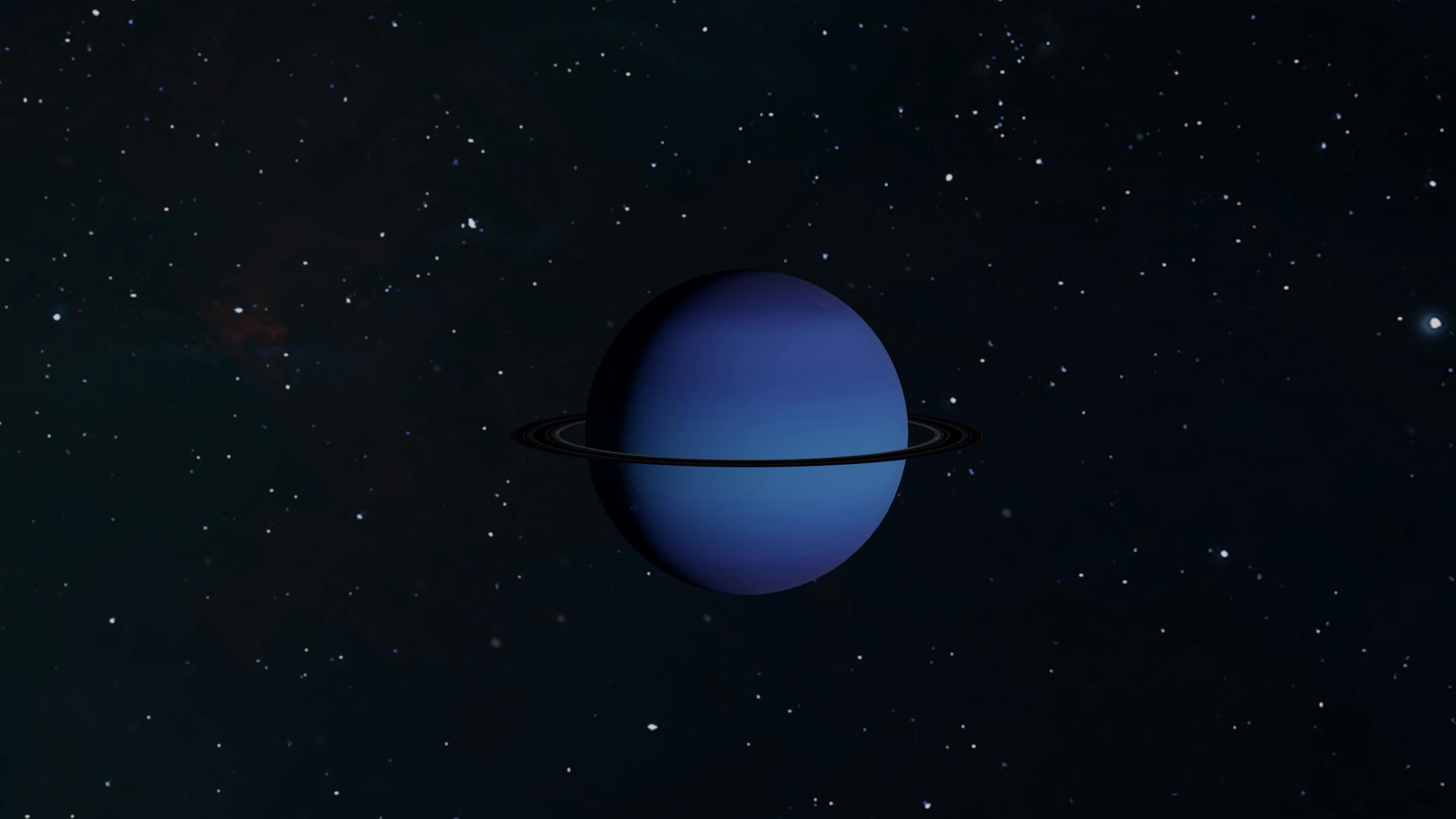
Uranus sits 1.8 billion miles from the sun, spinning on its side like a drunk planet that lost a cosmic bar fight. It has 13 known rings, but the outer ones are puzzling astronomers because they're too narrow and too stable to exist on their own. Without something holding them in place, they should have spread out and dissipated millions of years ago. The math doesn't add up unless there's a moon out there we haven't spotted yet. The rings in question are made of dark, icy particles barely reflecting any sunlight, which makes them absurdly difficult to photograph even with our best telescopes. Voyager 2 flew past Uranus in 1986 and gave us our only close up look, but the spacecraft's instruments weren't sensitive enough to catch a small, dark moon hiding in the gloom. Now, researchers are using computer models to simulate how ring particles move under different gravitational conditions, and every scenario that matches observations requires at least one undiscovered satellite. This isn't the first time a moon has been found by studying rings. Saturn's F ring led astronomers to discover Prometheus and Pandora, two tiny moons that bracket the ring and keep it corralled through gravitational nudging. Neptune's Adams ring clumps into arcs that only make sense if the moon Galatea is tugging on them. The pattern repeats across the solar system: weird rings mean hidden moons. Uranus is just the latest example, except nobody's actually seen the suspect yet. The proposed moon would be small, probably less than 10 miles across, and covered in the same dark, reddish material that coats Uranus's other moons. That material is likely organic compounds called tholins, created when ultraviolet light and cosmic rays bombard methane ice over billions of years. A moon that dark, that far away, orbiting a planet that dim, is essentially invisible to current telescopes. NASA and ESA are both considering Uranus orbiter missions for the 2030s, and finding this ghost moon is high on the target list. The stakes go beyond just adding another notch to the solar system's moon count. Understanding how rings form and evolve tells us about the violent history of planetary systems, the collisions that grind moons into debris, and the delicate gravitational dances that can preserve or destroy those remnants. Uranus's rings are probably the shattered remains of moons that got too close and were ripped apart by tidal forces, and whatever moon is out there now might be the last survivor of a much larger population that once orbited the ice giant.
 🔬 science
Uranus Hides a Ghost Moon in Plain Sight
Astronomers studying the weird rings orbiting Uranus billions of miles from Earth have stumbled onto evidence of a hidden moon nobody's ever seen. The distant ice giant's faint outer rings don't behave the way gravity says they should, and the best explanation is a small, dark moon shepherding debris into place like an invisible sheepdog.
My Take
We've been to Uranus exactly once, nearly 40 years ago, with a spacecraft built using 1970s technology. Since then, we've sent multiple missions to Mars, orbited Saturn for 13 years, and buzzed Pluto. The ice giants get no respect, and it's a travesty. Uranus and Neptune are the least understood planets in our solar system, and they're the most common type of planet in the galaxy based on exoplanet surveys. If we want to understand what's out there around other stars, we need to understand what's in our own backyard first. Finding this hidden moon would be a bonus prize for finally sending a proper mission to Uranus, but the real value is in studying the planet's bizarre magnetic field, its sideways rotation, its icy moon system, and its atmosphere. The rings are just one mystery in a stack of unsolved puzzles. NASA keeps saying a Uranus orbiter is a priority, but budgets are tight and Mars missions suck up funding like a black hole. We need to stop treating the outer solar system like an afterthought and start treating it like the frontier it actually is.
What Happens Next
NASA's Planetary Science Decadal Survey flagged a Uranus orbiter as the top priority for the next flagship mission, but launch windows and funding timelines push any arrival date to the late 2030s at best. In the meantime, expect astronomers to keep hammering the James Webb Space Telescope's observation schedule, trying to catch a glimpse of this ghost moon using infrared wavelengths that might pick up heat signatures invisible to optical telescopes. If they get lucky and actually spot it before a spacecraft arrives, that discovery will instantly reshape the mission's flyby trajectory to include close passes of the new moon. The wild card is China's aggressive timeline for outer solar system exploration. If they announce a Uranus mission before NASA even gets budget approval, suddenly the political will to fund American planetary science might materialize overnight. Discovering the moon from Earth would be the tidy ending, but the messy reality is that we probably won't know for sure until we get there, and getting there requires convincing Congress that ice giants matter as much as Mars rovers.
What History Tells Us
The discovery of Neptune in 1846 stands as the gold standard for finding celestial objects through mathematical prediction rather than direct observation. Astronomers noticed Uranus's orbit didn't match calculations, hypothesized an unknown planet was tugging on it gravitationally, did the math, pointed telescopes at the predicted spot, and there it was. Finding moons through their gravitational influence on rings follows the same playbook. In 1977, astronomers discovered Uranus's rings during a stellar occultation, when the planet passed in front of a star and the rings briefly blocked starlight. Those rings led to predictions about shepherd moons, and later observations confirmed several of them. The pattern holds: weird orbits and structures in space almost always point to hidden mass pulling strings behind the scenes.