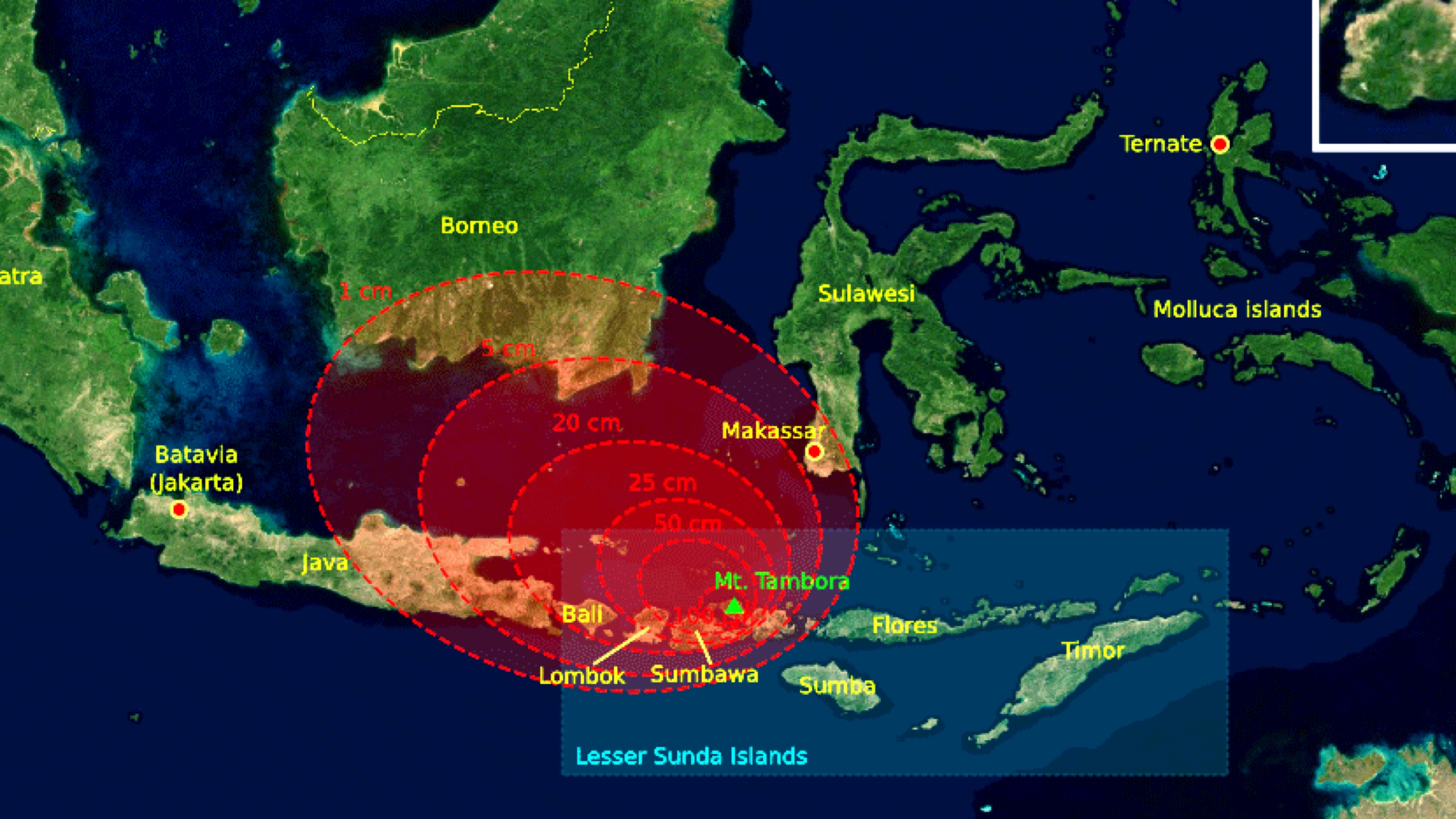
On April 10, 1815, Mount Tambora in Indonesia erupted with a force 100 times greater than Mount St. Helens, ejecting roughly 140 billion tons of rock, ash, and sulfur dioxide into the stratosphere. The explosion itself killed an estimated 71,000 people immediately, but that was just the opening act of a global catastrophe. The volcanic aerosols spread across the globe like a shroud, forming a veil that reflected sunlight back into space and dropped global temperatures by 0.4 to 0.7 degrees Celsius (0.7 to 1.3 degrees Fahrenheit). Sounds trivial, right? Those fractions of a degree meant the difference between harvest and mass graves. By the summer of 1816, North America and Europe were experiencing weather so bizarre it seemed like reality itself had broken. Snow fell in Quebec in June. Killing frosts destroyed crops in New York and New England throughout the summer months, turning green fields brown overnight. In Europe, the cold and relentless rain annihilated wheat harvests across France, Germany, and Ireland. Food prices didn't just rise, they exploded. The cost of wheat in England nearly doubled. Hungry, desperate populations stormed grain stores and bakeries across the continent. Switzerland descended into armed conflicts over food. Tens of thousands died from starvation and the diseases that follow famine like vultures. The connection between a volcano in the Dutch East Indies and crop failures in Connecticut wouldn't be understood for decades. In 1816, humanity had no framework for comprehending how an eruption on the other side of the planet could freeze their fields. Weather forecasting was in its infancy. Meteorology as a science barely existed. Some blamed sunspots, others divine wrath, still others figured it was just spectacularly bad luck. The scientific understanding of atmospheric circulation, aerosol physics, and volcanic forcing wouldn't emerge until the 20th century. They were dying in the dark, unable to even name what was killing them. The Year Without a Summer carved cultural scars that never fully healed. Mary Shelley, trapped indoors at Lake Geneva during the dreary, sunless summer of 1816, channeled the darkness into Frankenstein. Lord Byron penned "Darkness," an apocalyptic poem born from skies that refused to clear. The agricultural crisis triggered mass migration from New England westward as farmers abandoned frozen, useless fields for uncertain prospects in the Midwest. The famine conditions across Europe fed directly into a typhus epidemic that killed hundreds of thousands more. One eruption, years of cascading consequences. Today, climate scientists study the 1815 Tambora eruption and the 1816 response as an accidental geoengineering experiment. The volcanic aerosols did essentially what some researchers now propose doing deliberately: inject particles into the stratosphere to reflect sunlight and cool an overheating planet. The critical difference is scale, timing, and control. Or the illusion of control. Tambora was chaos, an uncontrolled experiment that caused mass starvation. Modern proposals involve carefully calculated sulfate aerosol injections designed to offset warming without wrecking agriculture. But 1816 stands as a brutal warning: even slightly altering the planet's radiative balance can shatter food systems that operate on razor-thin margins. We're not as clever as we think we are, and the Earth doesn't care about our spreadsheets.
 🔬 science
Volcano Killed Summer, Starved Millions, Could Happen Tomorrow
In 1816, Mount Tambora's eruption dropped global temperatures just half a degree. That was enough to cause July snow, crop death across continents, and mass starvation. Our food system today is even more vulnerable.
My Take
Here's what keeps me up at night: a Tambora-scale eruption could detonate tomorrow, and we'd be catastrophically more vulnerable than our ancestors in 1816. Sure, we have better weather satellites and forecasting, but our global food system is a house of cards compared to the localized, diversified agriculture of the early 19th century. We've ruthlessly optimized for efficiency at the cost of resilience. Three crops (wheat, rice, corn) now feed most of humanity. Strategic grain reserves have been deliberately drawn down to save money. Just-in-time supply chains mean there's no buffer stock, no cushion, nothing sitting in warehouses for emergencies. A Tambora-level eruption today hits a world already stressed by climate change, heat waves, droughts, and water scarcity. Stack volcanic cooling on top of existing climate chaos, and you get simultaneous breadbasket failures across multiple continents. Famine at a scale that makes 1816 look quaint. The geoengineering discussion terrifies me even more. We're seriously proposing to do on purpose what Tambora did by accident, and we're pretending we have the wisdom and control to manage it. The hubris is staggering. The 1816 disaster demonstrates exactly what happens when you cool the planet without truly understanding the consequences: you don't get a smooth, uniform temperature reduction, you get chaotic, unpredictable regional effects. Some places freeze, some flood, some turn to dust. Agricultural calendars that evolved over millennia through trial, error, and blood suddenly become obsolete. Farmers don't know when to plant. Crops fail at scale. And here's the real nightmare: unlike a volcano that eventually stops erupting, a geoengineering program would have to continue indefinitely or risk catastrophic rebound warming as all the greenhouse gases we've been masking suddenly take full effect. We're talking about putting the entire planetary system on a drug dependency we can never safely kick. One missed injection, one political collapse, one budget cut, and the whole thing unravels in real time.
What Happens Next
The next Tambora isn't a hypothetical. Geologists estimate a VEI-7 eruption (Volcanic Explosivity Index, the scale Tambora scored) happens somewhere on Earth roughly every few centuries. Statistically, we're overdue. Indonesia, the Philippines, and Japan top the watchlist as the most volcanically active regions harboring mountains capable of a civilization-disrupting blast. Modern satellite monitoring gives us maybe 24 hours of advance warning before the main eruption, enough time to ground aircraft and evacuate immediate danger zones, but laughably insufficient to prepare global food systems for a year or more of agricultural chaos. The geopolitical calculus gets dangerous fast. A major eruption will force the geoengineering question from academic debate to immediate crisis response. One faction will seize on the volcanic cooling as proof that sulfate injection works and buys precious time against climate change. The opposing camp will point at crop failures and food riots as definitive evidence that messing with planetary albedo is suicidal. My bet? Unilateral panic deployment. If a major eruption coincides with severe El Niño conditions and cascading harvest failures, some nation facing internal collapse and food riots won't wait for international consensus or UN deliberations. China or India, staring down regime-threatening instability, will start pumping aerosols into the stratosphere whether anyone else approves or not. And once that threshold is crossed, the era of improvised, contested geoengineering begins, complete with all the geopolitical chaos, retaliation threats, and potential conflicts that implies. We'll be managing the planet's thermostat through a combination of desperation, incomplete science, and great power competition. What could possibly go wrong?
What History Tells Us
The 1816 famine sits in a grim tradition of climate-driven collapses. The Late Bronze Age Collapse around 1200 BCE saw multiple civilizations fail simultaneously, possibly triggered by a volcanic eruption and resulting drought. The 535-536 CE event, likely caused by a massive volcanic eruption (possibly Krakatoa or Ilopango), brought famine across Europe and Asia and may have contributed to the Plague of Justinian. The Little Ice Age, a period of cooling from roughly 1300-1850, included several volcanic eruptions and coincided with crop failures, famines, and social upheaval across Europe - the French Revolution happened during a particularly cold period with harvest failures. The pattern is consistent: disrupt the climate for even a year or two, and human societies that depend on predictable growing seasons start to fracture. The difference now is that we have 8 billion people to feed instead of 1 billion in 1816, and our optimized industrial agriculture has eliminated the resilience that subsistence farming provided through diversity of crops and local knowledge.