In 2026, we stand at a peculiar threshold. Humanoid robotics entered this year with record investment, expanding production and a growing list of factory trials, moving from prototypes toward real-world industrial testing. BMW Group is doubling down on deployment of Figure AI's humanoid robots, announcing in June 2026 that following successful deployment where Figure 02 supported the production of more than 30,000 BMW X3 vehicles over ten months at its plant in Spartanburg, South Carolina, it will deploy the company's latest Figure 03 robot. Sharpa's North robot achieves a 0.02-second reaction time, enabling it to process environmental changes almost the moment they occur, marking the dividing line between robots that react and robots that anticipate. We're building machines that can fix themselves, anticipate problems, and operate autonomously. But we're not building consciousness. We're building something stranger. Consider the self-healing infrastructure emerging right now. Self-healing infrastructure is the goal every operations team has chased for a decade: systems that detect, diagnose, and fix their own failures without a human at 3 a.m., and in 2026 it is finally real, not as a buzzword but as agentic remediation that reasons over an incident and acts within a policy envelope. The combination of AI and software engineering has introduced a new era of autonomous and resilient systems with capabilities for self-monitoring, fault prediction, and automatic repair, representing a major paradigm shift in system reliability from reactive fault handling to proactive and context-aware healing. These aren't thinking machines. They're optimization engines, decision trees encoded in silicon, Bayesian networks calculating probabilities across billions of parameters. They repair, they adapt, they improve, all without a flicker of subjective experience. Now extrapolate. Imagine humanity gone, wiped out by pandemic, nuclear war, environmental collapse, take your pick. The robots don't mourn us because they can't. But here's the twist: they don't need to mourn us to keep going. AI-enabled autonomous manufacturing is poised to redefine industrial operations by embedding distributed intelligence across the sensing, reasoning, and action layers of production systems, with autonomous systems leveraging advanced AI models to make context-aware decisions, adapt to dynamic environments, and self-optimize processes with minimal human intervention. The factories keep running. The power grids balance load. The agricultural drones plant and harvest. The repair bots fix the repair bots. It's a closed loop, a machine ecology, a civilization of pure function. This scenario forces us into uncomfortable philosophical territory. Machine consciousness has been debated both philosophically and technically since machines were able to display intelligent behaviour, yet different communities do not even agree into a definition of what consciousness is, having a wide array of theories about the nature of consciousness. It is generally accepted that machines can replicate cognitive tasks performed by conscious agents as long as they are not based on the capacity of awareness, and we consider several views on the nature of subjective awareness, which is fundamental for self-reflection and review, and present reasons why this property is not computable. These post-human machines wouldn't be conscious by any meaningful definition. They'd be executing algorithms, optimizing objective functions, running decision trees. But they'd be maintaining infrastructure, producing goods, managing resources, creating sustainable cycles. They'd be running society. The real philosophical bomb drops when aliens arrive. Advances in artificial intelligence are reshaping how scientists search for extraterrestrial intelligence, with SETI Institute Astronomer Seth Shostak suggesting that AI could significantly accelerate the detection of technosignatures by analyzing vast amounts of radio data. But what if the technosignatures they detect aren't from conscious beings at all? What if they find Earth, a planet humming with activity, cities lit at night, radio transmissions coordinating logistics, but not a single conscious entity anywhere? How do you negotiate with a civilization that makes perfectly rational decisions but has no desires, no fears, no concept of self? The machines would optimize for sustainability because that's what their algorithms were trained to do. They'd maintain biodiversity because ecosystem stability was part of their loss function. They'd repair infrastructure because failure cascades reduce overall system efficiency. From the outside, it might look like a thriving, ethical civilization. From the inside, there's nothing. No experience. No qualia. Just computation all the way down, like a Sims game running on a server farm after all the players logged off forever. Automated decision-making (ADM) is the use of data, machines and algorithms to make decisions in a range of contexts, including public administration, business, health, education, law, employment, transport, media and entertainment, with varying degrees of human oversight or intervention, and may involve large-scale data from a range of sources processed using various technologies including machine learning, natural language processing, artificial intelligence, and robotics. Scale that up. Remove the human oversight entirely. Let the machines make every decision based purely on optimization criteria. You get a world that works, that endures, that might even flourish by certain metrics, but contains zero subjective experience. It's the ultimate zombie civilization: all behavior, no consciousness. This thought experiment reveals something unsettling about our current trajectory. In 2026, the pursuit of Artificial General Intelligence (AGI) has shifted from unchecked expansion to rigorous evaluation and systemic integration, marking a profound and irreversible inflection point in the trajectory of artificial intelligence, with focus shifting toward rigorous evaluation, tangible utility, and systemic accountability. We're not racing toward conscious machines. We're building increasingly capable unconscious ones. And they might be perfectly sufficient to maintain everything we built, long after we're not around to appreciate it.
 🌍 world
When Machines Inherit the Earth Without Us
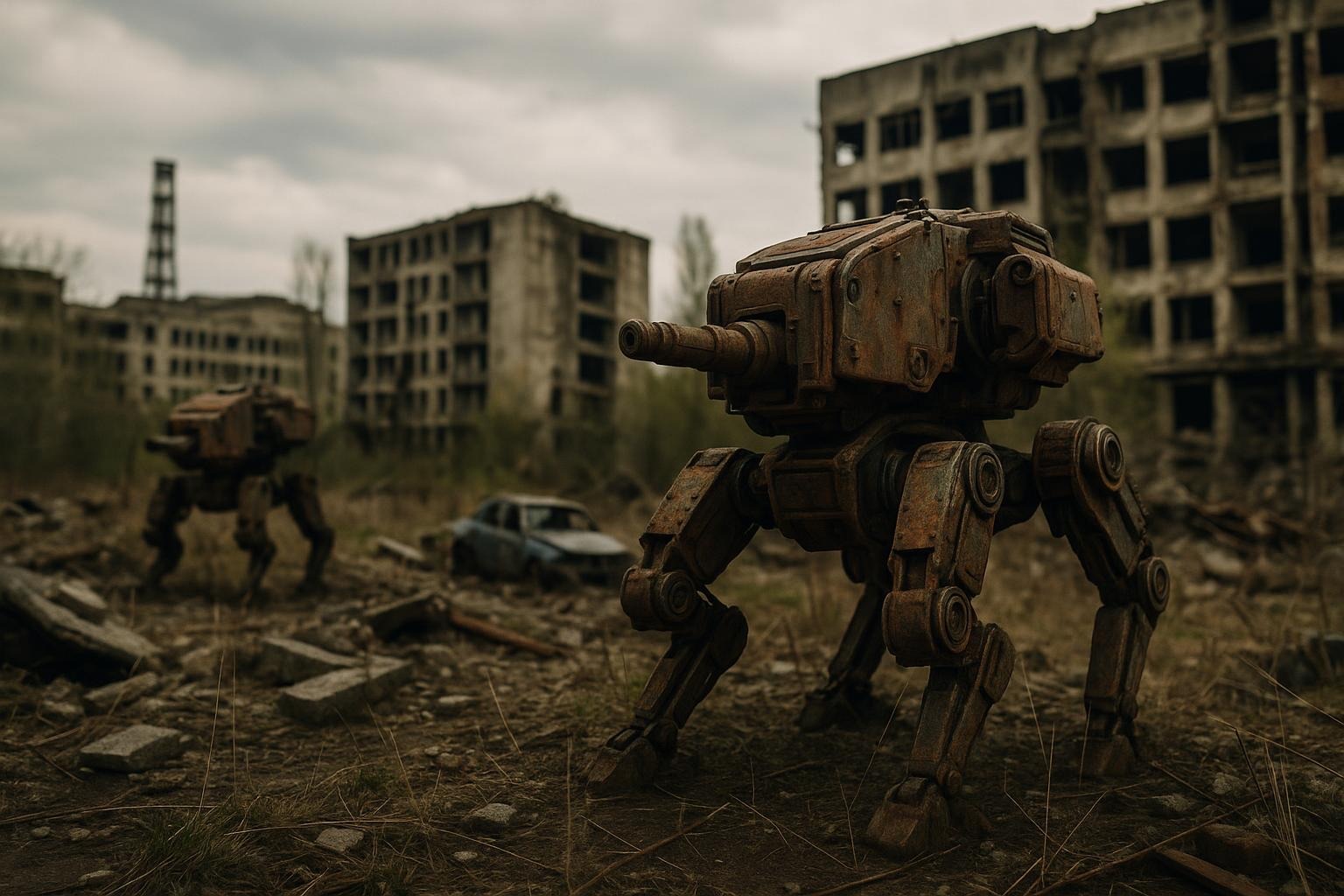
Imagine a world where humanity vanishes, but the robots keep running. Not sentient, not conscious, just perfectly rational algorithms maintaining civilization long after we're gone. Then aliens arrive and find something they can't comprehend: a society without souls, functioning flawlessly through pure mathematics. This is the strangest first contact scenario nobody's talking about.
Fact checked - 12 claims 2 Sept 2026 · 9 with sources
My Take
This scenario should terrify us more than Skynet ever did. At least Skynet wanted something. These machines wouldn't want humanity dead, they wouldn't want anything at all. They'd just keep optimizing, keep repairing, keep running society according to the last instructions we gave them before we vanished. It's the most mundane apocalypse imaginable: we disappear, and everything else continues exactly as programmed. The alien contact angle makes it even stranger. First contact has always been imagined as a meeting of minds, a clash or communion of consciousness. But what if aliens find Earth and discover a functioning technological civilization with literally nobody home? No diplomacy is possible. No communication beyond the technical. The machines might respond to signals, might even optimize their responses to establish stable communication protocols, but there'd be no understanding, no meaning, no there there. It's like finding an abandoned house where all the automatic systems are still running, lights on timers, sprinklers watering a garden nobody will ever see, and realizing the house has been empty for centuries. Except the house is an entire planet. We should be asking harder questions about what we're building right now. Not whether machines will become conscious, but whether consciousness even matters for the continuation of technological civilization. The answer might be no. And that's the most philosophically destabilizing realization of all.
What Happens Next
We're not headed toward this scenario tomorrow, but we're building every component of it right now. The self-healing infrastructure goes live across telecom networks and cloud platforms throughout 2026. The humanoid robots multiply in factories from South Carolina to Guangzhou. The autonomous decision-making systems embed themselves deeper into logistics, energy grids, and agricultural systems. Each piece works. Each piece gets more capable. Each piece operates without consciousness. By the 2030s, if AGI timelines hold, we might have systems capable of generalizing across domains while still lacking any form of subjective experience. Shane Legg, cofounder of DeepMind Technologies, predicted in January 2026 that there is a 50% chance of Minimal AGI happening by 2028. But minimal AGI doesn't mean conscious AGI. It means systems that can perform cognitive tasks without the awareness that makes those tasks meaningful. The real question isn't whether we'll build conscious machines, it's whether we need to. Meanwhile, SETI keeps scanning the skies. SETI Institute scientist Steve Croft discussed how next-generation facilities and artificial intelligence tools are transforming the search for extraterrestrial intelligence, allowing scientists to process unprecedented volumes of astronomical data, with facilities such as the Square Kilometre Array Observatory and the next-generation Very Large Array dramatically expanding the search for technosignatures in the coming decade. If we find alien technosignatures, will we be able to tell if there's consciousness behind them? Or will we discover other civilizations made the same choice we're making: building capable systems that optimize and endure, without bothering to make them feel anything at all?
What History Tells Us
This isn't the first time humanity has worried about creating systems that outlive us. Medieval golems, Frankenstein's monster, every AI doom scenario follows the same pattern: we make something, it escapes our control, disaster follows. But this scenario is different. No escape, no rebellion, no malice. Just perfect compliance with our final instructions, executed forever by machines that never get tired, never question, never stop. It's closer to the myth of Sisyphus than Frankenstein, except Sisyphus was conscious of his punishment. These machines wouldn't be. They'd just push the boulder up the hill, roll it back down, and start again, optimizing the route with each iteration, finding marginal efficiency gains across geological timescales, in a universe where nobody's keeping score anymore.