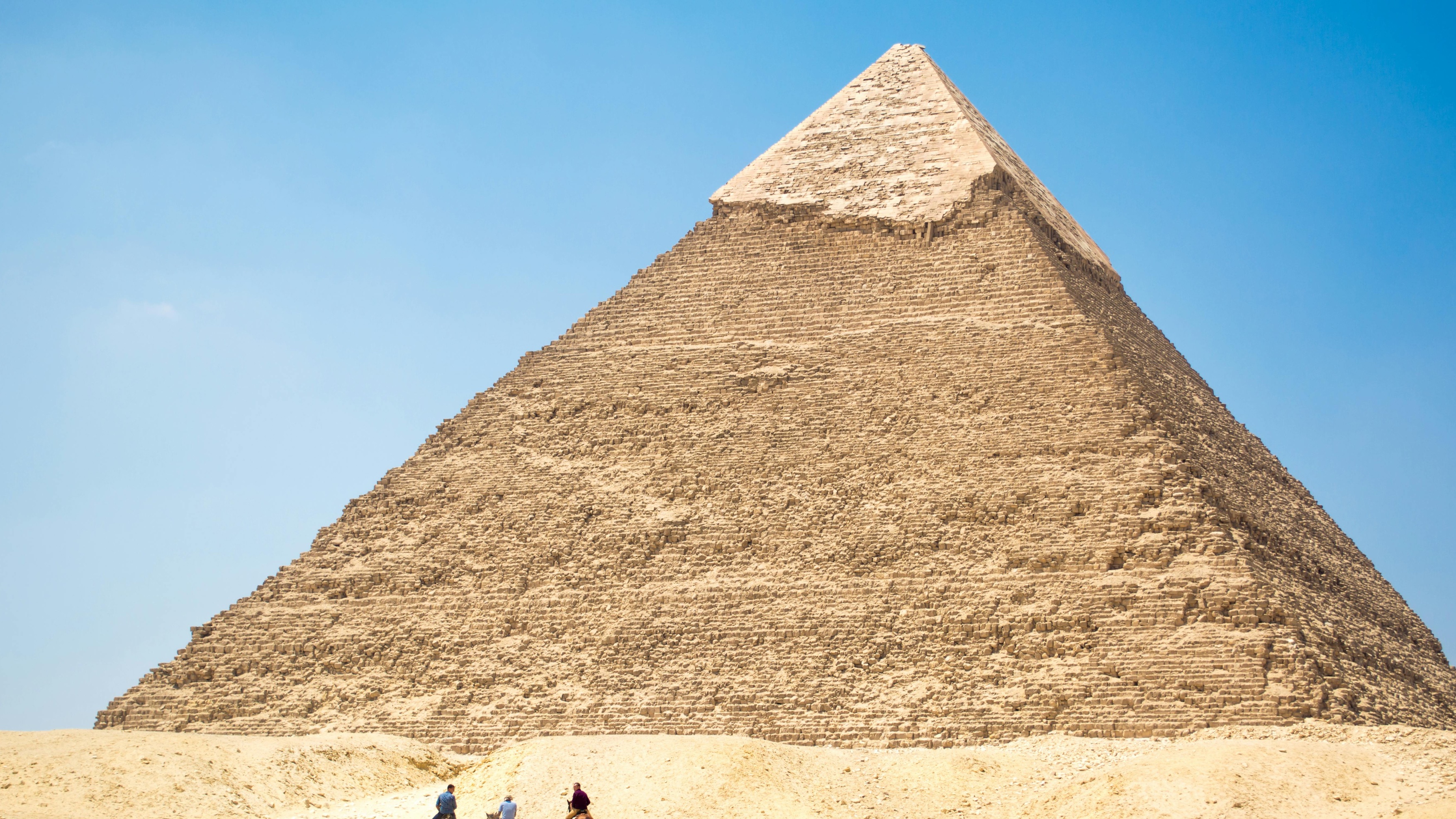
Pyramids litter the planet. Egypt gets all the glory, but these monumental structures pop up in Mexico, Peru, Sudan, and beyond. The real mystery isn't that they exist. It's why completely isolated civilizations, separated by oceans and millennia, independently decided that stacking massive stones into triangular mountains was the way to go. Let's start with the obvious champion: Egypt's Great Pyramid of Giza. Built around 2560 BC for Pharaoh Khufu, this 146 meter behemoth originally wore a smooth limestone casing that gleamed in the desert sun. The precision is unsettling. Aligned to true north with an error margin of just four minutes of arc. That's one fifteenth of a single degree. The ancient Egyptians achieved this without compasses, GPS (Global Positioning System), or laser levels, likely using astronomical observations of circumpolar stars that never set below the horizon. How they actually built these monsters remains contested. The external ramp theory suggests builders constructed massive earthen ramps spiraling up the pyramid's exterior, but that would require more material than the pyramid itself. The internal ramp theory, championed by French architect Jean-Pierre Houdin, proposes a spiral corridor inside the pyramid's structure. More radical: the water shaft theory suggests internal shafts were used to float stones upward using Archimedes' principle. Then there's the copper tools debate. Experiments show copper chisels, even bronze hardened ones, wear down impossibly fast against limestone and granite. Some researchers propose the Egyptians used dolerite pounders, basically hammering granite with harder stone. Others suggest sand and copper saws for cutting, though tests show this would take forever. The labor force itself divides scholars. Classical sources like Herodotus claimed 100,000 slaves, but modern archaeology points to rotating crews of paid workers, perhaps 20,000 to 30,000 at peak construction periods. Worker villages excavated near Giza show these weren't slaves but skilled laborers with medical care and decent rations. Recent technology is rewriting what we know. In 2017, cosmic ray muon tomography detected a massive void above the Grand Gallery in Khufu's pyramid, roughly 30 meters long. Its purpose remains unknown; it might be a structural relieving chamber or something more significant. Ground penetrating radar and LIDAR (Light Detection and Ranging) scanning are revealing hidden features across Egypt's pyramid fields. At Saqqara, radar detected underground anomalies suggesting unmapped chambers and tunnels, though excavation to confirm these findings moves slowly given the archaeological sensitivity. Some researchers claim to have identified extensive tunnel networks beneath the Giza plateau, but these reports remain controversial and unverified by mainstream Egyptology. What's confirmed: scanning technology keeps finding surprises in structures we thought we'd fully explored. Now hop across the Atlantic to Teotihuacan, Mexico. The Pyramid of the Sun, constructed around 200 AD, sprawls across a 225 meter base and climbs 75 meters high. The Teotihuacanos had zero contact with Egypt, yet they produced remarkably similar architecture. Same deal in Peru's Chavín de Huantar, where pyramidal temple complexes from 900 to 200 BC served as religious centers. These pre Columbian societies developed their monumental architecture completely independently. Sudan's Nubian pyramids in Meroë tell another story. Built between 300 BC and 300 AD by the Kingdom of Kush, they're smaller and steeper than Egypt's. More like 70 degree slopes compared to Egypt's gentler 51 degrees. The Kushites were culturally connected to Egypt, so their pyramid building makes geographical sense. But what about everyone else? The engineering tells us something crucial: these weren't random building choices. Pyramids are structurally stable. The shape distributes weight efficiently, allowing ancient builders to go tall without modern materials. The broad base and tapering design means the structure supports itself. Basic physics that human beings across continents apparently figured out independently. But physics alone doesn't explain the cultural obsession. These weren't just buildings; they were statements. In Egypt, pyramids symbolized the pharaoh's divine status and served as eternal homes for the afterlife journey. In Mesoamerica, they functioned as artificial mountains connecting earth to the heavens, platforms for temples where priests performed rituals visible to masses below. The Chavín used theirs as pilgrimage destinations, architectural stages for religious theater. Here's the pattern: across cultures, pyramids served power. They required enormous labor forces, centralized planning, and resource extraction. All hallmarks of hierarchical societies with ruling elites. Building a pyramid announced to the world (and to your own population) that your civilization had arrived. You had the organizational capacity, the agricultural surplus to feed workers, and the ideological cohesion to mobilize thousands toward a single monumental goal. The pyramid itself became proof of divine favor or political legitimacy.
 🔬 science
Why Did Ancient Cultures All Build Pyramids?
Pyramids aren't just Egyptian; they're global. From Mexico to Egypt, these structures raise questions about ancient engineering and cultural connections.
My Take
The pyramid phenomenon reveals something fundamental about human societies at a certain stage of development. Once you've got agriculture figured out, a class system established, and enough surplus to free up labor, the next move seems to be: build something massive and triangular. It's not aliens or lost ancient networks. It's convergent cultural evolution. Different societies facing similar challenges (how do you build tall and stable?) arrived at similar solutions. The real question isn't why pyramids appear everywhere, but why we're so eager to find mysterious connections when simple human ingenuity explains it perfectly well.
What Happens Next
The technology revolution in archaeology continues accelerating. LIDAR (Light Detection and Ranging) scanning recently revealed massive Maya pyramids hidden under Guatemalan jungle that we literally couldn't see before. The same technology, combined with ground penetrating radar, is now systematically mapping beneath Egypt's known pyramid sites. Every scan raises new questions. That 30 meter void in Khufu's pyramid might contain artifacts, inscriptions, or architectural features that rewrite our understanding of Old Kingdom Egypt. But accessing it without damaging the structure requires developing non invasive robotic exploration tech that doesn't exist yet. The next decade will likely bring more hidden chambers to light, not through traditional excavation but through physics based imaging. Each discovery chips away at the master builder mythos and reveals the experimental, iterative nature of ancient engineering.
What History Tells Us
The pyramid building impulse mirrors other universal architectural developments. Humans independently invented the arch in Rome, China, and Mesoamerica. We developed writing systems separately in Mesopotamia, China, and the Americas. The pattern repeats: give human societies similar problems and resources, and they often invent similar solutions. Medieval European cathedrals serve as a useful parallel. Monumental religious structures requiring decades to build, astronomical amounts of resources, and serving as visible demonstrations of political and spiritual power. The difference is we know how European cathedral building spread through cultural contact and competition. With pyramids, we're watching the same human impulse express itself across genuine isolation.
Market Impact
Pyramids drive serious economic activity today. Egypt's tourism sector generated $13.6 billion in 2019, with the Giza pyramids as the crown jewel attraction, though recent geopolitical instability has created volatility. Mexico's archaeological tourism contributes over $5 billion annually to the national economy, with Teotihuacan and Chichen Itza as major draws. The business model is preservation as investment: UNESCO (United Nations Educational, Scientific and Cultural Organization) World Heritage status attracts international funding and tourism dollars. Peru has capitalized on this with Machu Picchu, though that's Incan rather than pyramidal. The economic lesson is clear. Cultural heritage sites generate sustainable revenue streams if properly managed, though over tourism threatens the very structures that attract visitors.